Illinois Rules for a Visiting Wisconsin Rider
Planning a trip across the border from Wisconsin to ride your ATV or UTV in Illinois can feel like navigating a legal minefield. What's perfectly legal back home might land you a hefty ticket or an impounded machine here in the Prairie State. This guide is here to clear up the confusion, explaining the specific rules and requirements you, as a visiting Wisconsin rider, need to know to ensure a fun, legal, and hassle-free experience whether you're looking to hit some trails or just cross a local road.
Understanding Illinois's Baseline Ban on Street Riding
Let's be upfront: Illinois starts with a very different mindset than many other states when it comes to riding ATVs and UTVs on public roads. It's not a free-for-all, and understanding this foundational difference is crucial for any visiting rider, especially those coming from states like Wisconsin where street-legal UTVs might be more common.
Why Illinois Starts With "No" on Roads
The core of Illinois law regarding off-highway vehicles (OHVs) is that they are generally prohibited from operating on public streets, roads, and highways. This isn't just a suggestion; it's the default legal stance. Think of it this way: your ATV or UTV is designed for off-road adventures, and that's where the state legislature primarily intends for it to stay. This blanket prohibition can be a real shocker for Wisconsin riders who might be accustomed to their UTVs being routinely street legal with proper registration and equipment back home. You can't just slap a license plate on your side-by-side and expect to cruise down an Illinois county road. The state's approach means that unless there's an explicit exception carved out by local government, you simply cannot ride your machine on paved or gravel public thoroughfares. [Illinois Law Starts by Banning Street Riding] is the legislative reality you're up against. This often leads to frustration for visitors who assume a "street legal" designation from another state automatically transfers. It doesn't.
The Role of Local Ordinances in Illinois
Now, here's where it gets a little more nuanced, and where the "unless" comes into play. While the state broadly bans OHVs from roads, Illinois law does provide a pathway for local units of government—like villages, cities, and counties—to pass their own ordinances allowing UTVs (and sometimes ATVs, though less commonly) on specific roads within their jurisdiction. This means that if you're planning to use your UTV on public roads in Illinois, you absolutely must check the local rules for every single town or county you intend to ride in. This isn't a statewide permit system; it's a patchwork of individual decisions made by local officials. What's legal in one small village downstate might be strictly forbidden in the next town over. [Illinois Municipalities That Pass Ordinances] and [Illinois Counties That Pass Resolutions] are the bodies that hold the power to open up roads, but they do so on a case-by-case basis. Without a local ordinance specifically allowing it, you're back to the statewide ban. This localized approach is a huge difference from a state like Wisconsin where statewide legislation often provides more uniform guidance.
What Streets and Roads Are Even Eligible?
Even when a local government does pass an ordinance allowing UTVs, there are still strict limitations on which roads can be used. First and foremost, the speed limit on any street designated for UTV use cannot exceed 35 mph. If you find yourself on a road posted at 40 mph or higher, you're immediately outside the legal boundaries, even if a local permit is in hand. This rule is designed to keep slower-moving OHVs off busier, faster roads where they could pose a traffic hazard. [Only Streets Posted 35 mph or Lower Qualify]. Beyond speed limits, there are also blanket prohibitions for certain types of roads. No matter what a local ordinance says, you can never, under any circumstances, operate your ATV or UTV on Illinois interstates or tollways. These major arteries are strictly off-limits to all off-highway vehicles, period. This is another crucial point that can catch out-of-state riders who might encounter different rules in their home states. [Illinois Closes Tollways and Interstates to Every Machine] is a rule that applies to everyone, everywhere in Illinois.
Essential Illinois Requirements for Street-Legal UTVs
If you're lucky enough to find a local Illinois jurisdiction that does allow UTVs on its roads, simply having the local permit isn't enough. Your machine itself must meet a specific set of equipment standards, and you as the operator have personal requirements to fulfill. It's not just about what stickers you have, but what's physically on your machine and in your wallet.
Equipment Your UTV Must Have (Even if Wisconsin Doesn't Require It)
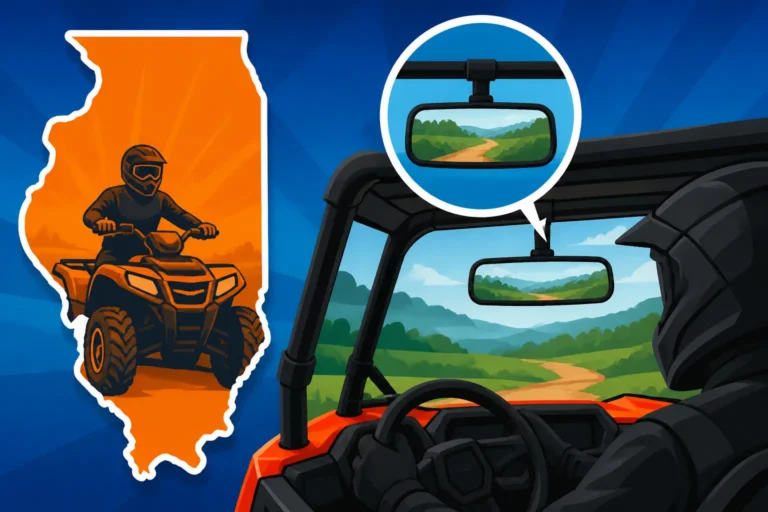
Illinois has a mandatory list of equipment that any non-highway vehicle, including your UTV, must have to be considered for street use on an authorized local road. This list goes beyond what might be considered standard on a factory UTV, and it's where many out-of-state riders find themselves needing to make modifications. You'll need a rearview mirror, visible and in good working order, allowing you to see at least 200 feet behind you. Reflectors are crucial, both front and rear, to enhance your visibility, especially when ambient light is low. Perhaps one of the most distinctive requirements is a slow-moving vehicle emblem – that orange triangle with a red border – mounted conspicuously on the rear of your UTV. This signals to other motorists that you won't be traveling at typical road speeds.
Furthermore, proper lighting is non-negotiable. You must have at least one headlight that can illuminate persons and vehicles at a distance of 500 feet, and a tail lamp that displays a red light visible from 100 feet to the rear. Functional brake lights that activate when you apply the brakes are also essential. And, for safer road navigation, turn signals are required. While many newer UTVs come with some of this equipment, especially if marketed for "street-legal" kits in other states, it's vital to check your machine against the Illinois list specifically. If your UTV isn't up to par, aftermarket parts can help. Companies like SuperATV offer a range of accessories, from turn signal kits to mirrors, that can help get your machine compliant with these stringent Illinois requirements. Don't assume your Wisconsin setup will pass muster here. [Illinois Non-Highway Vehicle Equipment List] spells out all the details. For specific components, remember [Illinois Requires a Rearview Mirror], [Illinois Requires Red Reflectors], [Illinois Requires a Slow-Moving Vehicle Emblem], [Illinois Requires a 500-Foot Headlight], [Illinois Requires a 100-Foot Tail Lamp], [Illinois Requires Brake Lights], and [Illinois Requires Turn Signals].
Driver's License and Insurance Proof
Operating any motor vehicle on an Illinois public road, even a UTV on an allowed local street, requires a valid driver's license. As a Wisconsin resident, your valid Wisconsin driver's license will suffice – you don't need to get an Illinois license just to ride your UTV here. [Illinois Requires a Driver's License] applies to everyone. However, simply having a license isn't the end of it. Illinois also mandates specific liability insurance coverage for any motor vehicle operating on its public roads. For UTVs, this means you'll need at least the state minimums: $25,000 for bodily injury to one person, $50,000 for bodily injury to two or more persons, and $20,000 for property damage. This is often abbreviated as 25/50/20.
It is absolutely critical that you carry proof of this insurance with you at all times when operating on an Illinois public road. This could be your insurance card or a digital copy on your phone. If you're stopped by law enforcement and can't provide valid proof of insurance, you could face fines, vehicle impoundment, and even suspension of your driving privileges. Make sure your insurance policy extends to cover your UTV for street use in Illinois. Don't assume your recreational OHV policy from Wisconsin automatically covers street legal operation across state lines. Always check with your insurance provider before your trip. [Illinois Insurance Minimums for Street Use] are not optional.
Local Permits and Fees
This is perhaps the biggest hurdle and source of confusion for visiting riders. Even if your UTV is fully equipped and you have your license and insurance, you still cannot just ride on an Illinois street unless that specific village or county has issued you a permit. This isn't a statewide permit, nor is it a registration that travels with you throughout Illinois. It's a local permit, issued by the specific local government, often for a fee, and valid only within that particular jurisdiction's boundaries.
For example, if you plan to ride your UTV on the village streets of Byron, Illinois, you'd need to go to Byron's village hall, apply for their specific UTV permit, pay their fee (which might be $100 for a first-year permit and $50 for renewals), and likely have your machine inspected to ensure it meets all equipment requirements. [Byron's UTV Permit Fees in Illinois] are an example of what you might encounter. This means that if your riding plan involves crossing through multiple towns or counties, you might theoretically need permits from each one, if each allows UTVs and requires its own permit. It's not uncommon for these permits to involve an application process, an inspection, and a specific sticker or decal that must be displayed on your machine. [Illinois Towns With UTV Permits] exist, but their rules vary wildly. Before you even load up your trailer, you should be researching the specific local ordinances and permit requirements for every area you intend to ride on a public road. [Applying for a UTV Permit at Village Hall] is a common step in this process.
Riding Off-Road: Permits and Access for Visitors
If the complexities of Illinois street-legal UTV rules have you throwing your hands up, don't despair! Illinois has some fantastic dedicated off-road riding opportunities, particularly at grant-assisted sites and private parks. However, just like with street use, there are specific permits and requirements you'll need to know as a visiting Wisconsin rider to access these trails.
The Illinois Usage Stamp and Public Access Decal
Illinois uses two distinct stickers to regulate off-road vehicle use: the Off-Highway Vehicle (OHV) Usage Stamp and the Public Access Decal. It's easy to confuse them, but they serve different purposes. The Usage Stamp is a statewide requirement for any ATV, UTV, or dirt bike operating off-road, primarily on private land or at certain non-grant-assisted private parks. It costs money, and it needs to be renewed annually. However, if you plan to ride at a state-designated "grant-assisted" riding area, like Sahara Woods, you'll need the Public Access Decal. This decal replaces the need for a Usage Stamp if you're only riding at grant-assisted sites. In essence, the Decal acts as your admission ticket to these specific public-funded trails. As a Wisconsin visitor, you will absolutely need one of these if you plan to ride on any designated public OHV trails in Illinois. You can't just show up with your Wisconsin registration and expect to ride. [Illinois OHV Permits: Two Stickers Explained] provides a deep dive into this, and [Illinois Public Access Decal Rules] outlines how they work.
Specifics for Grant-Assisted Riding Areas
Illinois has one state-run OHV park, Sahara Woods, which is a fantastic destination. There are also several other grant-assisted sites across the state, often run by local park districts or clubs. For these sites, the Public Access Decal is your entry ticket. As an out-of-state rider from Wisconsin, you'll pay a slightly different fee for this decal than an Illinois resident. Currently, the non-resident decal costs more, reflecting the state's investment in these trails through resident funds.
For Sahara Woods specifically, you'll need to purchase your permits in advance through the ExploreMoreIL website. They have daily caps on the number of vehicles allowed, especially on busy weekends and holidays, so booking ahead is crucial to avoid being turned away at the gate. You'll typically book a one-day or four-day permit, and each machine entering the park needs its own permit and decal. When you check in, you'll sign a waiver and receive a wristband that must be worn while riding. [Sahara Woods: Illinois's Only State OHV Park] is your primary destination for state-managed riding, and [Illinois Access Decal Cost for Visitors] details the pricing. Don't just show up hoping to buy a decal at the gate on a busy Saturday; plan ahead by [Booking a Sahara Woods Permit Through ExploreMoreIL].
Safety Requirements and Age Restrictions
Illinois, like most states, has rules in place to ensure rider safety, especially concerning minors. While there's no statewide mandatory OHV safety course for all riders, many riding parks, particularly private ones, may require proof of safety training or adherence to specific age and supervision rules. For operators under 16, typically helmets are required by law, and parks may enforce this for all riders.
Age restrictions for operating ATVs and UTVs are also important. Generally, a child under 10 cannot operate an ATV in Illinois, and those aged 10-15 must be supervised by an adult and often have completed a safety course. UTVs also have age restrictions, particularly for passengers. If you're bringing younger riders from Wisconsin, familiarize yourself with Illinois's specific youth riding rules before you hit the trails. Even if your child is experienced and legal to ride a certain machine in Wisconsin, Illinois rules might differ. Always double-check park-specific rules, as they can sometimes be stricter than the state minimums. [Illinois ATV Helmet Rules] and [Illinois ATV Age Requirements] are good places to start your research, along with [Illinois Rules for a Teen Rider] and [Illinois Rules for a Child Passenger].
Practical Tips for a Smooth Illinois Ride
Navigating the rules as an out-of-state rider can feel like a lot, but with a bit of preparation, your Illinois ATV or UTV adventure can be incredibly rewarding. Here are some practical tips to help ensure a smooth trip.
Research Before You Roll
This cannot be stressed enough: do your homework before you ever hook up the trailer. If you're thinking about street riding, use online resources to look up the specific village or county ordinances for your planned route. Most local governments have their ordinances available on their official websites. Don't assume; verify. For trail riding, check the website of Sahara Woods or any private park you plan to visit. Look for current operating hours, permit requirements, trail conditions, and any temporary closures due to weather or maintenance. [Illinois Ordinance Lookups Before You Ride] is a crucial first step for street use, and [Illinois Trail Conditions Before You Tow] will save you from arriving at a closed gate.
Documentation and Preparedness
When you're out riding, whether on a local street or a trail, you need to be prepared for an encounter with law enforcement or park staff. Always carry your valid Wisconsin driver's license, proof of vehicle insurance (even if you're only trail riding, it's smart to have it), and any Illinois permits or decals you've purchased. Keep these documents in a waterproof bag or pouch on your person or securely on your machine. [Carrying Papers at a Grant Site] is a good habit. Beyond paperwork, consider your machine. If you're tackling Illinois's often muddy and sometimes rocky terrain, proper recovery gear is a lifesaver. A good winch, perhaps a heavy-duty model from SuperATV, is invaluable, along with a tree saver strap and shackles. A basic toolkit, tire repair kit, and first aid supplies are also wise additions to your packing list. Illinois weather can be unpredictable, so pack layers and enough water.
Respecting the Rules and the Land
Finally, a big part of having a great experience and being welcomed back is showing respect for the local rules and the natural environment. This means adhering strictly to posted speed limits on roads and trails, staying on designated trails, and never creating new ones. Illinois takes trespass laws seriously, and riding on private land without explicit permission is a surefire way to get a ticket or worse. [Illinois Trespass Law for Riders] carries significant penalties. Be mindful of noise, especially in residential areas if you're on a street-legal machine. Avoid riding under the influence; Illinois's DUI laws apply to OHVs, even on private property. [Illinois DUI Law and Off-Road Machines] are just as serious as regular vehicle DUIs. Leave no trace, pack out everything you pack in, and if you encounter any issues, always cooperate respectfully with law enforcement or park personnel. By being a responsible and prepared rider, you'll not only have a fantastic time but also help ensure that these riding opportunities remain open for everyone.
| Feature | Illinois Street Use (if permitted) | Illinois Off-Road Use (Grant-Assisted Sites) |
|---|---|---|
| Primary Law | Default ban, local ordinances may allow | OHV Usage Stamp or Public Access Decal required |
| Permit/Sticker | Local municipal/county permit (varies by location), often requires application & fee | Illinois Public Access Decal (for grant sites like Sahara Woods), or Usage Stamp (for private land/non-grant sites) |
| Cost for Visitors | Varies by municipality/county (e.g., $50-$100+ annually) | Public Access Decal: Higher price for non-residents (check current fee); Sahara Woods permits: Daily/multi-day fees (book online) |
| Driver's License | Required (valid Wisconsin DL accepted) | Required for operators at some parks/public areas; general age restrictions apply |
| Insurance | Mandatory 25/50/20 liability for street use; proof must be carried | Recommended for all riding; may be required by private parks or lenders |
| Equipment | Rearview mirror, reflectors, SMV emblem, headlight, tail lamp, brake lights, turn signals (check all specific requirements) | Spark arrestor usually required; helmets often required for minors, sometimes for all |
| Speed Limits | Limited to roads posted 35 mph or less | Park/trail specific speed limits apply |
| Road Types | Limited to local streets/roads explicitly opened by ordinance; Interstates/Tollways never allowed; State Highways only crossed at intersections | Designated trails only; no cross-country travel |
| Booking Ahead | Research local ordinances & permit process | Highly recommended for Sahara Woods (daily caps); check private park reservation policies |
Disclaimer
This article is for general informational purposes only and does not constitute professional advice. Laws, prices and regulations vary by location and change over time. Consult a qualified professional for guidance on your specific situation.