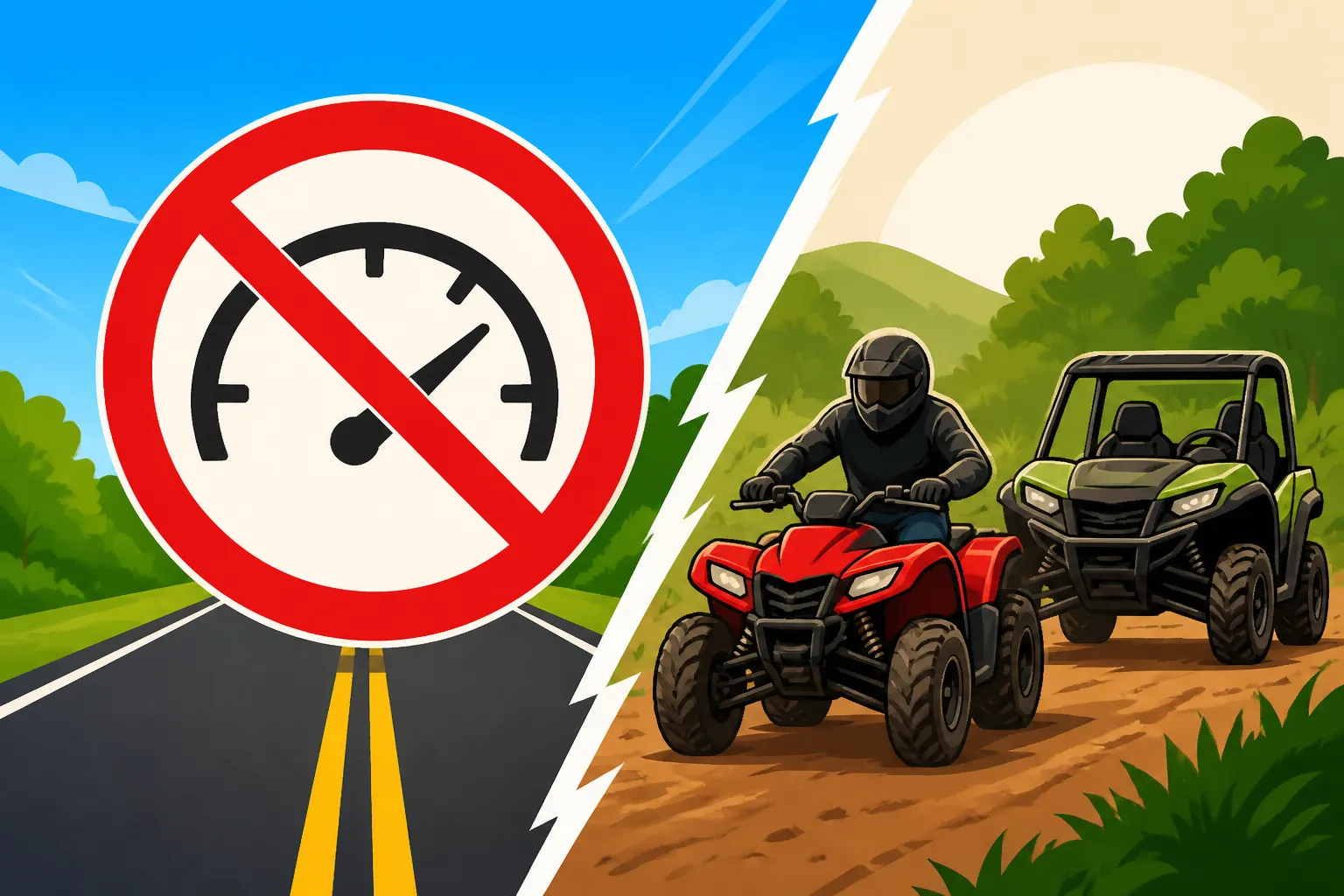
Roads Posted Above 35 mph Are Off Limits
It's a common dream for many Illinois ATV and UTV owners: the freedom to hop on your machine and run down to the corner store, visit a neighbor, or just cruise the local blacktop. But anyone who’s tried to make their off-road vehicle street legal in the Prairie State quickly runs into a wall of confusion, especially when it comes to road types and speed limits. One of the biggest and most frustrating restrictions you'll encounter is that roads posted above 35 mph are strictly off-limits, creating a real headache for route planning and legal riding. This guide will cut through the noise and explain exactly why this rule exists, how to identify these restricted roads, and what you need to know to stay legal and safe on Illinois's approved street network.
Why Illinois Puts the Brakes on UTVs on High-Speed Roads
Navigating the nuances of Illinois's street-legal UTV laws can feel like trying to solve a complex puzzle, especially when you encounter the hard-and-fast rule about speed limits. It's not just an arbitrary number; there are very real, safety-driven reasons why the state draws a line in the sand at 35 miles per hour for off-highway vehicles on public roads. Understanding this foundational principle is key to both staying legal and, more importantly, staying safe.
The Fundamental Law Behind the Limit
At its core, Illinois law dictates that ATVs and UTVs are primarily designed for off-road use. They're built for tackling trails, farm fields, and rugged terrain, not for the sustained speeds and traffic dynamics of public roadways. While local municipalities are granted the authority to open certain roads to these machines through local ordinances, this authority comes with strict limitations. The primary limitation, and one that often catches riders off guard, is the [Illinois's 35 mph Street Limit]. This isn't just a suggestion; it's a critical component of any ordinance that allows UTVs on the road.
This means that even if your small town council enthusiastically votes to allow UTVs on their streets, they cannot legally open up a major arterial road that has a posted speed limit of 45 or 55 mph. The state statute acts as an umbrella, setting the maximum conditions under which local governments can exercise their limited discretion. This framework aims to balance the desire for recreational access with the paramount need for public safety across the state's diverse road network.
Safety First: Why 35 mph is the Magic Number
You might be thinking, "My UTV can easily go 50 mph! Why the restriction?" The answer lies in the fundamental design differences between a utility task vehicle and a passenger car. UTVs, while robust and capable off-road, are simply not engineered for the same demands as traditional automobiles at higher speeds. Their suspension, steering, braking systems, and overall stability are optimized for low-speed torque, rough terrain, and agility, not for highway speeds.
At 45 or 55 mph, a UTV's braking distance increases dramatically, its handling can become less predictable, and the risk of a rollover in an emergency maneuver escalates significantly. Furthermore, the occupant protection in most UTVs, while improving with features like roll cages and seatbelts, is still not comparable to the crashworthiness of a passenger car at higher impact speeds. Imagine a side-by-side encountering an unexpected obstacle or having to make a sudden lane change on a busy 50 mph road. The potential for a catastrophic accident, involving both the UTV occupants and other motorists, becomes unacceptably high. The 35 mph limit acts as a critical safety buffer, acknowledging the inherent limitations of these vehicles on paved roads where traffic speeds increase.
The Role of Local Ordinances and State Statute
It's a common misconception that if one town allows UTVs on its streets, then all adjacent towns or even the entire county automatically follow suit. Unfortunately, Illinois law is far more granular, which can be a source of frustration for riders. The power to open roads to UTVs rests squarely with local units of government, such as villages, cities, and townships. This means that [Illinois Municipalities That Pass Ordinances] must individually consider and pass their own specific rules.
However, even when a local body passes an ordinance, it must operate within the confines of state law. The state's 35 mph maximum speed limit for UTV-legal roads is a non-negotiable ceiling. A village board might vote to allow UTVs on all its residential streets, which typically have 25 mph limits, and even some main thoroughfares if they fall under the 35 mph threshold. But they absolutely cannot, under any circumstances, designate a county highway that has a 45 mph limit as UTV-friendly. This interplay between local authority and state-imposed limits is crucial to understand, as ignoring it can lead to serious legal consequences and dangerous situations on the road. Always remember that even if your UTV is fully equipped, the speed limit of the road itself is the ultimate gatekeeper.
Spotting the Forbidden Zones: Identifying Off-Limits Roads
So, you've got your UTV ready for the road, and you've done your homework on local ordinances. That's a great start! But the next crucial step is being able to accurately identify which roads fall under the 35 mph restriction and which ones are simply off-limits, regardless of your vehicle's capabilities. It’s not always as obvious as a glaring "NO UTVs" sign, and misinterpreting the signs – or the lack thereof – can quickly land you in hot water, or worse, a dangerous situation.
Reading the Signs: Posted Speed Limits
The most straightforward way to identify a road's legal speed for UTVs is by reading the posted speed limit signs. These white rectangular signs with black numbers are your primary guide. If you see a sign that reads "SPEED LIMIT 40," "45," "50," or anything higher than 35, that road is immediately off-limits for UTV travel, even if your local village has an ordinance. It doesn't matter if you're just trying to cut across for a short distance; if the posted limit is above 35 mph, you cannot ride on that road.
What happens if there's no sign? This is where it gets tricky. In areas where no speed limit is posted, default state laws apply. Generally, in rural areas, this might be 55 mph, and in urban or residential areas, it could be 30 mph. Since 55 mph is well above the 35 mph UTV limit, any unposted rural road should be treated with extreme caution and likely considered off-limits for riding. Always err on the side of caution. If you're unsure, it's safer to assume the limit is too high for your UTV. Furthermore, roads like major state highways or U.S. routes almost invariably have speed limits above 35 mph, making them de facto forbidden zones for UTVs, except for specific, legal crossings. [Illinois Crossings of State Highways] are often limited to intersections only.
Understanding Road Design and Traffic Flow
Beyond just reading the signs, paying attention to the overall design and traffic patterns of a road can give you strong clues about its legal status for UTVs. Roads with multiple lanes in each direction, divided highways with a median, or those with limited access points are almost certainly designed for speeds well above 35 mph, even if a sign is temporarily obscured or missing. Think about major county connectors that facilitate regional travel, or state routes that link towns together; these often have higher speed limits to maintain efficient traffic flow.
Consider the volume and speed of other vehicles on the road. If cars and trucks are consistently traveling at 50-60 mph, it’s a clear indication that the road is not suitable for a UTV, regardless of a single, potentially misleading sign. These roads present a significant danger due to speed differential, reduced visibility, and the sheer momentum of larger, faster vehicles. Your UTV, even if you’ve added premium aftermarket accessories like those from SuperATV for enhanced visibility or protection, simply isn’t designed to safely integrate with such high-speed traffic. Prioritizing common sense and safety over convenience is paramount in these situations.
The Ramifications of Misjudgment
Ignoring the 35 mph limit or misinterpreting road signs can lead to a cascade of negative consequences. The most immediate is, of course, a traffic ticket. Police officers and county sheriffs are well aware of the limitations placed on UTVs. You could face significant fines, court costs, and potentially even have your UTV impounded if caught operating illegally on a high-speed road. [Illinois Penalties for Illegal Street Riding] are no joke and can quickly turn a fun ride into a very expensive headache.
Beyond legal penalties, there’s the undeniable safety risk. Operating a UTV on a road where vehicles are traveling at 45 mph or faster dramatically increases your risk of a severe accident. Your machine is less visible, less agile at speed, and offers less protection in a collision. Furthermore, if you’re involved in an accident while illegally operating your UTV on a restricted road, your insurance coverage could be jeopardized. Most policies have clauses that exclude coverage for illegal activities, meaning you could be personally liable for damages to your vehicle, other vehicles, and any injuries sustained. It's a risk simply not worth taking.
Mastering Your Route: Riding Legally and Safely
The key to enjoying your UTV on Illinois roads without running afoul of the law or putting yourself in danger is meticulous planning and a clear understanding of the rules. Since roads posted above 35 mph are off-limits, your route planning becomes a strategic exercise in identifying permissible paths and knowing how to navigate the road network legally. This proactive approach will save you headaches, fines, and most importantly, keep you safe.
Planning Your Journey: Pre-Ride Research is Key
Before you even think about putting your UTV tires to pavement, the most critical step is thorough pre-ride research. You cannot rely on assumptions or what you think might be allowed. Illinois law places the burden squarely on the rider to know and abide by local ordinances. This means checking the official websites of the village, city, county, and even township where you plan to ride. Many local governments post their UTV ordinances online, detailing which roads are open, what equipment is required, and any permit fees. If you can't find clear information, call the local police department or municipal clerk's office. Don't be shy; they are usually happy to clarify the rules for responsible riders.
Think of it like planning a cross-country trip: you wouldn't just jump in the car without a map. Similarly, for your UTV, you need a mental (or even physical) map of approved roads. Some enthusiasts even use mapping apps, though you must verify the accuracy of any speed limit overlays against official signs. Remember, [Illinois UTV Street Legal Rules by Town] can vary wildly, so what's okay in one village might be strictly prohibited just a few miles down the road in the next jurisdiction. Taking the time to do this homework upfront will prevent you from inadvertently straying onto a forbidden road.
Crossing vs. Riding: A Crucial Distinction
While riding on roads posted above 35 mph is strictly prohibited, Illinois law generally allows for the crossing of these higher-speed roads at intersections. This is a vital distinction that allows riders to connect approved lower-speed roads and complete their journeys. However, "crossing" does not mean treating the intersection as an opportunity to travel even a short distance along the higher-speed road.
When performing a crossing, you must do so as directly and safely as possible. This typically means stopping at the intersection, checking for traffic in all directions, yielding to all oncoming vehicles, and then proceeding straight across the road to the continuation of the approved lower-speed road. It's not the time for sightseeing or casual driving. This rule is a nod to practicality, acknowledging that many local road networks are intersected by state or county highways. For more detailed guidance, always refer to [Illinois Crossing Rules at Intersections] for the specific expectations. Remember, safety, visibility, and swift execution are paramount when making these crossings.
Equipping Your UTV for Approved Roads
Even when riding exclusively on roads with a 35 mph speed limit or lower, your UTV still needs to meet specific equipment requirements to be considered street-legal in Illinois. These requirements are in place to ensure your visibility and safety, as well as the safety of other motorists. Without the proper gear, you could still be ticketed, even on an approved road. Essential equipment typically includes functional headlights, taillights, brake lights, and turn signals. You’ll also need a rearview mirror (or mirrors, depending on the machine) and a slow-moving vehicle emblem prominently displayed on the rear of your UTV.
Many UTVs don't come from the factory with all of these street-legal components, especially turn signals or a horn. This is where aftermarket solutions come into play. Companies like SuperATV offer comprehensive street-legal kits designed to integrate seamlessly with various UTV models, providing all the necessary lights, signals, and mirrors to comply with the law. Installing these kits properly ensures your machine meets the [Illinois Non-Highway Vehicle Equipment List] standards. Beyond equipment, remember that [Illinois Requires a Driver's License] to operate a UTV on public roads, and [Illinois Requires Insurance for Street Use] with minimum liability coverage. Making sure your machine is properly equipped and you are properly licensed and insured are non-negotiable steps for any UTV owner hoping to enjoy the freedom of Illinois's approved road network.
Road Type and UTV Access in Illinois
To help consolidate the rules, here's a quick guide to common road types and how UTVs typically interact with them in Illinois, assuming a local ordinance exists to permit UTV use where applicable.
| Road Type | Typical Speed Limit | UTV Riding Allowed (with ordinance) | UTV Crossing Allowed (with caution) | Notes |
|---|---|---|---|---|
| Local City/Village Streets | 25-35 mph | Yes | N/A (as they are ridden on) | Must check specific village/city ordinance for designated streets. [Illinois Rules for Riding a Village Street] applies. |
| Township Roads | 35 mph or lower | Yes | N/A (as they are ridden on) | Often gravel; subject to [Illinois Townships and Their Authority]. |
| County Roads | 35 mph or lower | Yes | N/A (as they are ridden on) | Subject to county board resolutions. [Illinois Rules for Riding a County Road] applies. |
| State Highways (e.g., IL-XX) | 45+ mph | No | Yes, at designated intersections | Only direct crossings permitted, not riding on the highway itself. |
| U.S. Routes (e.g., US-XX) | 45+ mph | No | Yes, at designated intersections | Similar to State Highways, direct crossings only. |
| Interstates & Tollways | 65+ mph | No | No | Absolutely no UTVs allowed, ever. [Illinois Bans Riding on Interstates and Tollways]. |
| Private Roads / Farm Lanes | Varies | Yes (with landowner permission) | N/A (permission-based) | Not public roads; landowner rules apply. Always get explicit permission. |
This article is for general informational purposes only and does not constitute professional advice. Laws, prices and regulations vary by location and change over time. Consult a qualified professional for guidance on your specific situation.