Illinois Requires Turn Signals
It's incredibly frustrating when you just want to take your ATV or UTV out for a spin, perhaps to run a quick errand or get to a nearby trail, only to be met with a confusing maze of rules and regulations about street legality. Illinois, like many states, has a default stance that can feel like a "no" to street riding, but there are specific pathways to making your machine compliant. This guide will meticulously break down the crucial role of turn signals, among other requirements, for safely and legally operating your off-highway vehicle on approved Illinois roads.
The Foundation: Illinois's General Ban on Street Riding
Let's be honest, the initial state law regarding ATVs and UTVs on public roads can feel pretty restrictive. You might have heard whispers or even been told outright that you simply can't ride your machine on the street in Illinois. And largely, that's true as a starting point. It’s a common point of confusion and a source of irritation for many riders who see these capable machines as perfectly suited for short jaunts on local roads.
Why the Law Starts with "No"
The foundational legal framework in Illinois generally classifies ATVs and UTVs as "non-highway vehicles." This designation comes with a blanket prohibition against operating them on public streets, highways, and roadways. The thinking behind this often stems from safety concerns – these machines aren't designed or manufactured to meet the same stringent safety standards as passenger cars. Things like crash protection, braking distances, and visibility are all factors. From a legislative perspective, the initial ban aims to protect both the OHV operator and other motorists by keeping these machines off high-speed, high-traffic roads. It’s not meant to single out riders, but rather to establish a baseline of safety for everyone.
Historically, when ATVs first gained popularity, they were almost exclusively viewed as recreational, off-road machines. The idea of them sharing space with cars and trucks was simply not on the radar for lawmakers. This legacy still influences many state statutes, making it feel like we're constantly playing catch-up with the evolving capabilities and uses of modern UTVs. While today's side-by-sides are far more stable and advanced than their predecessors, the core legal definitions often haven't kept pace, leading to this initial "no" that riders then have to navigate around.
How Local Ordinances Change the Game
Here's where the plot thickens and hope emerges for Illinois riders: while the state law starts with a general prohibition, it wisely includes provisions that allow local units of government – specifically counties, townships, and incorporated municipalities like villages and cities – to pass their own ordinances permitting the use of UTVs on designated roadways within their jurisdiction. This local control is key. It means that the legal landscape for street riding can literally change from one town limit sign to the next. What's perfectly fine in Byron might get you a ticket in a neighboring community. This patchwork of rules is often the biggest headache for riders, making it essential to do your homework before venturing out.
These local ordinances are a direct response to the needs and desires of their communities, often pushed by local riders, farmers, and business owners who see the utility and recreational value of UTVs. They can define everything from which specific roads are allowed, to hours of operation, and, crucially, the required safety equipment. So, even though the state law sets the initial tone, it’s the local decision-makers who truly decide where and how you can ride your machine on the street. Understanding [Illinois Law Starts by Banning Street Riding] is crucial for any rider hoping to get their machine out of the woods and onto the local blacktop.
Essential Equipment for Street Legality: Focus on Turn Signals
If you're going to share the road with cars, you need to speak their language, and that means clearly communicating your intentions. When an Illinois municipality or county permits UTVs on its roads, it almost universally requires a suite of safety equipment designed to make your machine visible and predictable to other drivers. Among the most critical items on that list are turn signals.
The Mandate for Turn Signals
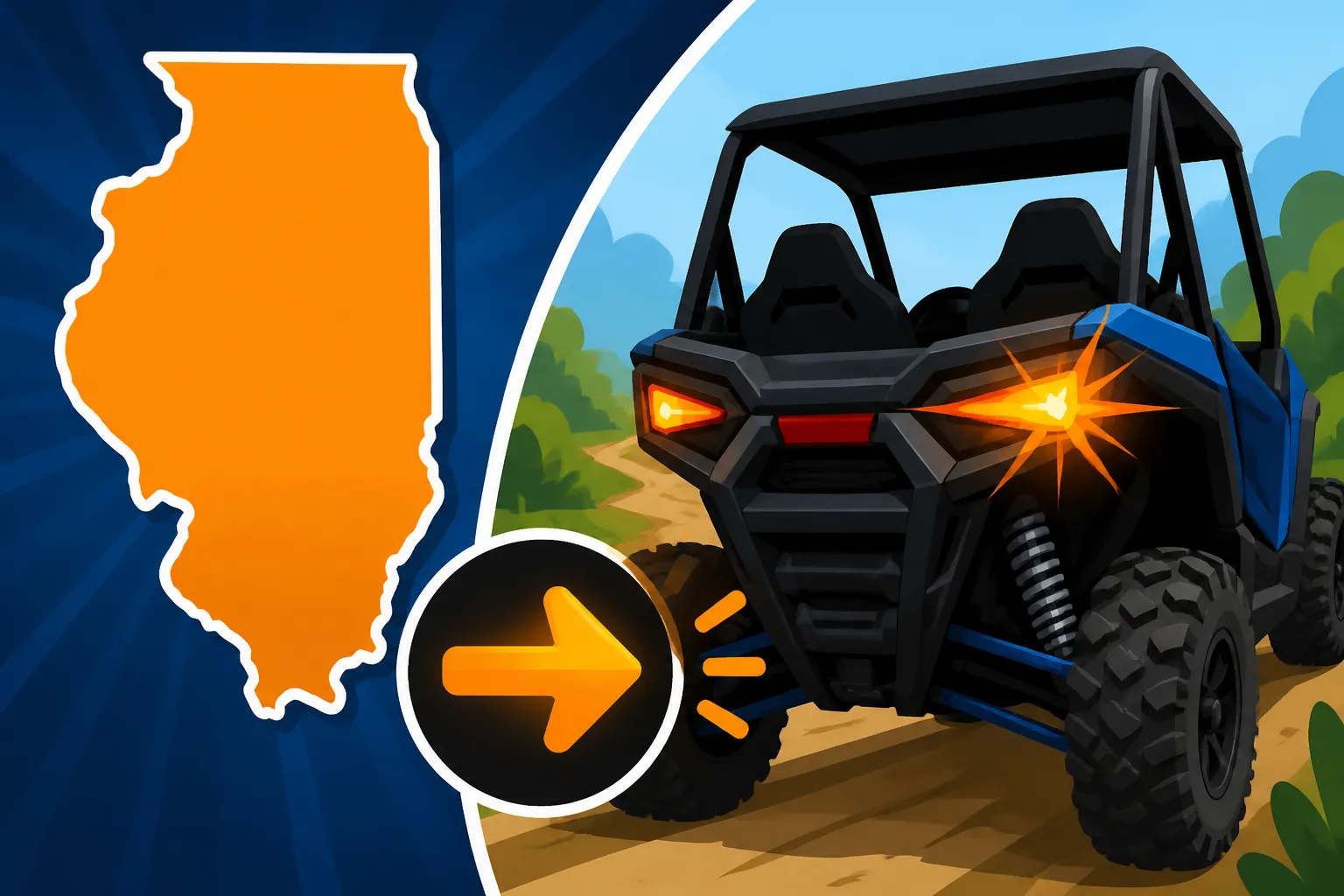
Think about it from a driver's perspective: if a vehicle ahead of you suddenly turns without warning, it's a recipe for an accident. Turn signals are non-negotiable for safe street operation because they provide advanced notice of your directional intentions. In Illinois, if you want to operate your UTV on any public road where a local ordinance allows it, you must have functional turn signals that are visible from both the front and the rear of your machine. This isn't just about avoiding a ticket; it's fundamentally about preventing collisions and ensuring everyone's safety on the road.
An acceptable turn signal system typically includes amber-colored lights at the front and rear, wired to a switch that allows the operator to select left or right. These lights should flash brightly enough to be seen clearly in daylight conditions, as well as at dusk and dawn. For many UTV owners, especially those with machines primarily designed for off-road use, adding turn signals means investing in an aftermarket kit. Companies like SuperATV offer a range of universal and model-specific turn signal kits that are designed to meet these street-legal requirements, often including everything from the lights and wiring harness to the switch and a flasher relay. It's a smart upgrade that immediately boosts your safety profile.
Beyond Just Blinking: Proper Function and Visibility
It's not enough to simply have lights that blink; they need to do so effectively and reliably. The law isn't just concerned with the presence of turn signals, but their proper function and visibility. This means ensuring that the lights are clean, unobstructed, and bright enough to cut through varying light conditions. If your lights are dim, covered in mud from your last trail ride, or mounted in a way that they're hidden from view by tires or accessories, they're not serving their purpose, and you could still face issues with law enforcement.
Maintenance is also critical. A loose wire, a blown bulb, or a corroded connection can render your turn signals useless. Before every street ride, make it a habit to quickly check that both your left and right turn signals illuminate and flash correctly. Remember, these signals are your primary way of telling other drivers, "I'm turning here!" or "I'm changing lanes now!" Without clear communication, you're putting yourself and others at risk. The detailed [Illinois Turn Signal Requirements] specify visibility distances and color, so make sure any system you install—whether factory or aftermarket—adheres to these standards.
Other Key Equipment for Illinois Street Use
While turn signals are a major piece of the street-legal puzzle, they're part of a larger ensemble of equipment that Illinois demands for machines sharing its roads. It’s all about creating a safer environment by ensuring your UTV or ATV is as visible and predictable as possible to other motorists. Think of it as suiting up for a different kind of terrain – one with cars, trucks, and paved surfaces.
Mirrors, Reflectors, and the Slow-Moving Vehicle Emblem
Communicating your intentions is vital, but so is being aware of your surroundings and being seen by others. This is where mirrors and reflectors come into play. Illinois ordinances typically require at least one rearview mirror, and often specify that it must allow you to see at least 200 feet behind your vehicle. For UTVs, many riders opt for both a center rearview mirror and side mirrors to maximize their field of vision. This helps you monitor traffic approaching from behind and to your sides, much like you would in a car. [Illinois Mirror Requirements for an ATV] are specific about what's needed.
Beyond mirrors, your machine needs to be reflective. Illinois law mandates that machines operating on public roads carry red reflectors. These are typically required on the rear of the vehicle, ensuring that if your lights fail or if you’re parked, other drivers can still spot you. These small additions can make a huge difference in low-light conditions. Furthermore, because UTVs and ATVs generally operate at lower speeds than typical road traffic, they are required to display a slow-moving vehicle (SMV) emblem on the rear. This bright orange triangle with a red border is universally recognized and serves as an immediate visual cue to other drivers that they might be approaching a vehicle moving slower than the flow of traffic. It's a crucial warning that can prevent rear-end collisions. Paying attention to [Illinois Requires Red Reflectors] and [Illinois Slow-Moving Vehicle Emblem Rules] will keep you compliant.
Headlights, Taillamps, and Brake Lights
Visibility isn't just about what you can see; it's about what others can see of you. Functional lighting is absolutely essential, particularly if there's any chance you'll be operating your machine around dusk, dawn, or in inclement weather. Illinois law requires your UTV to have at least one headlight (though most modern machines have two) that can project light for at least 500 feet. This ensures you can see far enough ahead to react to road conditions, obstacles, or other vehicles.
Equally important are the lights on the rear. Your machine must be equipped with at least one red taillamp visible from 100 feet to the rear. This constant red glow helps other drivers gauge your presence, especially when following. And, of course, brake lights are critical. These must illuminate a bright red when you apply the brakes, immediately signaling to anyone behind you that you are slowing down or stopping. These seemingly simple requirements are foundational for preventing accidents on shared roadways. Whether you're running stock lights or have upgraded, routinely check that your [Illinois Headlight Requirements for an ATV], [Illinois Requires a 100-Foot Tail Lamp], and [Illinois Requires Brake Lights] are all in proper working order before hitting the pavement.
Operational Rules and Rider Requirements on Illinois Roads
Getting your machine equipped is only half the battle. Once your ATV or UTV is street-legal in a specific Illinois jurisdiction, you still have to operate it responsibly and adhere to a different set of rules than you might on a private trail. This includes who can drive, who can ride along, and what kind of financial protection you need to have in place. These aren't just recommendations; they are legal mandates designed to ensure the safety and accountability of all road users.
Driver's License, Age, and Passenger Rules
One of the most fundamental requirements for operating any motor vehicle on public roads in Illinois is possessing a valid driver's license. Your ATV or UTV is no exception when it's permitted on the street. This means that if you're behind the wheel (or handlebars, in the case of an ATV) on a public road, you must have a current, valid driver's license – a learner's permit or an expired license simply won't cut it. This ensures that the operator has passed the state's driving competency tests and understands traffic laws. [Illinois Requires a Driver's License] clearly outlines this.
Age restrictions also apply, often aligning with standard driving age rules. Generally, minors who do not possess a valid driver's license cannot operate an ATV or UTV on public roads, even if the machine is otherwise street legal. Furthermore, passenger rules are often more stringent on public roads than off-road. For ATVs, which are typically designed for single riders, carrying a passenger on public streets is usually prohibited unless the machine is specifically designed by the manufacturer to carry more than one person (which is rare for ATVs but common for UTVs). For UTVs, passengers must typically be able to sit upright, use available seatbelts, and meet any age or height requirements set by local ordinances. Never assume that just because a child can ride with you off-road, they can do so on a public street. Always verify [Illinois Rules for a Child Passenger] and [Illinois Rules for Passengers on a UTV] in the specific town you plan to ride.
Insurance and Crossing State Highways
Just like any other vehicle operating on Illinois roads, street-legal ATVs and UTVs are typically subject to mandatory liability insurance requirements. If your machine is approved for street use in a particular municipality, you'll need to carry at least the state's minimum liability coverage, which is often referred to as 25/50/20 coverage (meaning $25,000 for bodily injury per person, $50,000 for bodily injury per accident, and $20,000 for property damage). This insurance is crucial because it protects you financially in the event you're at fault in an accident involving another vehicle or property. Without it, you could face hefty fines, license suspension, and significant out-of-pocket expenses. [Illinois Insurance Minimums for Street Use] is an important piece of research for any rider.
Another critical operational rule concerns crossing state highways. While many local ordinances allow UTVs on village or county roads, state highways (often designated by route numbers like IL-1, IL-13, etc.) fall under state jurisdiction. Illinois generally restricts ATVs and UTVs from traveling along state highways. However, many local ordinances do permit machines to cross state highways at an intersection, provided it's done safely and directly after stopping. This is a crucial distinction. You can't ride down a state highway, but you might be able to cross it to get from one approved local road to another. Always ensure you understand and adhere to [Illinois Crossing Rules at Intersections] to avoid dangerous situations and legal trouble.
The Permitting Process: Local Variations and Practical Steps
So, you've got your machine equipped with all the necessary lights, mirrors, and signals. You've got your driver's license and insurance. Now what? The final, and perhaps most variable, hurdle is navigating the local permitting process. Because local units of government are the ones granting permission for street use, they also establish the specific procedures for obtaining a permit or sticker. This is where the phrase "check with your local village hall" really comes into play.
Navigating Village and County Permits
Once a village, city, or county passes an ordinance allowing UTVs on its roads, it will invariably create a permitting system. This typically involves an application process, often available at the village or county clerk's office. You'll likely need to provide proof of ownership (like your title), proof of insurance, and your valid driver's license. There will almost certainly be an annual fee, which can vary widely from one jurisdiction to another. For example, a village might charge a nominal fee to cover administrative costs and the issuance of a permit sticker.
A crucial step in many permitting processes is a vehicle inspection. This is where local law enforcement or designated officials will check your UTV to ensure it meets all the equipment requirements outlined in their ordinance, including those turn signals, headlights, taillights, mirrors, and the SMV emblem. They'll want to see that all components are functional and correctly installed. Having robust, compliant aftermarket parts, like those offered by SuperATV, can make this inspection process smoother. Once your machine passes inspection and you've paid the fee, you'll be issued a permit sticker that must be affixed to your UTV in a prominent location, usually on the front or rear, as specified by the ordinance. This sticker is your visible proof to law enforcement that your machine is legally allowed on their roads for that year.
What Happens if You Don't Comply?
Riding your ATV or UTV on a public road in Illinois without having gone through the proper local permitting process, or without having the required safety equipment, carries significant risks and potential penalties. It’s not just about getting a slap on the wrist; the consequences can be costly and inconvenient. If you're pulled over by law enforcement and your machine isn't compliant, you could face fines that range from modest to substantial, depending on the specific violations and the local jurisdiction. These fines often start around $100-$200 but can quickly escalate, especially if there are multiple infractions or if the officer perceives a blatant disregard for safety.
Beyond monetary fines, you could also have your machine impounded. This means your ATV or UTV could be towed away, and you'd be responsible for towing fees, storage fees, and any administrative release fees on top of the initial citation. The process of recovering an impounded machine can be a bureaucratic headache and a significant financial drain. In some cases, repeated offenses or severe violations could even lead to your driving privileges being suspended. It's simply not worth the risk. Understanding [Illinois Penalties for Illegal Street Riding] reinforces why taking the time to comply with all regulations is the smartest course of action.
Practical Advice for Illinois UTV Street Riders
Making your UTV street-legal in Illinois can feel like a chore, but with the right approach and a commitment to safety, it's an achievable goal that unlocks new riding opportunities. As a seasoned enthusiast, I've seen countless riders struggle with the nuances, but a few practical tips can make all the difference.
Choosing the Right Aftermarket Components
When you realize your factory-fresh UTV needs some additions to hit the streets, you'll dive into the world of aftermarket parts. This is where quality really matters. You're not just adding accessories; you're adding critical safety equipment that needs to perform reliably under various conditions. When selecting turn signal kits, rearview mirrors, or even robust headlight upgrades, always prioritize reputable brands known for durability and compliance. Look for kits specifically designed for street legality, as these often come with all the necessary components, like amber lights, switches, and relays, that meet state and local requirements.
For instance, companies like SuperATV are well-regarded for their comprehensive street-legal kits, which can often include everything from turn signals and horns to mirrors and license plate brackets. Investing in a high-quality, integrated kit usually saves you headaches down the road compared to piecing together individual components. Read reviews, check compatibility with your specific UTV model, and don't be afraid to ask questions from experienced riders or even your local UTV dealer. Remember, these components aren't just for show; they're essential for your safety and legal compliance.
Pre-Ride Checks and Staying Informed
Once your machine is equipped and permitted, the responsibility doesn't end there. Regular pre-ride checks are paramount, especially before you venture onto public roads. Make it a routine:
- Lights: Check your headlights, taillights, brake lights, and especially your turn signals. Ensure they all illuminate brightly and flash correctly.
- Mirrors: Confirm your mirrors are clean, properly adjusted, and securely mounted.
- Reflectors & SMV Emblem: Verify these are clean and visible.
- Tires: Check tire pressure and inspect for any damage that could compromise safety on pavement.
- Brakes: Test your brakes to ensure they respond quickly and evenly.
Beyond mechanical checks, staying informed about local ordinances is an ongoing task. Because street-legal rules are set at the local level, they can change. Town councils might amend existing ordinances, or neighboring communities might pass new ones. Before you ride in a new area, or even if it’s been a while since you last checked, take a few minutes to look up the current rules for that specific village or county. Many municipalities post their ordinances online, often on their official village or county website. A quick search for "[Town Name] UTV Ordinance" or "ATV street legal rules [County Name]" can save you a lot of trouble. Being proactive and informed is your best defense against unexpected fines or dangerous situations. Keep [Illinois Ordinance Lookups Before You Ride] in mind as a vital resource.
Disclaimer
This article is for general informational purposes only and does not constitute professional advice. Laws, prices and regulations vary by location and change over time. Consult a qualified professional for guidance on your specific situation.