Spark Arrestor Checks at a Grant Site Gate
A spark arrestor check can become an unexpected delay when you arrive at an Illinois grant-assisted riding site. The device is part of the exhaust system, and site staff may check it as one part of the machine’s equipment requirements. Rules and inspection practices can differ by location, so confirm what applies before loading up.
What a spark arrestor check is looking for
A spark arrestor is designed to help keep hot particles from escaping an engine’s exhaust. That matters around dry vegetation, where a spark could contribute to a fire. On an ATV or UTV, the device is commonly built into the muffler or exhaust assembly, though the design varies by machine.
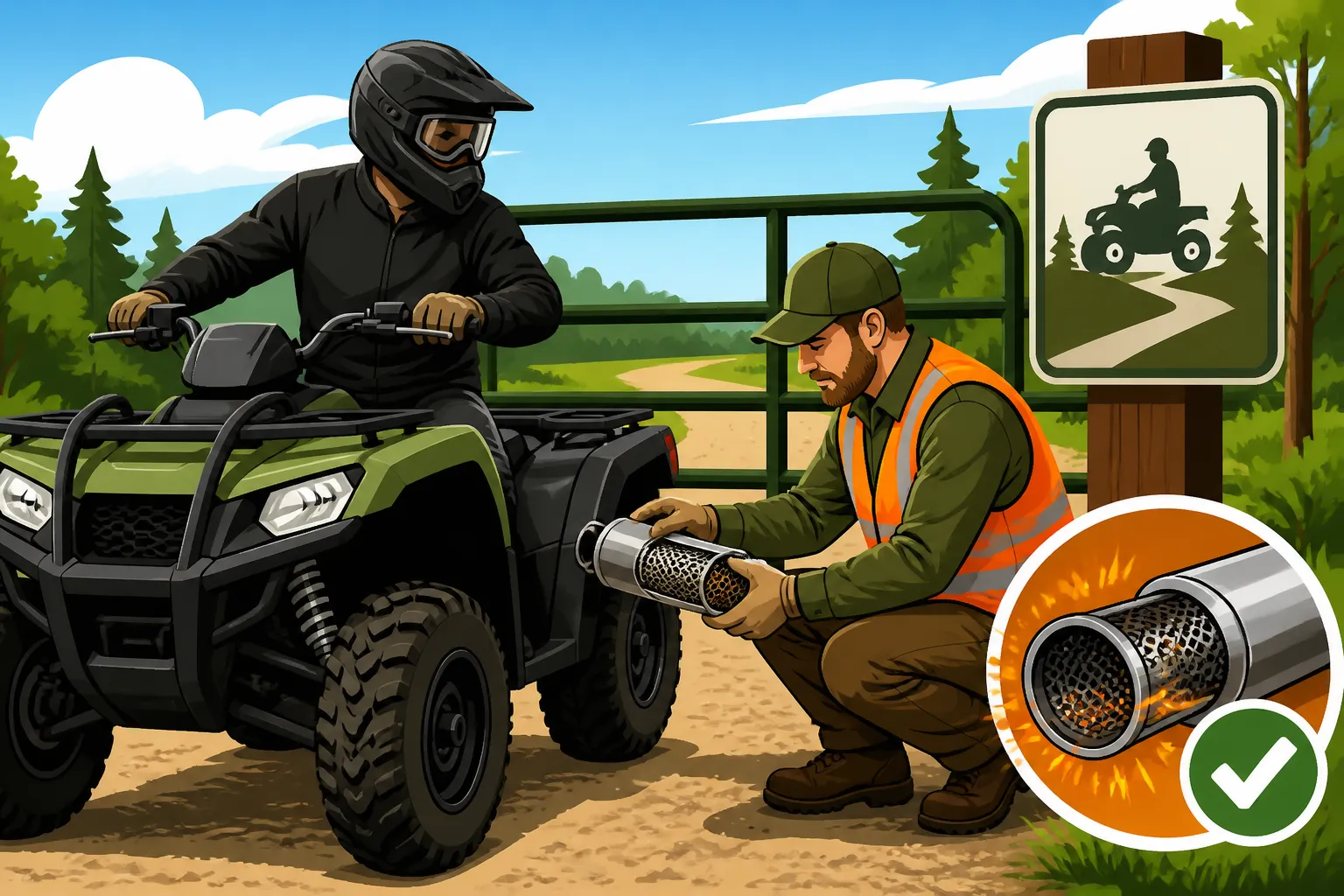
At a riding-site gate, an inspection may involve a visual check of the exhaust area and questions about whether the original or an appropriate replacement system is installed. A check is not necessarily a detailed mechanical inspection, and gate staff may not disassemble a muffler. But a missing, damaged, or obviously altered part could raise a concern.
There is not one inspection routine that should be assumed at every Illinois site. A grant-assisted area is a site supported through a public program, but the site’s operator sets and communicates its operating requirements. That means a rule at one location does not automatically apply at another. Start with What a Grant-Assisted Riding Site Actually Is and Illinois Grant Site Rules for Riders to understand why it is important to check the specific location’s requirements.
A spark arrestor check is also separate from permit paperwork. Illinois OHV permits and site-specific entry requirements address access, while an equipment check concerns whether a machine meets the site’s conditions for riding. Having the required sticker or permit does not necessarily mean a machine passes an equipment inspection. For the difference between the two main Illinois stickers, see Illinois OHV Permits: Two Stickers Explained.
| What staff may be checking | What you can do before arrival |
|---|---|
| Whether the exhaust system appears complete | Look over the muffler and exhaust outlet for missing or loose parts |
| Whether the machine has an apparent modification or bypass | Compare the current setup with the manufacturer’s configuration |
| Whether the machine meets the site’s posted equipment rules | Ask the operator about spark arrestor requirements before traveling |
| Whether the machine is too loud or otherwise outside site limits | Check for exhaust leaks or damage, and review Illinois Sound Limits at a Park |
| Whether a problem requires turning the machine away | Bring a clear description or model information if the setup is unusual |
This table is a preparation checklist, not a promise that every gate uses the same test. Some staff may make only a quick visual check; others may apply detailed site rules or inspect more than one part of the machine. Confirm the process directly with the site.
How to prepare before towing to the riding area
The simplest way to avoid a gate dispute is to check the requirements while you are planning the trip, not after you have unloaded. Start with the riding area’s current rules and ask specifically whether it requires a spark arrestor, how staff verify it, and what happens if the part is not visible or the exhaust has been modified.
If you are visiting a public grant-assisted area, do not rely only on a forum post, an old trip report, or what a different park required. Conditions and operating rules can change. The operator is the best source for current admission and equipment details. Illinois Grant-Assisted Riding Areas can help you understand the kinds of locations covered, while Illinois Trail Conditions Before You Tow is useful when checking other details that could affect the trip.
Inspect the exhaust at home
With the machine cool and parked safely, look over the exhaust from the muffler to the outlet. Check for obvious damage, loose components, missing fasteners, or signs that a part has been removed. Do not put your hand into the exhaust or try to inspect a hot system. If you are unsure whether the arrestor is present or serviceable, check the owner’s manual or ask a qualified repair shop familiar with your machine.
A machine that has been modified deserves extra attention. A different muffler, an aftermarket exhaust, or a repair made with non-original parts may change how the arrestor is installed or accessed. An aftermarket exhaust is not automatically unacceptable, but you should be able to establish that the setup meets the applicable site rule. If staff cannot verify it at the gate, the machine may still be refused entry.
If a replaceable screen or insert is part of your exhaust system, use the correct part for the exact make and model. A generic piece that fits physically may not be suitable for the system or accepted under the site’s rules. Parts listings on Amazon may help identify options, but confirm compatibility and compliance with the manufacturer or a qualified mechanic rather than relying only on a product description.
Ask what proof or access is needed
A spark arrestor is usually a physical component, not a document you can substitute for the equipment itself. Still, if your machine has an unusual exhaust design, ask the site what information would help staff identify it. The model, year, and manufacturer’s documentation may be useful when the device is enclosed or not readily visible.
Do not assume a permit, registration record, receipt, or ownership document proves the exhaust meets the site’s requirements. Those records serve different purposes. For general permit and access rules, consult Which Public Land an Annual Stamp Lets You Ride and Illinois Public Access Decal Rules. For a broader explanation of inspections, Machines Checked Against Factory Specifications at the Gate and Why a Modified Machine Gets Turned Away cover related issues.
What to expect at the gate
Arrive with enough time to complete check-in without rushing. Follow staff directions, keep the machine unloaded or positioned as requested, and do not start the engine unless staff ask you to do so. A cold engine is safer to inspect, and an exhaust can stay hot after the machine has been shut off.
The check may be brief: a staff member may look at the muffler area and confirm that the machine appears to have the required equipment. If the arrestor is internal or concealed, calmly explain the setup and show any useful manufacturer information you brought. Avoid arguing that another riding area allowed the machine; a different operator may have different rules.
A gate check can also cover other issues, such as noise, machine condition, or site-specific safety requirements. It is sensible to review the full rules rather than focusing only on the spark arrestor. For example, a site may have separate expectations for machine specifications, sound, passengers, or required permits. Illinois Private Park Waivers and Rules explains why private-site conditions should be checked separately from public access requirements.
If staff identify a problem, ask what specific requirement the machine does not meet and whether there is a way to resolve it. Do not remove or alter a part at the gate in an attempt to get through. A change made without understanding the exhaust system could create another safety issue, and it may not satisfy the rule anyway. If the site does not allow the machine to ride, follow staff instructions and contact the operator later for clarification.
A failed check can mean losing the planned riding day, so it is worth resolving uncertainty before departure. If the site cannot answer a technical question, contact the machine’s manufacturer, dealer, or a repair shop. Ask the riding-area operator what documentation or equipment they will accept; ask the mechanic how the exhaust is configured. Those are related questions, but they are not the same decision.
Common mistakes that lead to problems
One frequent mistake is assuming that a factory-looking exhaust must meet every site’s current requirements. A machine may have been altered, damaged, or repaired since it left the factory. A visual similarity is not a reliable substitute for checking the actual components and the site’s rule.
Another is confusing a spark arrestor with a noise-control device. The exhaust system may include components serving different purposes, and one does not automatically prove the other is present or functioning. A quiet-sounding machine could still have a missing arrestor, while an arrestor-equipped machine could still violate a site’s sound rules. Check both issues separately.
Riders can also over-rely on the word “approved” in a parts listing. The right fit depends on the specific machine and exhaust. A part described for a broad range of models may not match yours, and a product listing does not establish that a particular riding area will accept the setup. Verify the fit and ask the site if its requirements are unclear.
Finally, do not treat a gate check as a substitute for regular maintenance. Exhaust components can loosen or corrode, and a damaged system may create problems beyond entry approval. Inspect the machine periodically, repair it before the trip, and keep it in the configuration required by the manufacturer and the riding area.
A quick check at home, a direct question to the operator, and enough time at arrival can prevent a frustrating surprise. Because Illinois grant-assisted sites do not necessarily share one gate procedure, the practical rule is simple: confirm the location’s requirements and make sure your machine’s exhaust is complete and in good condition before you tow.
Disclaimer
This article is for general informational purposes only and does not constitute professional advice. Laws, prices and regulations vary by location and change over time. Consult a qualified professional for guidance on your specific situation.