Illinois Title Before Your First Ride
There's nothing quite like the excitement of getting a new-to-you ATV or UTV, whether it's fresh off the dealer lot or a diamond in the rough from a private seller. You just want to hit the trails or get to work on your property, but hold on a minute! Skipping the proper titling steps in Illinois before that first ride can lead to a world of headaches, fines, and even losing your machine. This guide will walk you through exactly why and how to secure your Illinois title to ensure a smooth, legal, and worry-free riding experience from day one.
Why Getting Your Title First Is Non-Negotiable in Illinois
We all dream of the open trail or the satisfaction of completing farm tasks with our new off-road machine. That immediate gratification can make the necessary paperwork feel like a frustrating hurdle. However, in Illinois, the title isn't just a suggestion; it's a foundational document for off-highway vehicle (OHV) ownership. Getting this done before you even think about your first adventure isn't just about following the rules—it's about protecting yourself and your investment.
The Legal Mandate and Proof of Ownership
Illinois law has been clear for quite some time: nearly every ATV, UTV, and off-road motorcycle operated in the state needs a Certificate of Title. This isn't a new regulation; in fact, [Illinois Titles Required Since 1998] made it mandatory decades ago. This legal requirement means that without a title in your name, you don't officially own the machine in the eyes of the state. It’s akin to owning a car without ever having the title transferred to you—you might possess it, but proving legal ownership in a dispute would be incredibly difficult.
The title serves as your undisputed proof of ownership. Imagine you bought a used quad from a private seller, and a few months later, the original owner claims it was stolen, or perhaps there's an undisclosed lien on it. If you don't have a properly executed title in your name, you could find yourself in a very difficult, costly, and emotionally draining situation. The state wants a clear, traceable chain of ownership, and your name on that title is the vital final link that confirms it’s truly yours.
This applies equally whether you’re purchasing a brand-new machine from a dealership or picking up a well-loved model from a private party. While Illinois titles but does not register ATVs, meaning you won’t get a license plate for most off-road use, the title itself is paramount. It’s the cornerstone of your legal right to the machine, protecting you from potential fraud and ensuring clarity should any questions about ownership arise.
Protecting Your Investment and Avoiding Penalties
Beyond the legal aspect of ownership, having your title sorted protects a significant financial investment. Off-road machines are not inexpensive toys; they represent a substantial outlay of cash. A clear title in your name acts as a safeguard against potential disputes, makes insurance claims smoother, and is absolutely essential in the unfortunate event of theft. Without it, proving you own the machine for an insurance payout becomes a bureaucratic nightmare.
Riding an ATV or UTV that isn't properly titled can lead to more than just administrative headaches; it can result in serious legal repercussions. Law enforcement, including conservation officers at state parks or local police, has the authority to request proof of ownership. If you're caught operating a machine without a valid title, or if the title isn't correctly transferred into your name, you could face hefty fines. The state sees this as a violation of ownership laws, and the penalties reflect that.
In worst-case scenarios, your machine could even be impounded. This means your prized ATV or UTV is towed away, and you'll be on the hook for towing fees, storage fees, and any associated fines. Recovering an impounded machine is a complex, costly, and time-consuming process that often requires you to legally prove ownership after the fact, frequently involving court appearances. It's an experience no one wants, and it highlights why tackling the titling process upfront is the simplest and most cost-effective approach.
The Step-by-Step Process for Titling Your ATV or UTV
The thought of government paperwork can be daunting, but breaking down the Illinois ATV/UTV titling process into manageable steps makes it much less intimidating. It primarily involves gathering the right documents, filling out the correct forms, and submitting them to the appropriate state agency. Being prepared and thorough here will save you considerable time and frustration in the long run.
Gathering Your Essential Documents
The titling process in Illinois absolutely hinges on having the correct paperwork in hand. This is where many new owners, especially those buying from private sellers, can encounter unexpected delays. For brand-new machines purchased from a dealer, you will almost always receive a Manufacturer’s Certificate of Origin (MCO). This critical document functions as the "birth certificate" for your ATV or UTV, verifying that it's a new machine and has never been titled before.
If you’re purchasing a used machine, the process requires the previous owner's Illinois Certificate of Title. It’s crucial to ensure this title is properly signed over to you by the seller. Verify that the signatures match the names printed on the title and that all fields for the sale date, purchase price, and any odometer readings (though less common for off-highway vehicles) are accurately completed. Missing or incorrect information here is a common reason for application rejection.
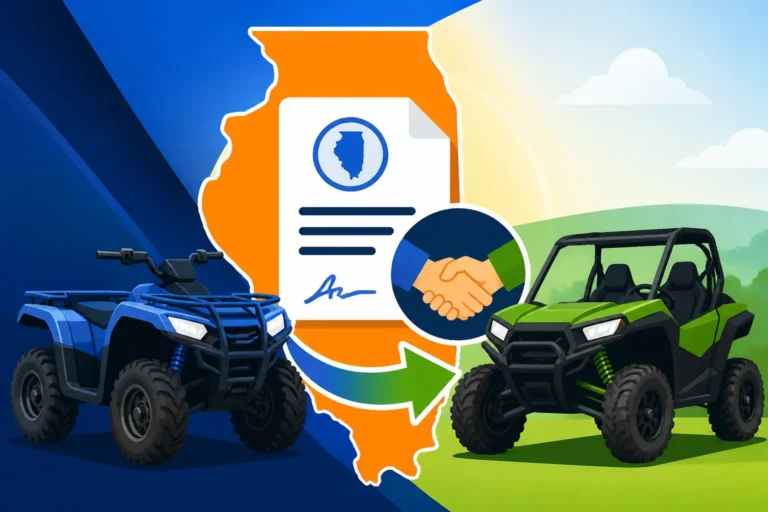
In both new and used scenarios, you'll need to complete an Illinois Application for Vehicle Transaction (Form VSD-190). This form is the cornerstone of your application, requiring all your personal details, information about the machine, and specifics of the sale. You'll also need proof of your identity and Illinois residency. For private transactions, a clear and comprehensive bill of sale is vital. This document should detail the machine’s make, model, VIN, purchase price, and the full contact information of both the buyer and seller. Resources like LawDepot offer customizable bill of sale templates that can help ensure you capture all necessary details, providing legal clarity for both parties involved in the sale. You can find more information on specific documents in [Illinois Title Paperwork Checklist].
Submitting Your Application and Awaiting Your Title
Once you've meticulously gathered all your paperwork, the next step is to submit your application and supporting documents. The primary authority for off-highway vehicle titling in Illinois is the Secretary of State (SOS). You can generally do this at an SOS facility, but it's important to note that not all facilities are equipped to handle OHV titling. It’s always a wise move to contact your local SOS office or check the official Illinois DNR website for a list of designated locations and current procedures to avoid a wasted trip. For a full rundown, refer to [Applying for an Illinois Off-Road Title] or [Illinois Secretary of State Facilities].
Along with your completed application and supporting documents, you will need to pay the applicable titling fee. It's important to budget for this, as well as any other taxes that apply. If you purchased your machine from a private individual, you'll typically pay a flat private-party tax. If bought from a dealer, standard sales tax will apply. These fees are a mandatory part of the overall titling expense, and it's best to confirm the current rates before you go to the SOS office. For details on the fees, check [Illinois ATV Title Cost].
After submission, your application enters a processing period. It's rarely an instant turnaround, so patience is key. The SOS reviews all submitted documents to ensure everything is in order. If your application is complete and accurate, your new Illinois Certificate of Title will be mailed to you. The anticipation can be tough when you’re eager to ride, but this waiting period is a necessary step to establish your legal ownership. Any errors or missing information will likely cause delays, sending your application back for correction, which further emphasizes the need for careful preparation.
What Happens If You Ride Without a Proper Illinois Title
The temptation to just hop on your new machine and go can be strong, especially if you're excited about a recent purchase. However, bypassing the titling process in Illinois is a risk that carries potentially severe consequences. The state takes ownership documentation seriously, and ignoring the rules can lead to significant headaches, financial penalties, and even loss of your machine. It's a gamble that almost never pays off.
Facing Fines and Potential Impoundment
Consider this all-too-common scenario: you've acquired a fantastic side-by-side, perfectly suited for the trails at a grant-assisted riding area. In your haste, you decided to put off the titling paperwork for "later." You’re out enjoying a beautiful day, when a conservation officer or local law enforcement initiates a routine check. They ask for proof of ownership, and you can’t produce a valid title in your name. This moment can quickly turn a fun outing into a stressful ordeal.
In Illinois, operating an off-highway vehicle without proper title documentation can result in substantial fines. The exact amount can fluctuate based on the specific circumstances and the jurisdiction, but it's generally far more than the cost of titling the machine in the first place. Worse still, your ATV or UTV could be impounded. This means your machine is towed away, and you become responsible for not only the initial fines but also towing and daily storage fees. Recovering an impounded machine is a complex, costly, and incredibly frustrating process that often requires proving ownership after the fact, which might involve court appearances and navigating extensive administrative hurdles. This is precisely the kind of distress that proper titling is designed to help you avoid.
Hindered Sales, Financing, and Insurance Challenges
The immediate penalties are just one aspect of the problem. Neglecting to title your machine also creates significant long-term complications. When the time eventually comes to sell your ATV or UTV, a machine without a clear, properly transferred title in your name is a major red flag for any potential buyer. Most experienced or legitimate buyers will rightfully refuse to complete a transaction without a valid title, understanding the legal entanglements they would inherit. This lack of proper documentation will severely reduce your machine's resale value and can make it nearly impossible to sell through conventional, legitimate channels. You might find yourself having to apply for a duplicate title or navigate an even more arduous process if the original title is lost or was never obtained, as discussed in [Illinois Machines With No Paperwork].
Beyond sales, if you intend to finance a used ATV or UTV, lenders almost universally require the machine to be properly titled in your name, as it serves as their collateral. Without a clean title, securing a loan becomes nearly impossible. Similarly, insuring your machine, particularly for comprehensive coverage that protects against theft or damage, typically requires proof of ownership via a valid title. If your ATV is stolen or significantly damaged and you cannot produce a title in your name, your insurance claim could be denied, leaving you financially responsible for the entire loss. Taking the time to title your machine correctly protects your financial interests and provides peace of mind on multiple fronts.
Common Misconceptions About Illinois ATV/UTV Titling
There are a lot of rumors and misunderstandings floating around about off-highway vehicle regulations in Illinois. These misconceptions can lead well-meaning owners astray, causing them to inadvertently break the law and face penalties. Clearing up these common myths is crucial to ensure you're fully compliant before you ever start your engine for that first ride.
"I Only Ride on My Own Property, So I Don't Need a Title"
This is perhaps one of the most persistent and problematic misconceptions among ATV and UTV owners in Illinois. The idea is that if your machine never touches public land or roads, you're exempt from all paperwork. While it's true that if you exclusively operate your machine strictly within the confines of your own private property, and never, ever traverse public roads, rights-of-way, or state-recognized trails, you might be exempt from certain annual usage stamp or public access decal requirements. However, the fundamental requirement to title your machine is entirely separate and far broader. [Illinois Residential Property Exemption] offers insight into specific exemptions related to property use, but these are distinct from titling.
The Illinois Department of Natural Resources (DNR) and the Secretary of State (SOS) clearly mandate that nearly all ATVs, UTVs, and off-road motorcycles must be titled, regardless of where their primary operation occurs. The title's purpose is to establish a clear, legal record of ownership with the state. Think of it this way: if you own a classic car that you only keep in your garage and never drive on public roads, you still possess the title for it, right? That title is essential for proving ownership if the machine is ever stolen, sold, used as collateral for a loan, or included in an estate. Do not confuse exemptions related to riding permits or usage with the core legal requirement of establishing official ownership through a Certificate of Title.
Confusing Titling with Vehicle Registration and Plates
Another frequent source of confusion arises from the distinction between "titling" and "registering" a vehicle, especially since traditional automobiles require both. In Illinois, ATVs, UTVs, and dirt bikes are indeed titled, but they are generally not registered in the same manner as cars or trucks, meaning they do not receive traditional license plates. This often leads new owners to mistakenly believe that if there's no license plate involved, there's no real need for any state-mandated paperwork at all. This assumption is a significant error and can lead to trouble.
The title is fundamentally about establishing and proving ownership, whereas registration (and the associated license plate) is typically about granting permission to operate a vehicle on public roads and ensuring it meets specific road-legal criteria. Since most off-highway vehicles are not designed or permitted for regular street use (without specific local ordinances and modifications), they do not receive traditional road registration. However, the state still absolutely requires a formal record of who owns which machine. This is precisely why when you complete the VSD-190 application form, you are specifically applying for an "off-highway vehicle certificate of title." You might even see documentation referring to [What "Title Only" Means on a Title Application] – this signifies that you will receive a title document proving ownership, but not a license plate for road registration. Understanding this critical distinction is paramount to remaining compliant with Illinois law and avoiding unnecessary fines or legal complications.
Here’s a quick overview of how the different pieces of paperwork fit together:
| Feature | Illinois ATV/UTV Title | Illinois OHV Usage Stamp | Illinois Public Access Decal |
|---|---|---|---|
| Purpose | Proves legal ownership | Allows riding on state-owned or managed lands | Allows riding on grant-assisted sites |
| Required For | Most ATVs/UTVs, regardless of where they are ridden | Machines used on state-owned lands (e.g., Sahara Woods) | Machines used at grant-assisted riding areas |
| Issuing Authority | Illinois Secretary of State | Illinois Department of Natural Resources (DNR) | Illinois Department of Natural Resources (DNR) |
| Cost | Fixed fee (check current SOS rates) | Fixed annual fee (check current DNR rates) | Fixed annual fee (resident/non-resident rates) |
| Display | Document held by owner | Affixed to the forward half of the machine | Affixed to the front and center of the machine |
| Exemptions | Farm/livestock, competition, government machines, etc. | Primarily farm use, residential property, grant sites | Machines with a Usage Stamp (they cancel each other) |
| Penalties | Fines, impoundment, legal ownership issues | Fines for non-compliance at state sites | Fines for non-compliance at grant sites |
| Transferable | Yes, with sale of machine | No | No |
Disclaimer
This article is for general informational purposes only and does not constitute professional advice. Laws, prices and regulations vary by location and change over time. Consult a qualified professional for guidance on your specific situation.