Illinois Rules for a Child Passenger
The thought of taking your kids along for a ride on your ATV or UTV in Illinois can bring up a lot of questions and, let's be honest, a fair bit of anxiety. You want to share the joy of the trail or the convenience of a quick trip down a permitted village street, but you also want to make sure you're doing it legally and, more importantly, safely. It's a confusing landscape with different rules for different machines and different locations. This guide aims to cut through that confusion, explaining Illinois's regulations for child passengers on both ATVs and UTVs, particularly when you venture onto public roads.
The Illinois Landscape: General Rules for Child Passengers on Off-Road Machines
Illinois law draws a pretty clear line between ATVs and UTVs, especially when it comes to who can ride and where. This distinction is absolutely critical when you're thinking about bringing children along. Many riders mistakenly believe the rules are interchangeable, leading to potential fines or, worse, dangerous situations.
No Passengers on ATVs (Under 16)
Let's start with ATVs. The law in Illinois is quite strict: no person under 16 years of age may operate or be a passenger on an all-terrain vehicle. This isn't just a suggestion; it's the law. Many ATVs are designed for a single rider, and even those with extended seats are generally not intended to carry passengers, especially children, due to stability and control issues. The physics of an ATV, with its straddle seating and reliance on rider body English for balance, make carrying a passenger inherently riskier, particularly for young, inexperienced riders or passengers who might shift unexpectedly. This rule is in place to protect children from the specific dangers associated with ATVs, which require significant physical input from the operator. It’s important to understand that an ATV is a very different machine from a utility task vehicle (UTV) in the eyes of the law and for safety.
UTVs: A Different Story for Passengers
Now, when we talk about UTVs, the landscape changes significantly. UTVs, often referred to as side-by-sides, are designed with bench or bucket seating, a roll cage, and typically a steering wheel and foot pedals, much like a small car. This design inherently lends itself more to carrying passengers. While Illinois law still has age restrictions for operators of UTVs on public roads (which often aligns with needing a valid driver's license), the general prohibition against passengers under 16 years of age that applies to ATVs does not apply to UTVs. This means that, in most contexts, children are permitted to ride as passengers in a UTV, provided they are properly seated and secured within the vehicle's design capacity. Think of it more like a car – if there’s a seat and a seatbelt, a passenger is generally allowed. However, always remember that even with UTVs, specific rules can vary greatly depending on where you are riding.
Why the Distinction Between ATVs and UTVs Matters for Kids
The distinction isn't arbitrary. It's rooted in safety. ATVs are dynamic, high-performance machines that require the rider to actively participate in balancing and controlling the vehicle through body weight shifts. Adding a passenger, especially a child who might not understand the need to stay still or lean with the driver, can drastically alter the ATV's center of gravity, making it unstable and prone to rollovers. UTVs, on the other hand, offer a more stable platform with a lower center of gravity, traditional seating, and often factory-installed seatbelts, all within the protection of a roll-over protection structure (ROPS). This design makes them inherently safer for carrying multiple occupants. Understanding this fundamental difference is your first step in ensuring you're compliant with Illinois law and, more importantly, keeping your young ones safe. Always consult resources like [Illinois ATV Age Requirements] to ensure you're up-to-date on who can operate these machines at what age.
Child Passengers and Street-Legal UTVs: What Illinois Law Says
Once you decide to take your UTV onto a public road, which requires it to be street-legal in Illinois, a new set of rules comes into play, especially regarding child passengers. These rules are often a blend of off-highway vehicle (OHV) regulations and general motor vehicle laws. It’s not just about the UTV itself, but also about the operator and every person inside.
The Driver's License Requirement for Street Use
Here's a crucial point that directly impacts who can drive and who can be a passenger when a UTV is on a public road: to operate a UTV on any street, highway, or public right-of-way in Illinois (where allowed by local ordinance), the operator must possess a valid driver's license. This isn't about the passenger, per se, but it's vital context. If the driver isn't legally licensed, the entire operation is unlawful, regardless of who else is in the vehicle. For a deeper dive into operator requirements, check out [Do You Need a License for a UTV in Illinois?]. This means that while a child might be permitted as a passenger in a UTV, they cannot be the driver, nor can a non-licensed adult operate the UTV with a child onboard on public roads. This rule emphasizes that operating a UTV on public roads carries the same responsibilities as driving a car.
Seatbelt Laws and Passenger Restraints for Children
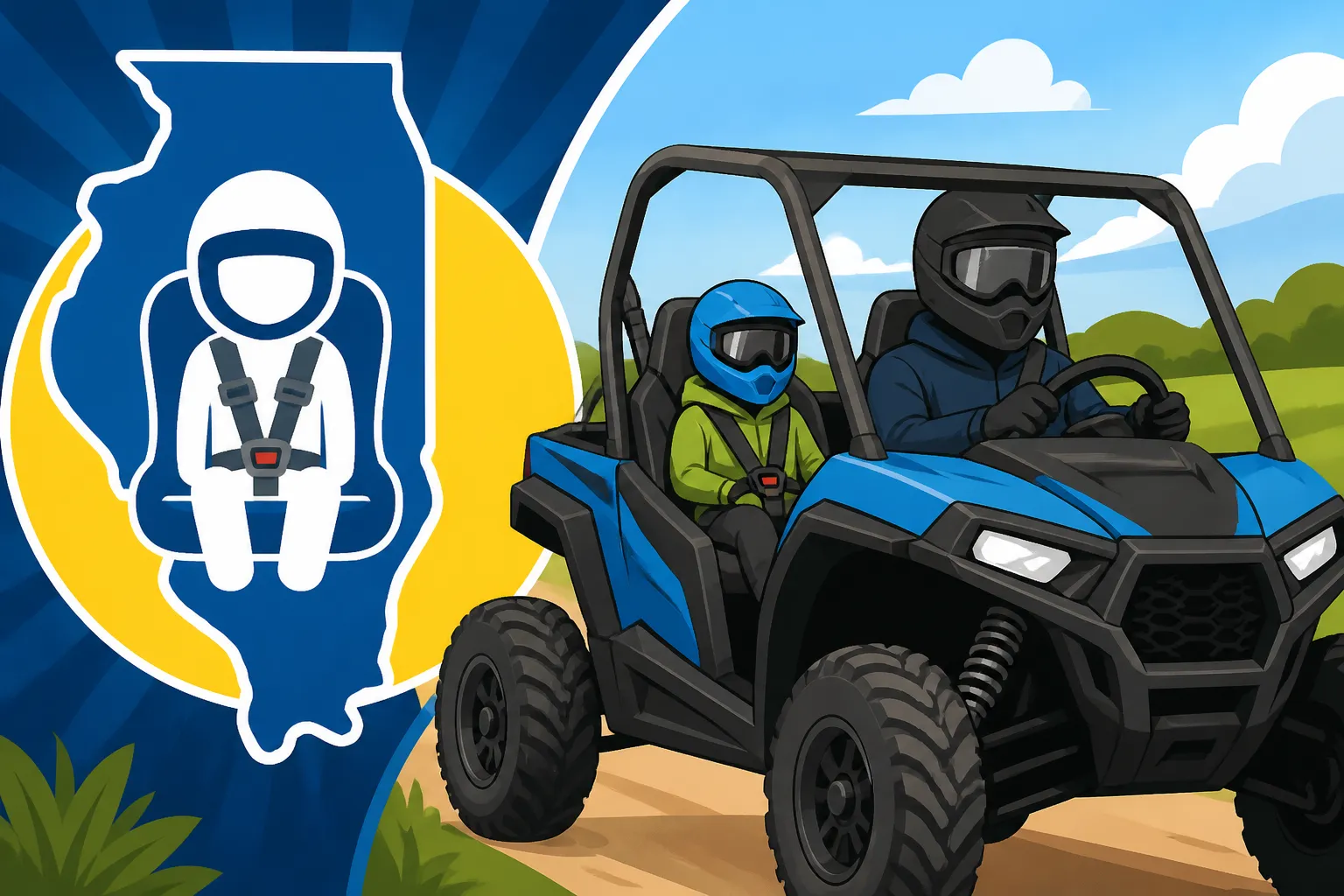
When a UTV is permitted for street use in Illinois, the vehicle effectively falls under many of the same safety regulations as other motor vehicles. This includes seatbelt laws. If your UTV is equipped with seatbelts (which most factory UTVs are), then all occupants, including children, must wear them. It’s not just good practice; it's often the law when operating on public roads. Children should be secured in the appropriate seating position, utilizing the vehicle's safety restraints. For very young children, this might even mean considering a car seat or booster seat if compatible with the UTV's seating and restraint system. You need to ensure the child is able to be safely and securely restrained by the UTV's belt system, just as you would in a car. Always refer to [Illinois Rules for Passengers on a UTV] for comprehensive passenger guidelines. The goal is to provide the same level of protection for children in a street-legal UTV as they would receive in a standard automobile.
Age and Weight Considerations for Passenger Safety
While Illinois law doesn't impose the same strict "under 16" passenger ban on UTVs as it does on ATVs, common sense and general safety guidelines still apply. Children should always be seated appropriately for their age and size. This means they should be able to sit upright with their back against the seat, their feet flat on the floor (or securely positioned), and be properly secured by the seatbelt. Never allow a child to ride standing up, on someone's lap, or in an area not designed for passengers. Their weight and size also play a role in the effectiveness of the seatbelt. If a seatbelt doesn't fit correctly, it can actually cause more harm than good in a sudden stop or collision. Some UTVs might not be suitable for infants or very small toddlers due to the size of the seats and the design of the restraint systems. It’s also crucial to remember that your UTV likely has a weight capacity for passengers; exceeding this can affect handling and safety.
| Feature | ATV (All-Terrain Vehicle) | UTV (Utility Task Vehicle) |
|---|---|---|
| Seating Type | Straddle, motorcycle-style | Bucket or bench, car-style |
| Steering | Handlebars | Steering wheel |
| Roll Protection | Minimal (rollover risk managed by rider's skill) | Integral Roll-Over Protective Structure (ROPS) |
| Child Passenger | Not permitted if under 16 years old | Generally permitted, with proper seating and restraints |
| Street Legal | Generally not designed for street use; very limited exceptions | Many models can be made street-legal via local ordinances |
| Restraints | No seatbelts (driver relies on grip) | Typically factory-equipped seatbelts |
Practical Safety Considerations for Carrying Young Passengers
Beyond just what the law requires, being a responsible UTV owner means taking extra precautions when children are on board. The dynamic environment of off-road or even low-speed street riding presents unique challenges. Your proactive steps in equipping your machine and educating your passengers can make a world of difference.
Essential Gear Beyond the Law (Helmets, Eye Protection)
While Illinois law regarding helmets on ATVs and UTVs can vary depending on the specific riding area (e.g., state parks like Sahara Woods often have specific [Illinois Helmet Rules on State Areas]), when it comes to children, a helmet should be non-negotiable, regardless of what the statute explicitly demands for a street-legal UTV. A properly fitted DOT-approved helmet can prevent serious head injuries in the event of a rollover, sudden stop, or collision. Similarly, eye protection – whether goggles or a full-face helmet visor – is crucial. Dust, debris, insects, and even low-hanging branches can become serious hazards, especially at speed. Children's eyes are particularly vulnerable. Consider sturdy, full-coverage eye protection that fits comfortably over or under a helmet. These aren't just accessories; they're vital pieces of a safety system.
Modifying Your UTV for Enhanced Child Safety
Many UTV manufacturers design their vehicles with adult passengers in mind. If you regularly carry children, you might want to consider some aftermarket modifications to enhance their safety. For instance, while factory seatbelts are a good start, installing five-point harnesses for younger children can provide significantly better retention and distribute impact forces more effectively in the event of an accident. These harnesses prevent a child from sliding out from under a lap belt or moving excessively during bumpy rides. Additionally, grab handles for child passengers, especially those that can be mounted to the roll cage or dash, provide something for them to hold onto securely, reducing their chances of being tossed around. Safety nets or doors are another excellent addition, especially for smaller children, as they prevent limbs from inadvertently extending outside the vehicle's protective cage. Companies like SuperATV offer a wide range of accessories, from full doors and windshields to upgraded harnesses and cargo nets, that can help make your UTV a safer environment for young riders. A clear windshield, for example, can protect children from wind, dust, and projectiles, enhancing both safety and comfort.
Pre-Ride Checks and Supervising Young Riders
Before every ride, especially with children, conduct a thorough pre-ride inspection of your UTV. Check tire pressure, brakes, steering, and all safety restraints. Ensure seatbelts are functioning correctly and that any child safety seats or harnesses are securely installed. Beyond the machine itself, constant supervision and clear communication are paramount. Establish ground rules with children before you even start the engine:
- Keep hands and feet inside the vehicle at all times.
- Stay seated and keep your seatbelt fastened.
- Do not distract the driver.
- Inform the driver if you are uncomfortable or need to stop.
During the ride, maintain a sensible speed, especially on unfamiliar terrain or when traversing local roads where [Illinois Rules for Riding a Village Street], [Illinois Rules for Riding a County Road], or [Illinois Rules for Riding a Township Road] might apply. Remember that children may not have the same risk perception or judgment as adults. Drive defensively, anticipate hazards, and always prioritize safety over speed or adventure, especially when navigating mixed-use roads.
Navigating Local Ordinances and Other Restrictions
Even when your UTV is street-legal in Illinois and equipped for child passengers, the ability to actually ride on public roads with kids is often determined by a patchwork of local ordinances. Illinois state law generally prohibits OHVs on public roads, but it grants specific local government entities the power to open up roads. This means that permission to ride, and any specific rules regarding passengers, can change block by block, town by town.
How Local Rules Can Impact Child Passenger Policies
It's common for villages, towns, and counties to pass their own ordinances regarding UTV use on public streets. These ordinances specify which roads are open, what hours you can ride, and sometimes, additional equipment requirements beyond state law. Crucially, they can also impose their own rules about passengers, including age restrictions or specific seating requirements for children that might be more stringent than general state guidelines for UTVs. For example, a village might specify that all passengers, regardless of age, must be seated in a forward-facing seat with a three-point harness, or they might have stricter speed limits when children are on board. It's imperative not to assume that if one town allows UTVs, the next one over does, or that the rules are identical. Each local jurisdiction has the authority to define its own terms for UTV usage on its roads. For a broader view of how these rules are established, you might find [Illinois Municipalities That Pass Ordinances] helpful.
The Importance of Knowing Your Route (Town, County, Township)
Before you ever pull your UTV onto a public road with children in tow, you need to be absolutely certain about the local regulations for every inch of your route. A road might start in a village that permits UTVs, but quickly cross into a township or county that has stricter rules, or no UTV allowance at all. Ignorance of the law is never an excuse, and a traffic stop with children onboard can be particularly stressful. Websites of local government bodies (villages, cities, counties) are often the best place to find their specific UTV ordinances. If the information isn't readily available online, a phone call to the local police department or clerk's office is your next best step. It might seem like a hassle, but ensuring you're compliant safeguards your family and your wallet. Remember, state highways are generally off-limits except for direct crossings at intersections, and interstates are a definite no-go. For more on navigating these rules, consider the article on [Illinois UTV Street Legal Rules by Town].
What to Do if You're Unsure About a Rule
If you've done your research and you're still uncertain about a specific rule, especially concerning child passengers in a particular area, err on the side of caution. It's always better to avoid a potentially illegal or unsafe situation. Don't rely on word-of-mouth from other riders; what was true last year or in another county might not be true today or where you are.
- Contact Local Authorities: Reach out to the local police department or the village/county clerk's office for the specific area you plan to ride in. They are the definitive source for their local ordinances.
- Check Local Government Websites: Many municipalities post their ordinances online. Search for "UTV ordinance" or "non-highway vehicle ordinance" for the specific town or county.
- Consult OHV Groups: Local ATV/UTV clubs often have members who are well-versed in local regulations and can provide practical advice, but always verify their information with official sources.
By being diligent and informed, you can enjoy the freedom of UTV riding in Illinois with your children safely and legally, making memories that last a lifetime without the worry of unexpected penalties or, worse, accidents.
Disclaimer
This article is for general informational purposes only and does not constitute professional advice. Laws, prices and regulations vary by location and change over time. Consult a qualified professional for guidance on your specific situation.