Keeping a Quad at a Deer Camp Downstate
When you're headed downstate to an Illinois deer camp, bringing your quad or side-by-side often seems like a no-brainer. After all, these machines are perfect for scouting, setting up stands, and especially for dragging out that big buck. But the truth is, many riders get tangled up in the various rules and regulations that apply once you leave your own backyard. This guide is here to untangle that confusion, helping you understand the Illinois requirements for keeping and operating your off-road machine responsibly and legally at your deer camp.
Understanding the Lay of the Land: "Downstate" and Your Quad
For many Illinoisans, "downstate" conjures images of rolling hills, dense forests, and wide-open fields – prime hunting territory. It’s a world away from the urban sprawl, and with that distance comes different expectations for off-road vehicle use. However, "different" doesn't always mean "fewer rules." It often means different kinds of rules, especially when it comes to where you can actually ride and what documentation your machine needs.
The Reality of Rural Illinois Riding
While the open spaces of southern Illinois might feel like a free-for-all for off-road enthusiasts, the vast majority of those lands are either private property or public lands with specific, often restrictive, rules regarding ATV and UTV use. Unlike some other states, Illinois does not have extensive public trail systems open to motorized vehicles outside of a few specific grant-assisted sites. This means that your primary riding opportunities at a deer camp will almost certainly be on private ground, which brings its own set of legal considerations. You won't be riding just anywhere; you'll be riding where you have explicit permission.
This distinction is critical because the state's titling, usage stamp, and access decal requirements are directly tied to where you intend to operate your machine. If you're only ever going to be on private land where you have permission, certain requirements might be different than if you were planning to use a designated riding park or even cross a public road. Understanding this fundamental difference is the first step in ensuring your deer camp quad experience is hassle-free.
Private Land: The Heart of Downstate Hunting
Most deer camps in Illinois are established on private land, whether it's land you own, lease, or have explicit permission to use from a landowner. This significantly simplifies some aspects of ATV and UTV use, as you are not subject to the same strict public land regulations concerning usage stamps and decals. However, it doesn't mean a complete absence of rules. Even on private land, you still have responsibilities, particularly regarding machine ownership and potential liability.
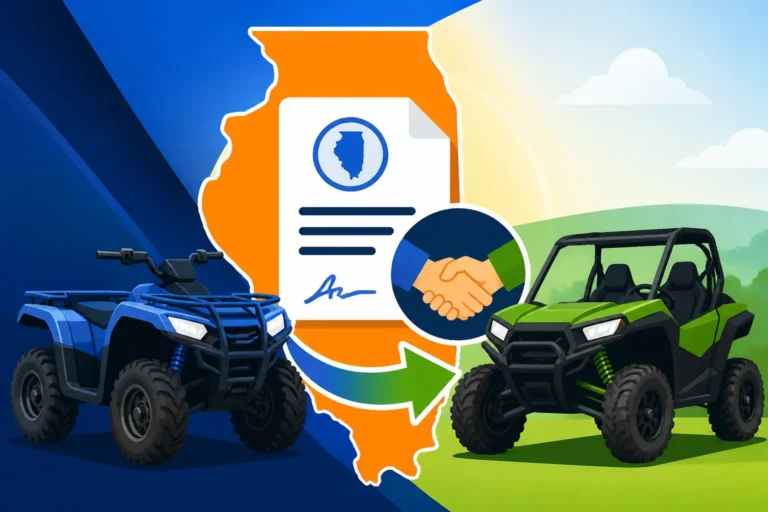
For instance, while you might not need a public access decal to ride solely on private property, your machine still needs to be properly titled. You'd be surprised how many folks think because it's "just for the farm" or "only at deer camp," titling isn't necessary. But [Illinois ATV Title Certificates Explained] makes it clear that the state requires titling for most off-road machines. It's a fundamental piece of ownership proof, and a vital step if you ever decide to sell the machine or if it's stolen. Formalizing agreements with landowners, even if it's family land, can also head off future misunderstandings. Resources like LawDepot can provide templates for land use agreements or even simple permission slips, which can be invaluable in rural settings.
Essential Paperwork for Your Deer Camp Quad
Even if your quad spends 99% of its life at a remote deer camp, tucked away on private land, there's still a specific set of paperwork you absolutely need to have in order. Illinois takes its off-road vehicle documentation seriously, and understanding these requirements is key to avoiding fines and ensuring a smooth season.
Titling Your Off-Road Machine in Illinois
Here's the deal: Illinois has required titles for off-highway vehicles (OHVs) since 1998. This applies to ATVs, UTVs, and even dirt bikes. If your machine was manufactured after that date, it needs a title. Full stop. It doesn't matter if you only ever ride it on your own property, at a friend's deer camp, or just use it to haul firewood. The title proves ownership and is an important legal document. Think of it like the title to your car, even if you never drive that car off your driveway.
Applying for an Illinois Off-Road Title involves a specific process, usually through the Secretary of State's office. You'll need documents like your bill of sale or Manufacturer's Certificate of Origin (MCO). Many people get confused because Illinois titles these machines but does not register them for street use, leading them to wonder [Do You Need to Register an ATV in Illinois?]. The answer is typically "no" for general registration like a car, but "yes" for titling. If you bought your quad from a private seller, you'll need to transfer the title into your name. If you bought it new from a dealer, they usually handle the initial titling paperwork for you. Without a title, proving ownership can become a nightmare, especially if your machine is ever stolen or involved in an accident.
Usage Stamps and Access Decals: When Do You Need Them?
Now, this is where it gets a little more nuanced, and where a lot of deer camp riders get tripped up. Illinois has two main types of stickers for off-road machines: the OHV Usage Stamp and the Public Access Decal.
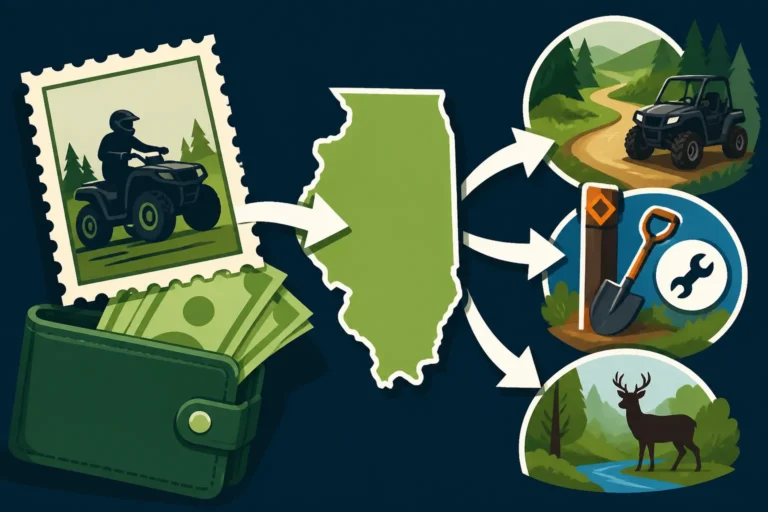
- Illinois OHV Usage Stamp Explained: This stamp is essentially a permit to ride on publicly accessible off-road trails and lands that are not specifically designated as "grant-assisted" sites. If your deer camp is on private land and you never take your quad off that private land, you generally do not need this stamp. However, if you ever venture onto any public trail, state land, or even some local community trails that aren't designated grant sites, you absolutely need it. [Illinois Charges $15 for a Usage Stamp], and it has to be renewed annually. [Illinois Usage Stamps Expire March 31] each year, so if you're hitting the woods in April for scouting, make sure your stamp is current.
- Illinois Public Access Decal Explained: This decal is specifically for riding at grant-assisted OHV sites. These are special parks or trails that have received state funding to develop and maintain their riding areas. Sahara Woods State Fish and Wildlife Area, for example, is a grant-assisted site where this decal would be required. Just like the usage stamp, if your quad lives exclusively on private land at your deer camp and never sees a grant-assisted trail, you likely won't need this decal. However, if you decide to take a break from hunting and hit up Little Egypt Off Road or Mill Creek Park, you'll need this specific decal. [Illinois Decal Prices by Residency] vary, with residents paying less than non-residents. The key takeaway here is: if you're strictly on private land with permission, you can probably skip both the stamp and the decal. If you ever leave that private property to ride publicly, you'll need one or both, depending on where you're going.
Carrying Your Documents
Regardless of whether you only have a title or if you also carry a stamp and decal, having proof of ownership and compliance with you is crucial. Imagine a scenario where a conservation officer, game warden, or even local law enforcement approaches you while you're dragging a deer out of the woods. They have the authority to ask to see your paperwork, especially if you're on a trail or road that's visible to the public, or if there's any question about your legal right to be there. [What a Conservation Officer Can Ask to See] includes your title or registration proof, and any applicable stamps or decals.
It's a really good idea to keep your actual paper title in a safe place at home, like a fireproof box, and carry a clear, legible photocopy with you on the machine. Some riders laminate their photocopies to protect them from the elements. For usage stamps and decals, make sure they are properly affixed to your machine as specified by the Illinois DNR – usually on the forward half for stamps and front and center for decals. Having your papers in order avoids delays and potential penalties, which can include fines for [Illinois Penalties for No Stamp] or [Illinois Penalties for No Decal].
Operating Your Quad Responsibly at Deer Camp
Beyond the paperwork, the actual act of riding your quad at a deer camp comes with its own set of responsibilities. This isn't just about following the letter of the law; it's also about being a good neighbor, respecting the land, and ensuring everyone's safety – yours, your hunting buddies', and any non-hunting landowners nearby.
Navigating Private Land with Permission
The golden rule for riding on private land is permission, permission, permission. Simply knowing the landowner isn't always enough; you need explicit consent for operating an OHV. This is particularly important for areas that might be adjacent to public roads, other private properties, or even areas where other hunters might be. [Illinois Landowner Permission Rules] are designed to prevent trespass, which can lead to significant fines and even impoundment of your machine.
If you are using land owned by someone else, even a family member, consider having a written agreement. This doesn't have to be a complicated legal document, but something in writing can prevent misunderstandings. LawDepot offers various legal document templates, which could include simple agreements for land use or even a basic letter of permission. This written proof can be invaluable if questions arise from neighbors or authorities. Remember, your hunting license is proof you can hunt, but [Your Hunting License Is Not a Riding Permit] for your off-road machine.
Hauling Game and Supplies
This is where your quad really shines at deer camp! Hauling stands, bait, corn, and especially a harvested deer becomes infinitely easier with an ATV or UTV. However, even during these practical uses, you need to be mindful of state regulations and landowner expectations. While [Using a Quad to Drag a Deer Out] is generally accepted on private land, ensure you're not causing excessive damage to the property. Deep ruts, especially in wet conditions, can upset a landowner or make future access difficult.
When crossing ditches, small streams, or sensitive areas, try to minimize your impact. Consider the weight you're carrying and the terrain. Overloading your machine isn't just a safety hazard; it can also lead to more significant environmental damage. Always make sure your load is secure, especially if you're traversing uneven ground. A deer falling off the back of your quad can damage the animal, your machine, or even cause an accident.
Safety and Local Nuisance Laws
Even on private land, safety should always be your top priority. Helmets are always a good idea, regardless of state law, especially in rough terrain or when operating unfamiliar machines. Adhering to manufacturer age guidelines for operators is also important. If you have younger riders at camp, ensure they are supervised and on machines appropriate for their size and skill level.
Beyond safety, consider how your machine's operation might affect others. Noise can be a significant issue, particularly if your deer camp is near other residences. While rural areas are generally more tolerant of engine noise than suburban ones, continuous loud riding can still be considered a nuisance. Be mindful of quiet hours, especially early mornings or late evenings when others might be sleeping or trying to enjoy the peace of nature. Your goal is to enjoy your hunting season without creating problems that could jeopardize future access to the land.
Avoiding Common Pitfalls and Penalties
Operating an ATV or UTV at a deer camp in Illinois shouldn't be a bureaucratic nightmare, but it's easy to overlook crucial details that can lead to unexpected headaches. Being aware of the most common mistakes can save you a lot of time, money, and frustration.
When Exemptions Don't Apply
One of the biggest misconceptions revolves around "farm use" or "private property" exemptions. While it's true that machines used exclusively for agricultural purposes or solely on your own land might have some different requirements, these exemptions are often narrower than people realize. For instance, [Illinois Machines Used Only on a Farm] might have specific rules for street crossings, but using your quad for hunting, even on farmland, isn't always considered "farm use" in the legal sense.
Similarly, if you ride your machine from your deer camp to a nearby gas station for fuel, or to a local store for supplies, you've now left the realm of "private land only" and entered public road territory. This immediately triggers requirements for street-legal equipment (if allowed by local ordinance), a driver's license, and insurance. The moment those tires touch a public surface, even briefly, the rules change drastically. It's a common trap many hunters fall into, thinking a quick hop down the road won't matter. But it does.
The Consequences of Skipping the Paperwork
Neglecting the required titling, usage stamps, or decals can lead to very real penalties. While a conservation officer might give you a warning for a minor infraction, they are fully authorized to issue tickets. These aren't just slaps on the wrist; fines can quickly add up, and in some cases, your machine could even be impounded. Imagine having your quad towed while you're deep in the woods, far from home!
The table below summarizes some key documents and their necessity based on where you ride. This isn't exhaustive, but it highlights the importance of matching your documentation to your intended use.
| Document Type | Riding Exclusively on Private Land (with permission) | Riding on Publicly Accessible Trails (not grant-assisted) | Riding at Grant-Assisted OHV Parks (e.g., Sahara Woods) | Crossing Public Roads (where permitted by local ordinance) |
|---|---|---|---|---|
| Illinois OHV Title | REQUIRED | REQUIRED | REQUIRED | REQUIRED |
| Illinois OHV Usage Stamp | NOT REQUIRED | REQUIRED | NOT REQUIRED (Decal instead) | NOT REQUIRED (if street-legal & insured) |
| Illinois Public Access Decal | NOT REQUIRED | NOT REQUIRED | REQUIRED | NOT REQUIRED (if street-legal & insured) |
| Landowner Permission (Written) | STRONGLY RECOMMENDED | N/A | N/A | N/A |
| Proof of Insurance | RECOMMENDED (for liability) | RECOMMENDED (for liability) | RECOMMENDED (for liability) | REQUIRED (for street use) |
Keeping a machine at your deer camp downstate is a fantastic way to enhance your hunting experience. Just remember that responsibility comes with that convenience. By ensuring your machine is properly titled, understanding when stamps and decals are needed, getting explicit permission from landowners, and prioritizing safety, you can enjoy many seasons of hassle-free hunting and riding. Don't let a simple paperwork oversight turn a great trip into a costly headache.
Disclaimer
This article is for general informational purposes only and does not constitute professional advice. Laws, prices and regulations vary by location and change over time. Consult a qualified professional for guidance on your specific situation.