Sound Testing Before an Illinois Park Lets You In
A loud ATV or UTV can turn a planned riding day into a long trip home if the park refuses entry. Sound checks are not necessarily handled the same way at every Illinois riding area, so it helps to know what staff may inspect, how to prepare your machine, and what to ask before you haul it there.
Why an Illinois riding park may test a machine’s sound
Sound testing is usually an access and site-management issue, not a single rule that works identically at every park. A riding area may set its own noise policy, use a sound meter, inspect exhaust components, or rely on staff judgment. Other places may not conduct a formal check at the gate. The operator’s current rules are the best guide to what will happen at a specific site.
This distinction matters because “Illinois park” can mean several different things: a grant-assisted riding site, a public park with a designated OHV area, or privately operated land. Those places can have different operators, permit systems, and entry conditions. A statewide usage stamp or access decal does not automatically override a park’s separate operating rules. For context on site access, see Illinois Grant Site Rules for Riders and Illinois Public Access Decal Rules.
A park may be concerned about noise for more than one reason. Excessive sound can disturb nearby residents, other visitors, wildlife, or people camping on the property. It can also create complaints that threaten the park’s ability to keep operating. At a private park, noise may be one of the conditions in the waiver or posted rules. At a grant-assisted site, the operator may also be managing public access and the expectations attached to the site.
A sound check can be part of a broader inspection. Staff might look for an altered or damaged exhaust, a missing muffler component, a spark arrestor, or signs that the machine has been substantially modified. A machine that seems loud to one person may pass a properly applied measurement, while a machine that sounds ordinary at idle could be much louder under load. That is why a staff member’s first impression is not always the whole test.
Do not assume a sound check means the park applies a specific decibel limit statewide. Rules, measurement methods, and consequences can differ by location and can change. Ask the site what standard it uses, where it tests, and what happens if a machine does not pass. The broader topic is covered in Illinois Sound Limits at a Park.
Sound policy is not the same as a street-legal equipment rule
Street-use requirements and riding-park policies answer different questions. A machine might meet the equipment rules for a particular kind of road use and still fail a park’s noise policy. Conversely, a park’s decision to admit a machine does not make it legal to ride that machine on public streets.
The practical point is to check the rule that applies to the place you plan to ride. A park may focus on its own noise limit, whereas a municipality or other authority may regulate noise in a different setting. Do not treat a plate, permit, decal, or street-use modification as proof that a machine meets every riding-area requirement.
What a sound check may involve
There is no single process to expect at every Illinois riding area. The park may publish its test method, explain it when you book, or describe it at check-in. If the website or registration materials do not make the procedure clear, contact the operator before leaving home.
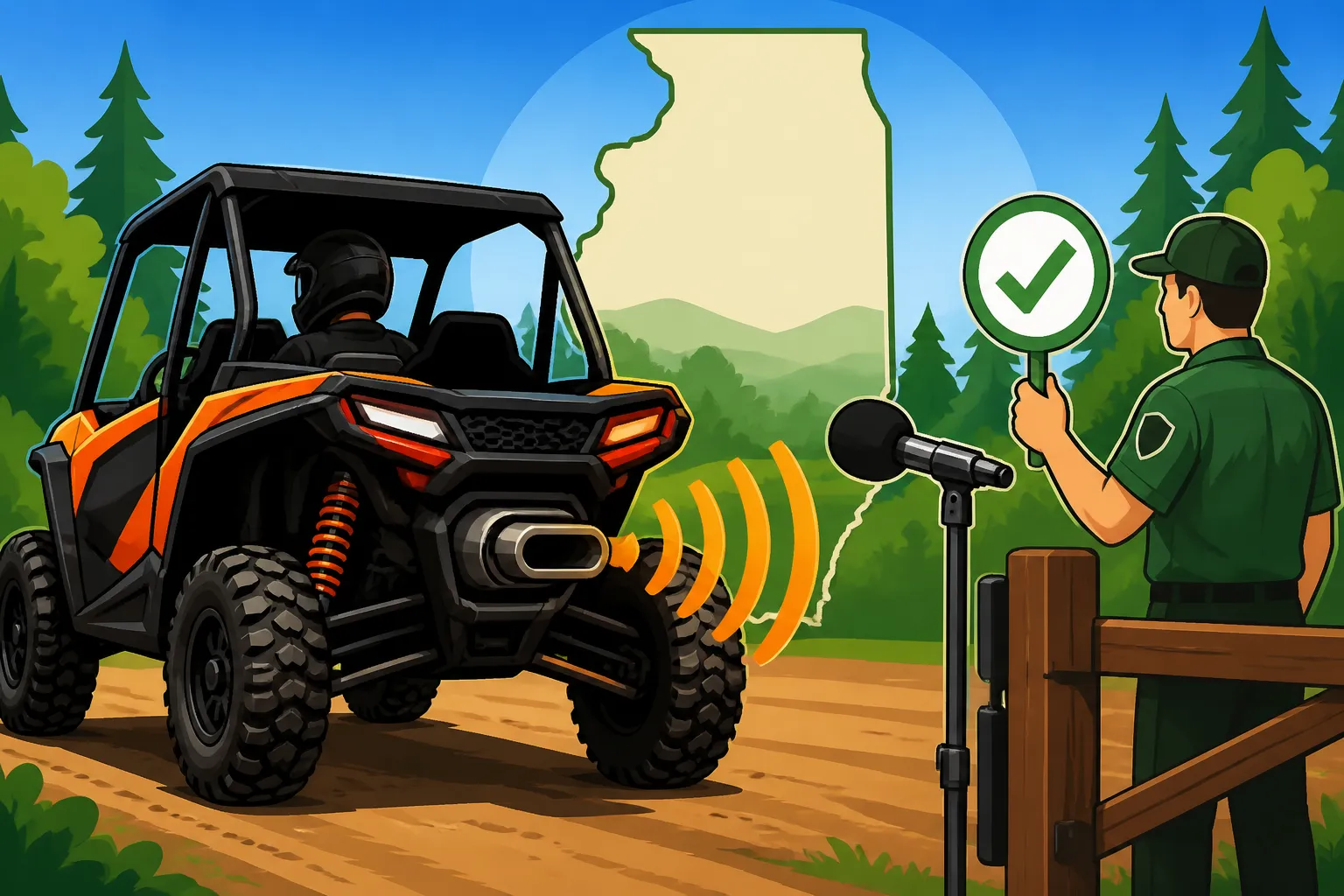
A formal sound test may use a sound-level meter. A staff member may position the meter at a specified distance and angle from the exhaust, ask the rider to hold a particular engine speed, then record a reading. The result can depend on how the test is performed, including the machine’s position, engine temperature, measurement distance, background noise, and throttle setting. Those details are why it is useful to ask about the park’s actual procedure instead of relying on a reading taken informally at home.
Other inspections may be less technical. Staff could listen while the engine idles or revs, look at the exhaust system, or check whether a required component is present. Some parks may use a sound meter only when a machine draws attention or when there is a complaint. That does not mean a published sound rule is optional; it means the enforcement method may vary.
| What staff may check | Why it matters | What to ask before you go |
|---|---|---|
| Sound-level reading | A park may use a meter and a set testing procedure | What method and limit apply at this site? |
| Muffler and exhaust condition | Damage or missing parts can increase noise | Are particular exhaust components required? |
| Spark arrestor | This is a separate equipment check from sound level | Does the site require one, and how is it checked? |
| Modified engine or exhaust | Changes may affect both noise and compliance | Are aftermarket parts allowed if the machine meets the sound rule? |
| Operating noise on the trail | A quiet idle does not necessarily represent sound under load | Can staff test a machine again after a complaint? |
Sound and spark-arrestor checks are related only in the sense that both may involve exhaust equipment. A spark arrestor is not a substitute for a muffler, and passing a sound check does not necessarily prove that a required spark arrestor is installed. Check Spark Arrestor Checks at a Grant Site Gate for that separate issue.
If the park’s staff tests your machine, listen to the instructions and avoid revving it on your own before the test. The operator may ask for a specific engine speed or position. Guessing at the procedure can produce a misleading result, make the machine seem louder than necessary, or create friction at check-in.
How to prepare before hauling your ATV or UTV
The most reliable preparation is to check the site’s current rules and inspect the machine before the trip. Do this well before departure, especially if you are traveling a long distance or have made recent changes to the exhaust.
- Confirm which riding area you are visiting. Find the park’s own contact information and current visitor rules. Do not rely solely on a general Illinois permit page or an old social media post.
- Ask whether sound testing is performed. Confirm whether every machine is checked, only selected machines, or whether checks are complaint-based.
- Ask how the test is conducted. Find out whether the operator uses a meter, what limit applies, where the test takes place, and whether the rider must operate the machine in a particular way.
- Ask what happens if the machine does not pass. The consequence might be denied entry, an opportunity to correct a problem, or another site-specific response. Do not assume a refund, retest, or repair option is available.
- Inspect the exhaust system. Look for loose connections, damage, missing hardware, or an obviously worn or compromised muffler. If you are unsure, have a qualified repair shop inspect it before the riding day.
- Bring the machine in its normal riding configuration. If you have installed an aftermarket exhaust or made engine modifications, ask the park about those parts in advance. Do not assume that a product advertised as quiet or trail-ready will satisfy a particular site’s policy.
- Keep other entry requirements in view. Sound is only one possible reason for a machine to be turned away. Review the site’s rules for permits, waivers, age limits, machine specifications, and safety equipment. Machines Checked Against Factory Specifications at the Gate explains why an apparently minor modification can matter at some entrances.
A machine that has been quiet on a short neighborhood test ride is not guaranteed to pass a park inspection. Engine load, terrain, and operating conditions differ. Similarly, a sound meter reading from a phone app may help flag an obvious problem, but it should not be treated as an official test unless the park says it uses that method.
A replacement muffler or other exhaust work can involve fit, heat, emissions, and safety considerations in addition to noise. Do not remove internal parts or make a last-minute change simply to meet a sound target. If you are considering a modification, check the machine manufacturer’s guidance and the park’s policy first. A park may restrict modifications even where a machine seems acceptably quiet; see Why a Modified Machine Gets Turned Away.
Prepare for the whole check-in, not just sound. Confirm your permit and access requirements, bring any required confirmation, and make sure the machine is in the condition described in the park rules. Illinois Trail Conditions Before You Tow can help with broader trip preparation, while Asking a Site Manager What Applies is useful when published information leaves a practical question unanswered.
What to do if staff says your machine is too loud
If staff raises a concern, stay calm and ask for a clear explanation of the issue. Find out whether the decision is based on a meter reading, a visible equipment problem, a posted policy, or the sound of the machine during operation. These are different grounds, and knowing which one applies may help you understand whether there is anything you can safely correct.
If a meter was used, you can politely ask how the test was conducted and whether the park allows a second test. Do not argue that a result must be wrong solely because your machine passed a test elsewhere. Different equipment, procedures, and site rules may produce different outcomes. If you believe the test was not conducted as described in the park’s policy, ask to speak with the manager rather than continuing the dispute at the gate.
Do not attempt a roadside repair that creates a new safety problem. Reinstalling or tightening a loose component may be reasonable if the park allows you to do so and you can work safely. Removing a baffle, altering the exhaust, or revving the engine repeatedly to challenge the result is unlikely to help and may worsen the problem.
If the park denies entry, ask what options exist before unloading or leaving the property. The operator can explain whether a repair, retest, or refund is available. Keep in mind that those options are site-specific; do not plan a trip on the assumption that the park will offer them. If the machine cannot be brought into compliance that day, the safest choice may be to leave it off the trails and arrange a repair before another visit.
A denial at a riding park is not necessarily the same as a citation for a statewide offense. It may simply be an access decision under the operator’s rules. But ignoring a staff direction, riding after being told to stop, or violating a posted site rule can create additional problems. For other access and enforcement questions, see Illinois Penalties for No Permit and Illinois Private Park Waivers and Rules.
The best way to avoid an unpleasant surprise is to verify the sound policy directly with the place you intend to ride, then make sure the machine’s exhaust is intact and appropriate for that site. A quick call can clarify the test method, the equipment requirements, and the consequence of a failed check before a trailer, fuel, and a full day depend on the answer.
Disclaimer
This article is for general informational purposes only and does not constitute professional advice. Laws, prices and regulations vary by location and change over time. Consult a qualified professional for guidance on your specific situation.