Illinois Charges $15 for a Usage Stamp
It can feel like there's a new fee or requirement around every bend when you're trying to enjoy your off-road machine in Illinois. One common source of confusion and cost for ATV and UTV owners in the Prairie State is the OHV Usage Stamp. This guide is here to untangle the purpose, cost, and requirements of this crucial sticker, helping you understand exactly why Illinois charges $15 for a usage stamp and how to stay compliant.
Understanding the Illinois OHV Usage Stamp
Navigating the world of off-highway vehicle (OHV) regulations can sometimes feel like trying to find your way through a dense Illinois cornfield after dark. Many riders are simply trying to enjoy their machines, only to be met with a labyrinth of rules, fees, and acronyms. Among the most common questions is, "What exactly is this 'usage stamp,' and why do I need it?" It's a valid frustration, especially when you just want to hit the trails or ride your property.
What the Usage Stamp Is and Why It's Required
The Illinois Off-Highway Vehicle Usage Stamp is a sticker that essentially grants your ATV, UTV, or dirt bike permission to use designated public OHV riding areas throughout the state, as well as some private, grant-assisted sites. Think of it as a small toll you pay to help maintain and develop the very places you love to ride. The state created this requirement to ensure that those who benefit directly from these riding opportunities contribute to their upkeep. It’s a way for Illinois to fund the programs that support the trails and facilities many of us rely on for our off-road adventures.
Without this stamp, you're technically riding illegally on any land that requires it. It’s not just a suggestion; it’s a mandate rooted in Illinois law. The funds collected from these stamps are typically channeled back into the Illinois Department of Natural Resources (IDNR) OHV Grant Program, which then provides grants to both public and private entities to acquire, develop, operate, and maintain OHV riding areas. So, while it might feel like "just another sticker," it's actually contributing directly to the future of off-roading in Illinois. For a broader overview of the various requirements, you might find [Illinois OHV Usage Stamp Explained] helpful.
The $15 Fee: Breaking Down the Cost
Yes, Illinois charges $15 for a usage stamp. This isn't just a number pulled out of thin air; it's a specific fee established by state statute. This amount has been set to balance affordability for riders with the necessary funding for the OHV program. The $15 directly supports the infrastructure and management of riding areas. When you purchase this stamp, you're not just buying a sticker; you're investing in the trails, the signage, the parking areas, and the general operations that make these sites enjoyable and safe for everyone.
It's also important to remember that while the base fee is $15, you might encounter an additional charge when purchasing your stamp. Many vendors, particularly those operating the electronic system, are allowed to add a small issuance fee on top of the base cost. This issuance fee typically covers the administrative costs associated with processing the transaction. So, while the stamp itself is $15, don't be surprised if your total comes out to slightly more, perhaps $15.50 or so. This additional charge is usually minimal and goes to the vendor. For more details on this, you can check out [Illinois Adds a 50 Cent Issuance Fee].
Machines That Need the Usage Stamp
Understanding which machines require the usage stamp is crucial, as the definition of an "off-highway vehicle" can sometimes feel a little vague. Generally, if you're operating an all-terrain vehicle (ATV), a utility terrain vehicle (UTV), or a dirt bike on public or grant-assisted riding lands in Illinois, you're going to need this stamp. This includes your standard four-wheelers, side-by-sides, and two-wheeled dirt bikes designed for off-road use. The key is that the machine is designed for off-road purposes and will be ridden on designated trails that are open to the public or receive state grant funding.
However, not every machine used off-road needs one. For instance, if you have a golf cart you only use on your private property or within a private community, it typically wouldn't fall under this requirement. Similarly, specialty vehicles like snowmobiles have their own distinct registration and titling systems and are not covered by the OHV usage stamp. The focus here is squarely on recreational ATVs, UTVs, and dirt bikes that utilize shared riding spaces. When in doubt, it's always best to assume you need the stamp or consult the IDNR guidelines to avoid any potential issues. Knowing the specific types of machines and their requirements can save you a lot of headache down the line.
When and How to Get Your Usage Stamp
Getting your Illinois OHV Usage Stamp isn't a one-time deal; it's an annual commitment that aligns with a specific riding season. Missing the deadline or not knowing where to buy one can quickly turn a fun day on the trails into a stressful encounter with law enforcement. Let's break down the timing and process so you can keep your machine legal and your adventures worry-free.
The Annual Renewal Cycle
The Illinois OHV Usage Stamp operates on a very specific annual cycle that doesn't necessarily align with the calendar year. Instead, the usage stamp is valid from April 1st through March 31st of the following year. This means that no matter when you purchase your stamp within that window, it will expire on March 31st. So, if you buy a stamp in October, it's still only good until the following March 31st, not for a full year from your purchase date. This unique cycle is something many riders overlook, leading to expired stamps and potential fines.
It's wise to make a note in your calendar to renew your stamp around March each year to ensure continuous coverage. Waiting until you're already at the trailhead on a sunny April day is a recipe for disappointment, as you'll likely be turned away or ticketed. Proactive renewal means you're always ready for your next ride. Missing this annual renewal date means your previously purchased stamp is no longer valid, and you'll need a new one for the upcoming riding season. More information on this specific deadline can be found under [Illinois Usage Stamps Expire March 31].
Where to Purchase the Usage Stamp
Thankfully, Illinois has made purchasing the OHV Usage Stamp relatively convenient, with several options available to riders. The most common and often easiest way for many is through the Illinois Department of Natural Resources' (IDNR) online portal, ExploreMoreIL. This platform allows you to purchase your stamp from the comfort of your home, print a temporary permit to carry with you, and then receive the physical sticker in the mail. This online method is usually the quickest way to get legal, especially if you're a last-minute planner.
Additionally, the usage stamps are often available through a network of DNR Direct Vendors. These are typically local businesses like sporting goods stores, bait shops, and some convenience stores that are authorized by the IDNR to sell various permits and licenses, including the OHV Usage Stamp. These brick-and-mortar locations can be a lifesaver if you prefer an in-person transaction or need a stamp immediately and can't wait for shipping. Before making a special trip, it's always a good idea to call ahead to ensure they have stamps in stock. To locate a vendor near you, checking [Finding a DNR Direct Vendor That Sells Stamps] could be beneficial.
Applying for Your Stamp: Step-by-Step
The application process for the Illinois OHV Usage Stamp is designed to be straightforward, especially when done online. If you're using the ExploreMoreIL system, you'll typically start by creating an account or logging in. From there, you'll navigate to the OHV section and select the option to purchase a usage stamp. You'll need to provide some basic information about yourself and your off-highway vehicle, such as your name, address, and potentially the make and model of your machine, though a VIN isn't usually required for the stamp itself (that's more for titling).
Once your information is entered and verified, you'll proceed to payment. As mentioned, expect the $15 fee plus any small transaction fee. After successful payment, you'll usually be given the option to print a temporary confirmation or receipt. This temporary document serves as proof of purchase and can be carried with you while you wait for the physical sticker to arrive in the mail. This way, you don't have to put your riding plans on hold. Make sure to keep this proof accessible on your person or in your machine when riding until the official stamp is affixed. When dealing with official documents like proof of ownership or permission slips, services like LawDepot can be incredibly helpful for creating legally sound forms to keep everything organized.
Exemptions and Special Circumstances for the Usage Stamp
While the $15 usage stamp is a common requirement for many Illinois OHV riders, it's not universally applicable to every machine or every situation. Understanding the exemptions and special circumstances can save you money, time, and potential legal trouble. It’s not about finding loopholes, but rather understanding where the law genuinely intends for the stamp to apply, and where it doesn't.
Machines Exempt from the Stamp
There are several notable exemptions to the Illinois OHV Usage Stamp requirement. One of the most significant is for machines ridden exclusively on private property. If your ATV or UTV never leaves your own land – whether it's your backyard, farm, or private hunting grounds – then you generally do not need an OHV Usage Stamp. This is a common exemption for those who use their machines primarily for chores, farm work, or just recreational riding within the confines of their own property. This exemption is quite clear and is a relief for many landowners. For more specific details, you might want to read [Machines Ridden Only on Your Own Yard Skip the Stamp].
Another key exemption involves machines that display a valid Illinois Public Access Decal. The access decal is a different sticker, usually required for riding at IDNR grant-assisted sites. If your machine proudly displays this decal, you are generally exempt from needing the separate usage stamp for those specific sites. This is because the decal itself signifies that you've paid a different fee to support those facilities, and the state doesn't require you to double-pay for the same access.
The Access Decal vs. The Usage Stamp
This is where things often get confusing for Illinois riders. Many people wonder, "Don't I need both?" or "What's the difference between the usage stamp and the access decal?" They are indeed distinct, though sometimes related. The Illinois OHV Usage Stamp, as we've discussed, is a general permit that helps fund the statewide OHV grant program and is broadly required for riding on public lands. It costs $15 and has the April-March cycle.
The Illinois Public Access Decal, on the other hand, is specifically for use at IDNR grant-assisted riding sites. These are typically public parks or privately-owned, publicly-accessible areas that have received state funding for their OHV trails. The cost of an access decal varies based on residency, with residents paying $11 and non-residents paying $17. The crucial point is this: if you have a valid Public Access Decal on your machine, you do not also need the $15 usage stamp for riding at a grant-assisted site. The decal essentially covers the usage stamp requirement in those specific locations. However, if you plan to ride on other public lands that are not IDNR grant-assisted sites, you would still need the $15 usage stamp. It's a bit of a nuanced distinction, but understanding it can prevent you from buying two stickers when only one is needed for your intended riding location. For a full breakdown of the differences, see [Illinois Stamps and Decals Compared]. To understand the access decal more deeply, check out [Illinois Public Access Decal Explained].
Out-of-State Riders and the Illinois Usage Stamp
Visitors from neighboring states often arrive in Illinois eager to explore its trails, but they, too, must adhere to local regulations. If you're an out-of-state rider bringing your ATV, UTV, or dirt bike into Illinois, you will generally be required to purchase the Illinois OHV Usage Stamp if you plan to ride on any public land or grant-assisted riding areas. Your home state's registration or usage sticker typically doesn't transfer or exempt you from Illinois's specific requirements. This is a common practice across states, where each jurisdiction requires its own permits for non-resident use of its facilities.
The process for out-of-state riders to obtain the usage stamp is the same as for residents: you can purchase it online through ExploreMoreIL or at an authorized DNR Direct Vendor. This ensures that even visitors contribute to the maintenance of the trails they enjoy. While it might seem like an extra step, it's a necessary one to ensure you're riding legally and contributing to the upkeep of the state's valuable OHV resources. It's always best to plan ahead and secure your stamp before you even load your machine onto the trailer for your Illinois adventure.
Proper Placement and Penalties
You've done the right thing, purchased your Illinois OHV Usage Stamp for $15, and now you're ready to hit the trails. But the job isn't quite done. Proper placement of the stamp on your machine is just as important as having it, and understanding the penalties for non-compliance can help you avoid an unpleasant surprise from a conservation officer. These details often get overlooked, but they're critical for a smooth riding experience.
Where to Mount Your Usage Stamp
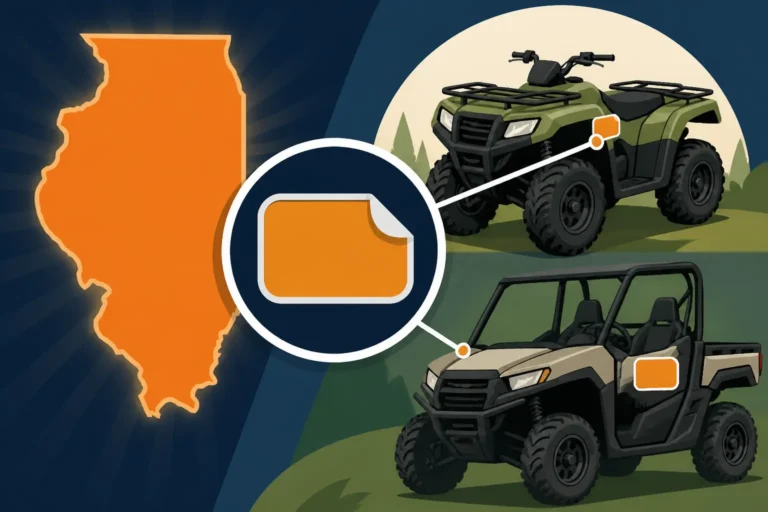
Once you receive your physical OHV Usage Stamp, it’s essential to affix it correctly to your machine. The guidelines are specific to ensure the stamp is visible and easily verifiable by law enforcement or park staff. Generally, the usage stamp should be mounted on the forward half of your ATV or UTV. This means somewhere on the front fender, the handlebars, the frame near the front, or the front body panel. The key is that it must be clearly visible and easily accessible for inspection.
Avoid placing it in areas that are frequently covered by mud, obstructed by accessories, or are difficult to reach. For example, sticking it on an obscure part of the engine or under a seat won't cut it. The goal is for a conservation officer to be able to spot and read the stamp without having to climb all over your machine or ask you to move components. Make sure the surface is clean and dry before applying the sticker to ensure good adhesion, so it doesn't peel off during a ride. You can find more specific guidance on this under [Where the Usage Stamp Goes on Your Machine].
Consequences of Not Having a Valid Stamp
Riding without a valid Illinois OHV Usage Stamp, or with an improperly displayed one, can lead to more than just a stern warning. Conservation officers and other authorized personnel have the authority to issue citations for non-compliance. These penalties can vary, but generally involve a fine. The exact amount can depend on the jurisdiction, the officer's discretion, and whether it's a first offense or a repeat violation. Beyond the financial penalty, being caught without a valid stamp could also lead to being asked to leave the riding area, cutting your day short and potentially spoiling your plans.
It’s important to remember that these regulations are in place for a reason – to fund and manage the very trails you want to enjoy. Ignoring the requirement undermines the system that supports off-road riding in Illinois. Always carry proof of ownership and any required permits with you when you ride, as a conservation officer can and will ask to see them. Understanding what they're looking for can help you prepare. Check [What a Conservation Officer Can Ask to See] to be fully informed. Having clear documentation, like a bill of sale, can also be useful, and services like LawDepot can help you draft a professional one if you're buying or selling a machine.
Lost, Stolen, or Damaged Stamps
Life happens, and sometimes a sticker can get lost, stolen, or so damaged that it's no longer legible. If your Illinois OHV Usage Stamp goes missing or becomes unreadable, you can't simply continue riding and hope for the best. An unreadable or absent stamp is treated the same as not having one at all, and you could still face penalties. In these situations, you will need to apply for a replacement.
The process for obtaining a replacement stamp is generally similar to applying for a new one. You’ll typically need to go through the ExploreMoreIL system or visit a DNR Direct Vendor again. While the state might not charge the full $15 fee again for a duplicate in all cases, there might be a nominal fee for issuing a replacement. It's crucial to address this as soon as possible, as continuing to ride without a valid, visible stamp is a risk. Keeping records of your original purchase can sometimes streamline the replacement process, so always hold onto your receipts or confirmation emails.
The Bigger Picture: Budgeting for Your Off-Road Adventures in Illinois
Owning and operating an ATV or UTV in Illinois involves more than just the initial purchase price of the machine. The $15 usage stamp is a single, relatively small piece of a larger financial puzzle that responsible riders consider. Thinking beyond just the stamp is essential for enjoying your machine for years to come without unexpected financial headaches. A little planning now can save a lot of stress later.
Beyond the Stamp: Other Costs to Consider
The $15 Illinois OHV Usage Stamp, while important, is far from the only cost associated with enjoying your off-road machine in the state. First and foremost, if you purchased your machine from a private seller or an out-of-state dealer, you'll need to title it with the Illinois Secretary of State. This involves a separate fee, typically around $30, and is a mandatory step for establishing legal ownership. Without an Illinois title, selling your machine later becomes incredibly difficult, and proving ownership can be problematic. You can learn more about this process in [Illinois ATV Title Certificates Explained].
Then there's the Illinois Public Access Decal, which, as we discussed, is required for specific grant-assisted riding sites and costs either $11 for residents or $17 for non-residents. If you plan on frequenting these sites, this annual decal will be another recurring expense. Furthermore, dedicated park permits, such as those for Sahara Woods, are often sold separately and can vary in price depending on the duration of your visit. For example, [Illinois Sahara Woods Permit Cost] details specific fees for that popular state park. Beyond permits, consider insurance. While not always legally required for off-road use on private land, comprehensive insurance is a wise investment to protect your machine against theft, damage, or liability, especially if you ever ride on public roads where it may be mandated. Finally, regular maintenance, fuel, and potential gear upgrades all add to the annual cost of ownership.
Planning for a Full Season of Riding
To truly enjoy a full season of off-road adventures in Illinois, budgeting is key. Don't just factor in the initial $15 for your usage stamp; sit down and outline all the potential costs you might incur. Create a checklist: $30 for the title, $15 for the usage stamp, $11-$17 for an access decal (if applicable), potential daily or annual park permits (which could range from $10-$30 per visit), and don't forget fuel expenses for your machine and your tow vehicle. Factor in a portion for routine maintenance like oil changes, air filter cleaning, and tire wear, which can easily add up over a year.
It's also a good idea to set aside a small emergency fund for unexpected repairs or potential upgrades. Many riders find that a well-maintained machine provides more enjoyment and fewer headaches. When planning for group rides or even lending out your machine, having liability waivers or agreements drafted through resources like LawDepot can be invaluable, especially if you're organizing an event or have specific rules for use. By taking a comprehensive approach to budgeting and understanding all the associated fees and requirements, you can ensure that your passion for off-roading remains a source of fun, not financial stress, throughout the entire Illinois riding season.
Disclaimer
This article is for general informational purposes only and does not constitute professional advice. Laws, prices and regulations vary by location and change over time. Consult a qualified professional for guidance on your specific situation.