Illinois Trails Near Quincy
If you live in Quincy, finding a place to ride an ATV or UTV can mean sorting through hiking trails, private property, and riding areas a long way from home. This guide explains the practical Illinois options near Quincy, how to check whether a route is actually open to machines, and what to confirm before loading up and driving.
Where to look for ATV and UTV riding near Quincy
Quincy is in western Illinois, where public places to ride are not as easy to find as a map full of green space might suggest. A county park, forest, conservation area, or dirt road is not automatically open to ATVs and UTVs. In practice, riders near Quincy should start by looking for established private riding areas and designated OHV sites, then verify the rules directly before making plans.
Start with the Pike County area
For riders based in Quincy, the Nebo area in Pike County is one of the more relevant Illinois options to investigate. Heartland Lodge runs a riding area there, making it a potential choice for a day trip or a longer riding weekend. It is worth checking its current access arrangements, machine requirements, schedule, and reservation process before you hitch up the trailer. [Heartland Lodge Runs a Riding Area at Nebo]
A riding destination can be close enough to consider without being an easy, casual stop. Work out the whole trip from your driveway: travel time, fuel, trailer parking, check-in, and whether your group can ride for the amount of time you have planned. If you are bringing children or meeting friends there, also confirm what the site allows for riders, passengers, and different machine types.
Some Pike County riding information describes an extensive trail network. Treat mileage as a description of the riding area, not a guarantee that every route will be open, suitable for your machine, or available on the day you arrive. Recent rain, maintenance, special events, and site policies can all affect what you can ride. For background on that destination, see [Riding 60 Miles of Trail at a Pike County Lodge].
Expand your search only when the drive makes sense
If you are willing to travel farther, look at riding areas elsewhere in Illinois rather than assuming that every trail system is close to Quincy. Southern Illinois has several named riding destinations, including sites that are privately operated or associated with public access programs. Those may work for a planned weekend, but they are a different proposition from a quick ride after work. [Illinois Southern Riding Areas]
One useful way to organize your search is to sort places into three groups:
| Type of riding option | What it usually means for a Quincy rider | What to confirm |
|---|---|---|
| Nearby private riding area | Potentially the most practical choice for a day trip | Hours, reservations, machine rules, fees, and trail status |
| More distant Illinois riding destination | Better suited to a full day or overnight trip | Drive time, camping or lodging, check-in, and current access |
| Public land or a local road | Not open to OHVs by default | Written or posted authorization and applicable local rules |
If a search result shows a park, forest, or public recreation area, do not take that as proof that riding is allowed. Illinois has public land where motorized riding is prohibited or limited to specifically designated areas. Check the site’s official rules and contact its manager if the wording is unclear. [Illinois Trails Closed to Machines]
How to check whether a trail is really open to machines
The biggest planning headache is often not finding a line on a map; it is figuring out what that line represents. A mapped path may be a hiking trail, a farm lane, a service road, a closed route, or a trail that allows only certain vehicles. A route that looks rideable online can still cross land where you do not have permission.
Verify the land and the site rules
Before you plan around a trail, identify who manages the land. A private park sets its own entry rules. A county or state site may have separate regulations and may permit motorized use only in a defined OHV area. If the route crosses multiple parcels, permissions and restrictions may change along the way.
For private property, get the owner’s permission before riding, and be specific about where you may go, when you may ride, and which machines are allowed. Do not rely on an old social-media post or a neighbor’s recollection as current authorization. For public destinations, look for language that explicitly permits OHVs rather than assuming that “recreation area” means motorized access. [Illinois Private Land Permission Rules]
A map app can help with planning, but it cannot give you permission to ride. onX Offroad can be useful for reviewing mapped routes and nearby land information, especially when you are comparing possible approaches to a destination. Still, confirm boundaries and access with the site itself. Map layers can help you ask better questions; they do not replace posted rules or the land manager’s answer.
Distinguish trail access from road use
A machine that is allowed on a private OHV trail is not automatically legal to ride on nearby public roads. Street use has its own requirements, and local ordinances matter. Do not assume you can ride an ATV or UTV from your lodging to a trailhead or use a county road as a connecting route just because the riding area is nearby.
The same caution applies to levees, rail beds, field roads, and river-adjacent paths. They may look like convenient connectors, but the right to use them depends on ownership, authorization, and applicable rules. If you are unsure whether a route is a trail or a road, ask the property manager or local authority rather than finding out after you have unloaded.
For a fuller look at the distinction between street access and off-road riding, read [Illinois ATV Road Rules: Local Ordinances Decide]. When your plan is specifically to ride on designated OHV property, the more relevant question is whether that site allows your machine and whether you have met its entry requirements.
Permits, decals, and paperwork to check before leaving Quincy
A ride can be cut short by a missing permit just as quickly as by a closed gate. Illinois requirements depend on where you are riding and what kind of site you are visiting. Before you travel, identify the exact destination and ask which documents, stamps, decals, or day permits apply.
Know the difference between a stamp and an access decal
Illinois uses different requirements for different kinds of riding access. An OHV usage stamp and a public access decal do not serve the same purpose. The stamp is associated with eligible off-highway vehicle use, while an access decal is connected with access to grant-assisted riding sites. One should not be treated as an automatic substitute for the other. [Illinois Stamps and Decals Compared]
If your destination is a grant-assisted riding site, check its rules for the required decal and how it must be displayed. If you are going to a private park, ask whether it has its own permit, day-pass, waiver, or vehicle-sticker process. A private park’s entry requirements and state requirements can be separate issues, so ask about both. [Illinois Public Access Decal Rules]
Keep the information with your trip paperwork. A useful pre-departure folder, whether digital or printed, can include your reservation confirmation, waiver instructions, proof of ownership if requested, and a note of the site’s contact details. If you are visiting a grant-assisted area, read [What a Grant-Assisted Riding Site Actually Is] and [Illinois OHV Usage Stamp Explained] before assuming that one purchase covers every riding situation.
Confirm details for every machine and rider
Do not assume that one permit or sticker covers a whole group. Ask whether each machine needs its own documentation, whether rented machines are handled differently, and whether passengers or young riders have additional requirements. If you are riding a side-by-side, confirm that the trail system accepts its width and configuration. A machine that is legal to own may still be too large or otherwise unsuitable for a particular trail.
It also helps to keep the basics in order before the trip: machine identification, current registration or title documents where applicable, safety gear, and any information the site asks you to bring. If the machine is borrowed, rented, or recently purchased, ask what proof of authorization or ownership the gate staff expects. Sorting this out at home is much easier than trying to call around from a parking area.
A practical Quincy trip-planning checklist
Planning from Quincy is easier when you treat a ride as a destination trip rather than assuming there will be a public trail waiting nearby. A short call and a careful map check can save you from a long drive to a closed gate, a route that does not allow your machine, or an access rule you did not know about.
Check maps, conditions, and access together
Use a map to understand the general location and route, then confirm access with the operator or land manager. onX Offroad may help you compare mapped options and prepare for areas with limited cell service, but use the site’s own information for hours, closures, and entry rules. Download or save essential directions before leaving if your route may take you through rural areas with unreliable reception.
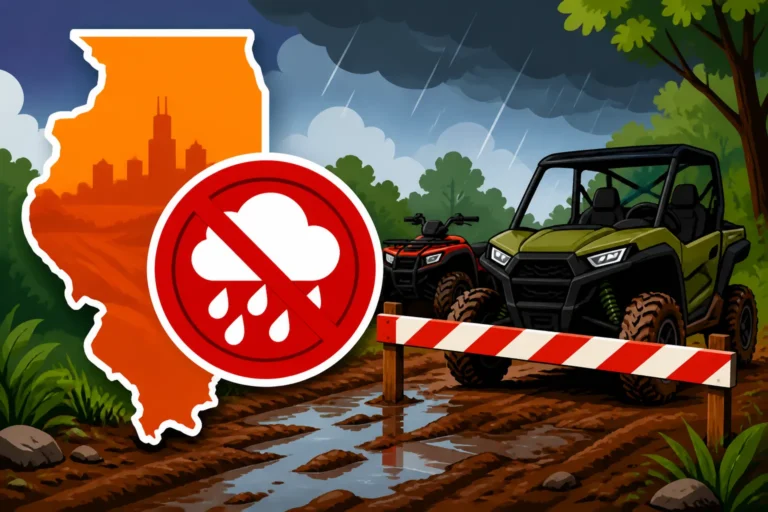
Weather matters, too. Rain can make trails muddy, increase the chance of closures, or turn a manageable route into a difficult one. Ask whether the site posts trail conditions and whether it closes particular sections after heavy rain. Before towing a long distance, review [Illinois Trail Conditions Before You Tow] and contact the destination if conditions are not clear.
A simple sequence can keep the planning manageable:
- Pick a specific riding area rather than searching broadly for “trails near Quincy.”
- Confirm that it allows ATVs or UTVs and that your machine fits its rules.
- Check the operating schedule, reservation requirements, and trail conditions.
- Ask which Illinois stamps, decals, permits, or site-specific documents apply.
- Confirm trailer parking, fuel availability, and any camping or lodging arrangements.
- Save the address, directions, and operator’s contact information before you leave.
Build a realistic day around the drive
For a destination outside Quincy, include enough time for towing, check-in, unloading, and any required orientation. A group that arrives late may have less riding time than expected, especially if the site uses scheduled entry or has limited daily capacity. If you are organizing a mixed-experience group, ask whether the area has easier routes as well as more challenging terrain.
Pack for the actual conditions, not just the forecast at home. Bring water, suitable protective gear, basic recovery supplies, and a way to communicate your plan if riders split into smaller groups. Keep phones charged, but do not rely on cell service as your only navigation or emergency plan. onX Offroad can support route preparation, while a saved map and a clear meetup plan provide useful backups.
Finally, leave room for a plan change. If the first choice is closed, muddy, booked, or unsuitable for your vehicle, do not improvise by riding an unmarked road or entering land without permission. Have a second confirmed destination or reschedule. In western Illinois, that small bit of preparation can be the difference between a frustrating haul and a well-planned riding day.
Disclaimer
This article is for general informational purposes only and does not constitute professional advice. Laws, prices and regulations vary by location and change over time. Consult a qualified professional for guidance on your specific situation.