Illinois ATV Road Rules: Local Ordinances Decide
One of the biggest headaches for ATV and UTV owners in Illinois is figuring out where, exactly, you can legally ride your machine on the road. It feels like a confusing maze, doesn't it? You see people driving side-by-sides down a village street in one town, then hear stories of folks getting ticketed just a few miles away. This guide is here to untangle that knot, explaining how Illinois law works and, crucially, how local cities, counties, and townships make the final call on street access for your off-road machine.
The Illinois Default: Why Street Riding is Generally Off-Limits
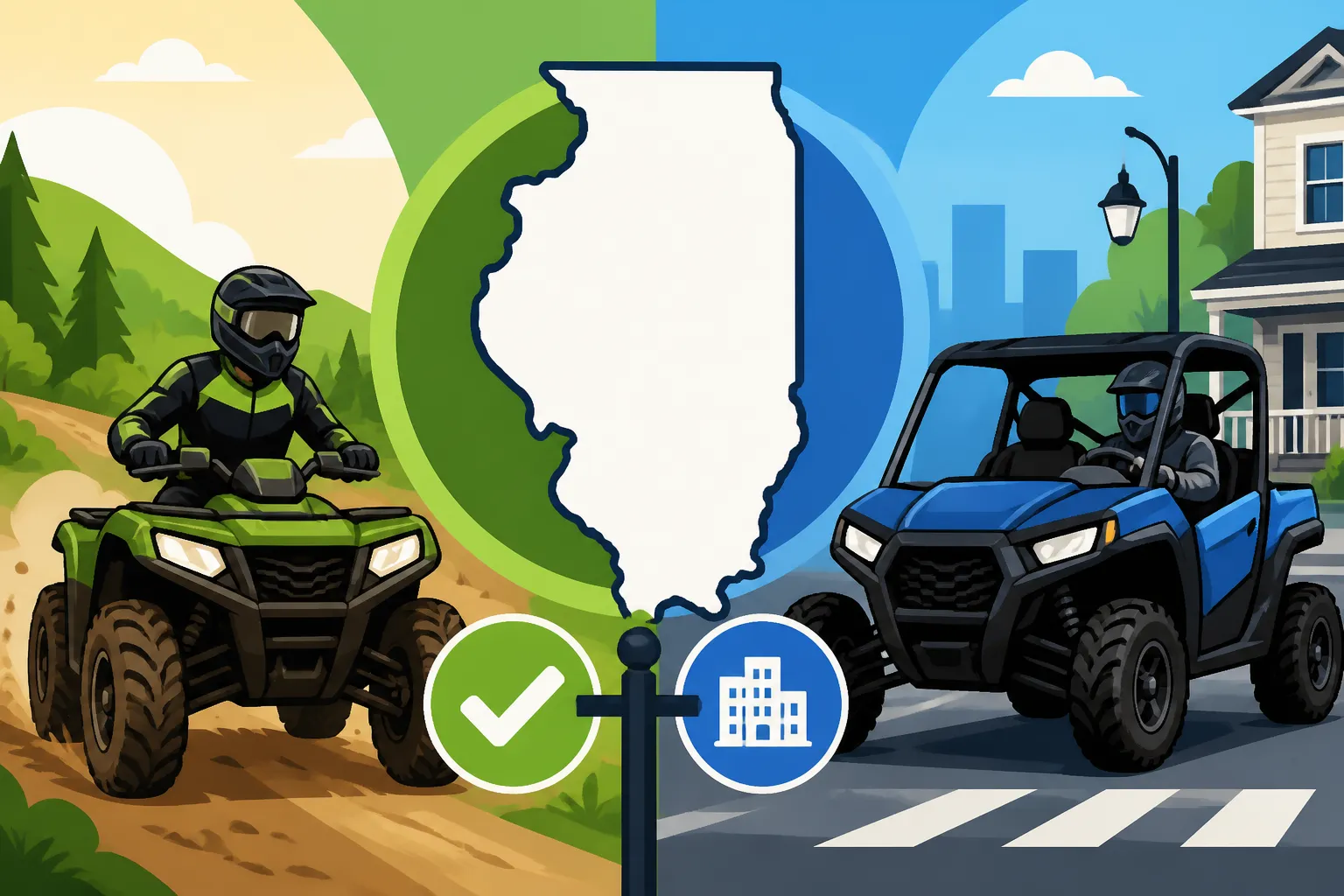
It’s a common misconception that if a road isn't explicitly banned, it must be allowed. But for off-highway vehicles (OHVs) in Illinois, it’s actually the exact opposite. The state law starts with a blanket prohibition against operating ATVs and UTVs on public roads. This isn't meant to be punitive; it's a foundational legal stance designed to regulate traffic flow and safety across the board. So, unless there's a specific, localized exception, your dirt bike or side-by-side should stay off paved or graveled public thoroughfares.
Understanding the Foundation of the Ban
The legal framework in Illinois, [Illinois Law Starts by Banning Street Riding], generally classifies ATVs and UTVs as "non-highway vehicles." This designation means they aren't designed or manufactured to meet the same safety and operational standards as cars, trucks, and motorcycles that are licensed for street use. Think about it: things like turn signals, headlights, rearview mirrors, and even braking systems are often designed differently for off-road environments. The initial ban is a recognition of these differences and an attempt to keep all road users safe. It’s a pragmatic approach, albeit one that can be frustrating for riders eager to connect trails or simply run to the corner store.
This foundational ban creates a clear starting point for all discussions about street legality. It means that the burden of proof, so to speak, is on local governments to permit riding, rather than on the state to prohibit it everywhere. Without a specific local ordinance or resolution in place, any attempt to ride your ATV or UTV on a public road in Illinois is technically a violation of state law, regardless of how safe or modified your machine might be. This is why you can't just assume anything about street access; you absolutely have to do your homework for every area you plan to ride.
For many riders, this blanket ban feels unfair, especially when they've invested in making their machines safer or more visible. They might argue that a UTV with a full complement of lights and a horn is just as safe as a golf cart, which often can be driven on certain streets. However, the state's perspective focuses on the original design intent and the potential for these machines, when driven on public roads, to interact with faster, heavier traffic in ways they weren't engineered for. It's a risk management strategy, even if it feels restrictive to the dedicated enthusiast.
The State's Stance on Non-Highway Vehicles
Illinois defines "non-highway vehicles" quite broadly, encompassing ATVs, UTVs, off-highway motorcycles (dirt bikes), and even golf carts, when they are not specifically licensed for highway use. The law specifies that these machines are generally intended for off-road recreational use, agricultural purposes, or industrial applications. This distinction is crucial because it informs why the state sets different rules for them compared to conventional vehicles. It's not just about engine size or top speed; it's about their fundamental classification within the state's vehicle code.
The designation also comes with implications for titling and registration. While ATVs and UTVs do require an Illinois title, they typically aren't registered with a license plate for street use like cars. This "title only" status reinforces their non-highway vehicle classification. Without a traditional registration, they lack the legal basis for widespread street operation. This means that even if you have a valid title, it doesn't automatically grant you permission to cruise down Main Street. [What "Title Only" Means on a Title Application] explains this further.
Furthermore, this state classification affects how insurance companies view your machine. While you might carry insurance for off-road use, it's a completely different ballgame when it comes to liability on public roads. The state's stance makes it clear that operating these machines on streets is an exception, not the rule, and any required insurance would be specific to that permissive local ordinance. It's a layered approach designed to keep things tidy, even if it often just creates more questions for the average rider.
The Frustration of Unclear Guidelines
Ask any group of Illinois ATV and UTV riders about street legality, and you'll likely get a dozen different answers, all delivered with varying degrees of certainty and frustration. This isn't because riders are misinformed, but because the guidelines are inherently complex and localized. What's perfectly fine in one small village might land you a hefty ticket in the next town over, even if the roads look identical. This patchwork of rules makes spontaneous riding trips a planning nightmare and can deter new riders from even trying to understand the system.
The lack of a single, statewide "street-legal" standard for ATVs and UTVs is the primary source of this confusion. Unlike other states that might have clear rules for all counties or a process to make an OHV street-legal across the board, Illinois delegates this power to individual local governments. This means that riders are forced to research ordinances for every single town, county, or even township they intend to visit or pass through. It’s an enormous amount of legwork just to avoid a penalty, and it’s completely understandable why many riders simply give up trying to navigate it all.
This ambiguity also impacts how enforcement is handled. A sheriff's deputy in one county might be very familiar with local UTV ordinances, while a state trooper covering a wider area might default to the general state ban, not knowing about a tiny village's specific exception. This inconsistency can lead to frustrating encounters for riders who genuinely believe they are following the rules. It highlights the need for clear, accessible information from local authorities, and for riders to carry proof of any permits or ordinances that apply to their route.
Empowering Local Government: How Ordinances Change the Game
So, if the state generally bans street riding, how do you see ATVs and UTVs on public roads anywhere in Illinois? The key lies in the power granted to local units of government. Cities, villages, counties, and even townships have the authority to pass ordinances or resolutions that allow the operation of non-highway vehicles on certain roads within their specific jurisdictions. This legislative power is the mechanism by which exceptions to the statewide ban are created, turning what was once a "no-go" into a "go," provided you meet all local requirements.
Which Units of Government Can Open a Road
The authority to permit OHV street use rests with several different types of local government in Illinois. Villages and cities, typically through their village or city councils, are the most common entities to pass such ordinances. They have direct control over municipal streets and can define specific routes, times, and conditions for UTV operation. This is why you often see signs announcing "UTV Friendly" in smaller towns. [Which Units of Government Can Open a Road] details this structure.
Counties also hold significant power. A county board can pass a resolution that applies to unincorporated county roads. This is especially relevant in rural areas where there might not be many incorporated towns. However, a county resolution does not override municipal ordinances; a city within that county might still prohibit UTVs on its streets, even if the surrounding county roads permit them. Understanding this hierarchy is vital for planning your ride and avoiding a ticket.
Then there are townships. In many parts of Illinois, townships maintain local roads that aren't part of a city or county system. The township road commissioner or board has the authority to make decisions regarding these specific roads. This adds another layer of complexity, as a single ride might traverse village streets, county roads, and township roads, each with its own set of rules. It truly is a patchwork, and riders need to know which governmental body has jurisdiction over the exact stretch of pavement they wish to travel.
The Specific Roads That Qualify for Local Access
Not every road is fair game, even if a local government decides to open up its streets. State law, even with its general ban, provides specific guidelines for what types of roads can be designated for OHV use by local ordinances. The most crucial factor is the speed limit. Roads posted at 35 mph or lower are the primary candidates for UTV and ATV access. This limit is in place for safety, recognizing that off-road machines generally travel at lower speeds than traditional vehicles and would pose a greater hazard on faster roads.
Beyond speed limits, local ordinances often specify certain types of roads. This could include residential streets, connector roads between neighborhoods, or specific routes designed to provide access to trails or local businesses. It's rare for a local ordinance to open all streets; usually, a specific map or list of permitted roads is included in the ordinance itself. Riders need to consult these maps carefully to ensure they stay on approved routes. This is where researching [Illinois UTV Street Legal Rules by Town] becomes invaluable, as each community crafts its own specific network.
Furthermore, local ordinances will typically dictate how intersections are handled. While you might be able to ride on a permitted street, crossing a major state highway might still be prohibited, or only allowed under very specific conditions, such as at a designated intersection. It's not just about the road you're on, but also how you interact with the broader road network. Always look for clarity on intersection crossing rules within any local ordinance you find.
Roads That Remain Strictly Off-Limits
Even with local ordinances in place, certain types of roads in Illinois remain universally off-limits to ATVs and UTVs. This is a crucial point that often catches riders by surprise. Regardless of what a village or county might decide, state law maintains a firm stance on specific high-traffic or high-speed thoroughfares. This means that even if you've got a street-legal UTV and a valid permit for a local area, you still cannot take it just anywhere.
Foremost among these forbidden zones are interstates and tollways. These high-speed, controlled-access highways are simply not designed for the presence of non-highway vehicles, and attempting to operate an ATV or UTV on them is illegal and extremely dangerous. [Illinois Closes Tollways and Interstates to Every Machine] is a non-negotiable rule. This isn't just about local preference; it's a statewide safety mandate that applies to all vehicles not explicitly designed and licensed for these types of roads.
Similarly, state highways often fall into this category of off-limits roads, except for very limited crossing purposes. While a village might allow you on its municipal streets, you typically cannot ride for any significant distance on a state highway, even if it passes through that village. Crossings might be permitted at intersections, but continuous travel is usually prohibited. This is another reason why route planning is critical – you need to know not just which local roads are open, but also which major arteries remain closed to OHV traffic.
Navigating the Local Decision-Making Process
Understanding that local governments hold the power is one thing; understanding how they exercise that power is another. The process by which an ordinance or resolution is passed can vary significantly depending on whether you're dealing with a tiny village, a sprawling county, or a rural township. Knowing this process can help riders advocate for access, understand the rationale behind decisions, and even predict potential changes in local rules. It's not just about finding the rule; it's about understanding its origin.
Village Boards and Their Path to Permission
For incorporated villages and cities, the decision to allow ATVs and UTVs on public streets typically rests with the elected village or city council. These bodies hold regular public meetings where ordinances are introduced, discussed, and voted upon. A common path starts with a group of local residents or an ATV club petitioning the board, presenting a case for why UTVs should be allowed. This often involves highlighting economic benefits for local businesses, recreational opportunities, or simply the convenience for residents.
Once an ordinance is proposed, it usually goes through several readings and opportunities for public comment. This is a critical time for riders to show up, voice their support, and address any concerns raised by other residents, such as noise, safety, or property values. [How a Village Board Votes to Allow UTVs] outlines this procedure. The board will consider these various inputs, potentially ask for input from local law enforcement or public works departments, and then ultimately vote on whether to adopt the ordinance, often with specific conditions or restrictions tailored to that community.
If an ordinance is passed, it will typically include details about permitted roads, operating hours, required equipment, and any local permit fees. Many villages opt for a permit system, which helps them track who is riding and provides a revenue source to maintain roads or cover administrative costs. Riders in these towns then need to follow the specific application process, which might include an inspection of their machine and payment of an annual fee, like the one described in [Byron's UTV Permit Fees in Illinois].
County Boards and Broader Resolutions
County boards operate on a larger scale than village councils, overseeing unincorporated areas within the county. When a county board decides to allow OHVs on its roads, it typically does so through a resolution. This process is similar to a village ordinance but covers a much wider geographic area, encompassing roads that are not under municipal jurisdiction. Such resolutions are often sought by agricultural communities or those with significant rural populations where OHVs are used for both recreation and farm work.
The county board's deliberations will also involve public hearings and input from various departments, including the sheriff's office and highway department. They'll weigh the economic impact, safety concerns on county roads, and the practicalities of enforcement across a large area. A county resolution, if passed, typically applies to designated county highways and township roads within the unincorporated areas, but never within incorporated municipalities unless those municipalities also pass their own specific ordinances. [When a County Board Passes a UTV Resolution] explains this process.
It's important to remember that even if your county has a UTV resolution, you still need to verify the rules for any incorporated towns you might wish to ride through. A county resolution provides access to the "spaces between" the towns, but not necessarily through them. This means a rider could legally be on a county road, pull into an adjacent town, and immediately be in violation if that town hasn't passed its own ordinance. It's a key distinction that frequently trips up riders trying to navigate the Illinois landscape.
Township Roads and the Road Commissioner's Authority
Township roads represent yet another layer of local governance in Illinois, particularly prevalent in rural settings. These roads are typically maintained by a township road district, and the authority over their use for OHVs often falls to the township road commissioner or the township board of trustees. This can be the most localized and, at times, the most informal decision-making process, though it still must comply with state law. [Illinois Townships and Their Authority] clarifies this role.
For many farmers and rural residents, township roads are the most practical routes for accessing fields, connecting properties, or simply getting around without traveling on busier state or county roads. Therefore, townships might be more amenable to allowing OHV use, especially if there's a strong local need. The process could involve a direct request to the road commissioner, who might then bring it to the township board for a vote. Public input and community sentiment play a significant role here, as these are often tight-knit communities.
However, just like with county roads, a township's decision only applies to its specific roads. If a township road ends at a village limit, or if it's actually a county road maintained by the township under an agreement, the rules can change immediately. This creates scenarios where [Roads Two Governments Share Need Two Ordinances], requiring coordination and approval from both entities. For riders, this means checking in with the township office in addition to village and county offices to get the full picture of local road access.
Essential Gear for Street-Legal Compliance
If your local government has passed an ordinance allowing ATVs or UTVs on certain streets, that's only half the battle. The other crucial half is ensuring your machine is properly equipped to meet the state's and any local ordinance's requirements for street use. This isn't just about being seen; it's about being safe and legally compliant. Ignoring these requirements can not only lead to tickets but also compromise your safety and the safety of others on the road.
Meeting the Illinois Non-Highway Vehicle Equipment List
Illinois has a specific equipment list that non-highway vehicles must adhere to if they are to be operated on public roads where permitted by local ordinance. This list aims to bring these machines closer to the safety standards of conventional vehicles, ensuring they are visible and controllable in a mixed-traffic environment. Familiarizing yourself with [Illinois Non-Highway Vehicle Equipment List] is your first step in preparing your machine.
The requirements typically include items like working headlights, tail lights, and brake lights to ensure visibility during all hours of operation. You'll also need a horn, a muffler, and sometimes additional reflectors. It's not just about having these components; they must be in good working order and meet specified visibility or sound standards. For example, a headlight isn't just a headlight; it must be visible from a certain distance to be compliant.
Many riders, especially those new to street legality, find themselves needing to add or upgrade components on their machines. This might mean installing a full turn signal kit, adding a rearview mirror, or ensuring their brake lights are bright enough. Companies like SuperATV offer a wide range of accessories designed to help UTV and ATV owners meet these street-legal requirements, from wiring kits to full lighting packages that are compliant with state and local regulations. It simplifies the process of getting your rig ready for the road.
Visibility: Lights, Reflectors, and Emblems
Visibility is paramount when operating an OHV on public roads, and Illinois law reflects this with several specific requirements for lighting and reflective gear. Your machine must have a working headlight that projects a white light and is visible for at least 500 feet. This ensures that you can see where you're going and, more importantly, that oncoming traffic can see you, especially during dawn, dusk, or in inclement weather.
At the rear, a red tail lamp visible from at least 100 feet is mandatory. This, combined with working brake lights, alerts drivers behind you to your presence and when you're slowing down or stopping. Many stock ATVs and UTVs have basic lighting, but these might need to be upgraded or supplemented with additional lights to meet the required visibility distances, especially if you plan to ride after dark or in areas with poor street lighting.
In addition to active lighting, passive visibility is also required. Your UTV or ATV will need red reflectors on the rear and a slow-moving vehicle emblem prominently displayed. [The Orange Farm Emblem Your UTV Must Carry] is a distinct, reflective orange triangle with a red border that signifies your machine travels at 25 mph or less, warning faster traffic to approach with caution. Ensuring all these elements are correctly installed and functioning is non-negotiable for street-legal operation. SuperATV is a great resource for compliant lighting upgrades and safety reflective gear, helping riders easily find what they need to adhere to these crucial visibility standards.
Control and Communication: Mirrors, Signals, and Brakes
Beyond simply being seen, your machine must also be equipped for effective control and communication with other road users. A crucial piece of equipment is a rearview mirror. [Illinois Requires a Rearview Mirror] states that your machine must have at least one mirror that allows the operator to see at least 200 feet to the rear. This is vital for changing lanes, making turns, and general situational awareness on public roads, where traffic can approach from behind much faster than on a trail.
Turn signals are another key requirement for communicating your intentions to other drivers. While many stock ATVs and some UTVs might not come with factory-installed turn signals, local ordinances permitting street use will almost certainly require them. You’ll need functional front and rear turn signals that are clearly visible. Installing an aftermarket turn signal kit, such as those offered by SuperATV, is a common upgrade for riders looking to make their UTV street-legal. These kits often come with everything you need for a complete installation, making compliance much easier.
Of course, your braking system must also be in top working order. While this is a given for any safe operation, it bears repeating for street use. Your machine must have functional brakes on all wheels, capable of stopping the vehicle safely and effectively. Any modifications to your ATV or UTV should never compromise the integrity or performance of your braking system. These control and communication features are not just legal checkboxes; they are fundamental to safe interaction with other vehicles on Illinois roads.
Driver Qualifications and Insurance Imperatives
Having a properly equipped machine is only part of the equation for street legality in Illinois. The person operating the ATV or UTV, and the machine's financial backing, also come under scrutiny when it's on public roads. This means meeting specific licensing requirements and carrying adequate insurance coverage. These are non-negotiable aspects that ensure both rider responsibility and financial protection for all parties in the event of an incident.
The Driver's License Requirement
Perhaps one of the most straightforward rules for street-legal ATV or UTV operation in Illinois is the driver's license requirement. Simply put, if you're going to drive your off-road machine on a public street, you need a valid driver's license. [Illinois Requires a Driver's License] clearly states that the operator must possess a valid driver's license appropriate for the class of vehicle being driven, which in this case, generally means a standard Class D license.
This requirement applies regardless of the specific local ordinance that permits street use. It's a foundational safety measure, ensuring that anyone operating a vehicle on public roads has demonstrated a basic level of driving competence and knowledge of traffic laws. It also means that youth riders, even if they are legally allowed to operate an ATV off-road under supervision, cannot drive one on a public street if they do not yet hold a valid driver's license.
For out-of-state riders, the rules typically extend recognition to valid driver's licenses issued by their home state or country. So, if you're visiting Illinois from Indiana, for example, and you want to ride your UTV on a street where it's permitted by a local ordinance, your valid Indiana driver's license should suffice. However, always carry it with you, along with any other required permits or proof of insurance, as conservation officers or local police may ask to see it.
Mandatory Liability Insurance for Street Use
This is where things get really serious: insurance. Operating an ATV or UTV on public roads in Illinois, even where permitted by local ordinance, mandates specific liability insurance coverage. This is a crucial protective measure, ensuring that if you're involved in an accident on a public street, there's financial recourse for damages or injuries to other parties. Without it, you could face severe financial penalties and legal troubles. [Illinois Requires Insurance for Street Use] is an absolute requirement.
The minimum liability coverage required in Illinois for street-legal vehicles is commonly referred to as "25/50/20." This translates to:
- $25,000 for the bodily injury or death of one person in an accident.
- $50,000 for the bodily injury or death of two or more persons in an accident.
- $20,000 for damage to property of another person in an accident.
This coverage is designed to protect other motorists, pedestrians, and property owners in the event of an incident where you are deemed at fault. It's important to note that this basic liability coverage does not cover damage to your own ATV or UTV, nor does it cover your own medical expenses. For that, you'd need to consider additional coverage like collision and comprehensive insurance. Always talk to your insurance provider to ensure your policy specifically covers street use for your OHV and meets Illinois's minimums.
Out-of-State Riders and Reciprocity
If you're an out-of-state rider bringing your ATV or UTV to Illinois, you might wonder if your home state's OHV registration or street-legal status carries over. Unfortunately, when it comes to street use, reciprocity isn't as simple as it is for traditional vehicles. While your out-of-state driver's license is generally recognized, the legality of operating your OHV on Illinois public roads hinges entirely on Illinois law and local ordinances. [Illinois Rules for a Visiting Indiana Rider] illustrates these nuances.
This means that even if your UTV is fully street-legal in your home state, say Wisconsin or Missouri, it does not automatically mean it's street-legal on Illinois roads. You still must abide by Illinois's foundational ban and rely on specific local ordinances for permission. This includes meeting Illinois's equipment requirements and carrying the minimum liability insurance specified by Illinois law, not just your home state's requirements.
Therefore, before crossing state lines with the intention of street riding in Illinois, you absolutely must research the specific local ordinances of the towns or counties you plan to visit. Assume nothing. While your valid out-of-state driver's license will be accepted, your machine's street legality and insurance requirements must align with Illinois standards and the specific permissions granted by the local jurisdiction. Failure to do so could result in fines, impoundment, or more severe penalties.
Permitting Systems and Their Associated Costs
Once a local government passes an ordinance allowing OHVs on its roads, it almost always establishes a permitting system. This system serves multiple purposes: it helps the local government track which machines are operating on its streets, ensures compliance with local rules, and often generates revenue to cover administrative costs or contribute to road maintenance. Understanding how these permits work and what they cost is crucial for legal street riding.
Applying for a Local UTV Permit
The process for applying for a local UTV permit typically involves visiting the village, city, or county office (often the clerk's office or police department) responsible for issuing them. You'll usually need to fill out an application form, providing details about your machine (make, model, VIN), your driver's license information, and proof of insurance that meets Illinois's minimum liability requirements for street use. Some applications might also require proof of residency if there's a different fee for residents versus non-residents.
Many jurisdictions also require that your UTV undergo a physical inspection as part of the permit process. This inspection is to verify that your machine meets all the specified equipment requirements – working headlights, tail lights, brake lights, turn signals, rearview mirror, horn, slow-moving vehicle emblem, etc. It's the local government's way of ensuring that every permitted machine is safe and compliant before it hits their streets. [The Inspection a Village Runs Before Issuing a Permit] covers this in detail.
Once your application is approved and your machine passes inspection, you'll pay the applicable fee and be issued a permit or sticker. This permit is your official proof that your UTV is authorized for street use within that specific jurisdiction, under the conditions of their ordinance. Make sure to keep a copy of the permit application and the ordinance itself, perhaps in a glove box, to clarify any questions if you're pulled over.
Understanding Permit Fees and Renewals
Local permit fees for UTVs can vary significantly from one jurisdiction to another. Some villages might charge a nominal annual fee, while others might have a more substantial charge, especially for initial permits. For example, [Byron Charges $100 for a First-Year UTV Permit], with a reduced rate for renewals. These fees are typically collected on an annual basis and must be renewed to maintain legal street access.
The cost structure often differentiates between initial permits and renewals. Initial permits may include an administrative fee for setting up your record and conducting the first inspection. Renewals are often less expensive, assuming your machine remains compliant. It's vital to know the renewal date for your permit and to ensure you reapply before it expires. Operating with an expired permit is just as problematic as not having one at all.
These fees contribute to the costs of administering the permit program, funding local law enforcement efforts related to OHV use, and sometimes even local road maintenance. While they add to the cost of ownership, they are a necessary part of the system that allows you to legally enjoy your machine on designated roads. Always check the village or county's official website or call their administrative office to confirm current fees, payment methods, and renewal procedures.
Inspections and Permit Display
The inspection component of a local permit system is a critical step. During the inspection, a designated official (often from the police department or a public works department) will go through a checklist to ensure your UTV has all the required safety equipment. This typically includes checking all lights, signals, the horn, rearview mirror, and verifying the presence of a slow-moving vehicle emblem. They might also check tire condition, exhaust noise levels, and sometimes even the VIN. It's a thorough check to confirm your machine's road-readiness.
Once your permit is issued, you'll typically receive a sticker or decal that must be prominently displayed on your machine. [Where to Put a Village Permit Sticker on a UTV] specifies that it often goes on the front, perhaps near the headlight or on a fender, so it's easily visible to law enforcement. This sticker acts as a quick visual confirmation for officers that your machine is permitted to be on the road. Do not obscure it, and ensure it's securely affixed so it doesn't get lost while riding.
Failure to display the permit sticker, or failing an inspection, means you cannot legally operate your UTV on the streets of that jurisdiction. If you're pulled over without a visible permit sticker, you could face fines, even if you technically have an active permit. The permit system is designed for clear, visible compliance, and adherence to these display rules is just as important as having the permit itself. Treat the permit and its placement seriously to avoid unnecessary hassles.
Common Challenges and Smart Rider Strategies
Even with ordinances, permits, and proper equipment, navigating the world of street-legal ATVs and UTVs in Illinois can present its own set of challenges. From dealing with overlapping jurisdictions to managing community perceptions, riders need to be proactive and informed. Having a solid strategy can make the difference between a smooth ride and a frustrating encounter.
When Jurisdictions Overlap and Conflict
One of the most significant challenges for Illinois riders is the issue of overlapping jurisdictions. You might start your ride on a village street where UTVs are permitted, transition to a county road that also allows them, but then find yourself inadvertently on a township road that has a different, or even no, ordinance. Or, you might be allowed on county roads but hit the city limits where UTVs are banned. This happens frequently because [Roads Two Governments Share Need Two Ordinances] for shared or bordering areas.
The key here is diligent pre-ride planning. Before you even load your machine, study maps of the area you intend to ride. Identify all the municipal boundaries, county lines, and township roads. Then, cross-reference these with the specific ordinances or resolutions from each governing body. Don't assume that because one jurisdiction allows it, the adjacent one does too. If your route takes you through multiple jurisdictions, you need to be compliant with all of them.
If a specific stretch of road falls under the authority of two different government bodies (e.g., a county road that borders a township), you'll need to confirm that both entities have passed authorizing legislation. In the absence of clarity, err on the side of caution and avoid that specific stretch of road, or contact both authorities directly for confirmation. It's a hassle, but it's far better than facing a ticket or impoundment because of jurisdictional confusion.
Addressing Community Concerns and Noise
When local governments consider allowing ATVs and UTVs on streets, community concerns often rise to the forefront. Noise is a primary concern, especially in residential areas. Many stock OHVs are louder than passenger cars, and aftermarket exhausts can amplify this significantly. Dust on gravel roads, potential for reckless driving, and perceived safety risks are also common points of contention. These concerns can influence whether an ordinance is passed, how restrictive it is, or even if it's eventually repealed.
As riders, we have a responsibility to be good neighbors and respectful members of the community. This means driving responsibly, adhering to speed limits, and being mindful of noise levels. If your machine is excessively loud, consider investing in a quieter exhaust system. When passing homes, especially early in the morning or late at night, slow down and reduce noise as much as possible. It's about preserving the privilege of street access.
Actively engaging with local government and community groups can also help. Attending public meetings, offering to help with safety campaigns, or simply demonstrating responsible riding can build goodwill. If complaints arise, be part of the solution rather than contributing to the problem. The long-term ability to ride on streets often depends on the overall perception of OHV riders within the community.
Staying Up-to-Date on Local Rules
Because local ordinances can change, be repealed, or be amended, staying informed is an ongoing responsibility. What was legal last year might not be this year. Villages might tweak permitted routes, change permit fees, or even revoke permission if there's widespread non-compliance or too many complaints. Relying on outdated information is a sure way to run into trouble.
Your best strategy is to regularly check the official websites of the villages, cities, and counties where you ride. Many local governments post their municipal codes and ordinances online. Additionally, sign up for any local newsletters or email updates if available. Engaging with local ATV/UTV clubs is also a great way to stay informed, as they often monitor legislative changes and share information among members. For riders who upgrade their machines to comply with street-legal requirements, checking resources like SuperATV for the latest compliant accessories can ensure they’re always up to code.
Before any significant ride that involves street portions, particularly if you haven't ridden that specific area in a while, take a few minutes to confirm the current status of relevant ordinances. A quick phone call to the village clerk or local police department can save you a lot of grief. Being proactive about staying informed is the most important smart rider strategy in Illinois's complex street-legal landscape.
The Future of Illinois OHV Street Access
The landscape of Illinois ATV and UTV street access is constantly evolving. While the current system relies heavily on localized decision-making, there are ongoing discussions and efforts that could shape the future for riders across the state. Understanding these dynamics can help riders not only stay informed but also actively participate in advocating for their interests.
Ongoing Advocacy and Rider Groups
Many passionate ATV and UTV riders in Illinois are not content with the current fragmented approach to street legality. They understand the frustrations of the "patchwork" system and are actively advocating for more cohesive, statewide solutions. This advocacy often comes from organized rider groups and clubs, who work to educate lawmakers, share responsible riding practices, and propose changes to the existing laws.
These groups often engage in direct lobbying efforts, presenting data on economic benefits to small towns, promoting safety initiatives, and highlighting how a more uniform approach could actually make enforcement easier and clearer for both riders and law enforcement. They understand that while local control is important, a baseline of statewide clarity could benefit everyone.
For individual riders, joining these groups is an excellent way to lend your voice to the cause and stay informed. Whether it's signing petitions, attending legislative meetings, or simply talking to your local elected officials, collective action can make a real difference. The future of OHV street access in Illinois will undoubtedly be shaped by the continued efforts of these dedicated advocates.
Potential for Broader State-Level Changes
While the focus remains on local ordinances, there's always the potential for broader, state-level changes in Illinois regarding ATV and UTV street legality. Lawmakers periodically review existing statutes and consider amendments based on changing recreational trends, safety data, and public demand. This could manifest as new legislation that provides clearer guidelines for local governments, or even establishes a statewide framework for certain types of roads.
Such changes could include standardized equipment requirements that apply everywhere, a clearer process for designating county or township roads, or even mechanisms for inter-jurisdictional agreements that simplify travel across boundaries. However, passing such legislation is a complex process, requiring careful balancing of various interests, including rider access, public safety, environmental concerns, and local control.
Any potential state-level changes would likely involve extensive public debate, input from various stakeholders, and thorough legislative review. Riders should monitor proposed bills during legislative sessions and understand that incremental changes are often more achievable than sweeping overhauls. The dialogue around Illinois ATV Road Rules: Local Ordinances Decide is ongoing, and state-level discussions are a part of that larger conversation.
Staying Informed and Engaging with Local Government
Ultimately, regardless of any future state-level changes, the immediate reality for Illinois ATV and UTV riders will likely continue to involve local ordinances for the foreseeable future. Therefore, the most powerful tool in any rider's arsenal remains staying informed and actively engaging with their local government. Ignorance of the law is never an excuse, and in a system as localized as Illinois's, being well-informed is paramount.
Make it a habit to periodically check your village, city, county, and township websites for updates to ordinances. Attend local board meetings, especially if OHV use is on the agenda, to express your views respectfully. If you have questions about a specific road, don't hesitate to call the local police department or municipal clerk for clarification. Building positive relationships with local officials and demonstrating responsible riding can go a long way in maintaining or expanding access.
By being proactive, responsible, and engaged, Illinois ATV and UTV riders can not only navigate the current complex legal landscape but also play a vital role in shaping its future. The freedom to ride on designated roads is a privilege, and active participation ensures that privilege can continue to be enjoyed by the riding community for years to come.
Illinois Street-Legal UTV Equipment Checklist
To help you keep track, here's a general checklist of equipment commonly required for street-legal UTV operation under Illinois local ordinances. Always consult your specific local ordinance for exact requirements.
| Feature | Requirement | Notes |
|---|---|---|
| Headlights | At least one, white, visible from 500 feet | Must be functional and adequately bright for road use. |
| Tail Lamp | At least one, red, visible from 100 feet | Located at the rear. |
| Brake Lights | Functional and visible when brakes are applied | Must clearly illuminate when stopping. |
| Turn Signals | Front and rear, clearly visible | Required for indicating turns, often an aftermarket addition. |
| Rearview Mirror | Allows operator to see at least 200 feet to the rear | Essential for situational awareness on roads. |
| Horn | Audible from at least 200 feet | Must be operational to alert others. |
| Muffler | Functional, prevents excessive noise | Helps comply with noise regulations. |
| Red Reflectors | Required on the rear | Passive visibility, especially at night. |
| Slow-Moving Vehicle Emblem | Orange triangle with red border, mounted at rear | Warns faster traffic of slow-moving vehicle. |
| Seatbelts/Restraints | For all occupants (if designed with them) | Ensure they are functional and worn. |
| Tires | Must be approved for road use (no excessive wear/damage) | Check local ordinances for specific tire type restrictions. |
| Fenders | Must cover tires sufficiently to prevent debris spray | Helps keep mud and debris off other vehicles. |
This article is for general informational purposes only and does not constitute professional advice. Laws, prices and regulations vary by location and change over time. Consult a qualified professional for guidance on your specific situation.