Can You Drive a UTV on the Road in Illinois?
It's a common frustration for UTV owners across Illinois: you've invested in a fantastic side-by-side, perfect for tackling trails, farm work, or just enjoying the outdoors, only to find yourself wondering if you can legally drive it down the road to grab groceries or visit a neighbor. The rules can feel like a confusing patchwork of state laws and local ordinances, leaving many riders unsure of where they stand. This guide aims to clear up that confusion, breaking down exactly when and how you can drive a UTV on public roads in the Prairie State.
The General Ban and Local Authority
Let's get right to it: Illinois state law generally considers UTVs (Utility Task Vehicles), often referred to as side-by-sides, as "non-highway vehicles." This designation means they aren't designed or typically allowed for use on public roads. However, the good news is that Illinois law also provides a pathway for local units of government—like villages, cities, counties, and townships—to pass their own ordinances allowing UTVs on certain public roads within their jurisdiction. It's this local authority that creates the varied landscape of UTV road legality across the state.
Illinois Law Starts by Banning Street Riding
At its core, Illinois law takes a pretty straightforward stance: if a machine isn't built or equipped for highway use, it's generally banned from public roads. This applies to ATVs, dirt bikes, and UTVs. The intent is to keep vehicles that might not meet standard safety requirements off busy thoroughfares where they could pose a risk to themselves or other motorists. This statewide prohibition sets the baseline, meaning you can't just assume you can ride your UTV on any street unless a specific local law says otherwise. It’s why you see so many side-by-sides on trailers, heading to designated riding areas, rather than cruising down Main Street in every town.
Which Units of Government Can Open a Road
The power to permit UTVs on roads falls primarily to local government entities. This means a town's village board, a city council, a county board, or even a township's road commissioner can, through official action, designate certain roads within their boundaries as open to UTV traffic. This decentralized approach means that one town might be completely open to UTVs, while the town next door could strictly forbid them. It can be a real headache trying to keep track, especially if you live near a municipal border or plan to travel through multiple jurisdictions. It's crucial to understand which unit of government controls the roads you wish to use, as each will have its own process and requirements.
Navigating Local Ordinances and Permissions
So, your first step isn't just to jump on your UTV and hit the road. It's to do your homework. Finding out if your local village, city, or county has an ordinance allowing UTVs is paramount. This often involves a visit to the municipal website, a phone call to the clerk's office, or attending a local board meeting. Ignoring this step can lead to hefty fines and a lot of headaches. [Illinois Municipalities That Pass Ordinances] and [Illinois Counties That Pass Resolutions] are important resources here.
How a Village Board Votes to Allow UTVs
For many towns, the process begins with citizens, often UTV owners themselves, approaching their local village board or city council. This usually involves petitions, public hearings, and careful consideration by elected officials. The board will weigh factors like public safety, traffic volume, noise concerns, and community benefits. They'll draft an ordinance outlining specific rules, such as required equipment, operating hours, designated roads, and permit fees. This isn't a quick process; it can take months, even years, to move from initial discussion to a passed ordinance. When it finally happens, it's usually a cause for celebration among local riders! You can often find details on [How a Village Board Votes to Allow UTVs] by checking your local municipal website's meeting minutes.
Roads Two Governments Share Need Two Ordinances
Here’s where things can get really tricky. Imagine a road that serves as the border between a village and a township, or a county road that cuts through a small town. If you want to ride your UTV on that road, and it falls under the jurisdiction of two separate governmental bodies, both of them must have an ordinance in place permitting UTV use. If the village says yes but the township says no, then that stretch of road remains off-limits. This is especially relevant in rural areas where [Illinois Roads Under Two Jurisdictions] are common. It means you can’t just rely on one approval; you need comprehensive coverage for your entire intended route. Always double-check boundary lines and jurisdictional maps before you venture out.
Essential Equipment for Street-Legal UTVs in Illinois
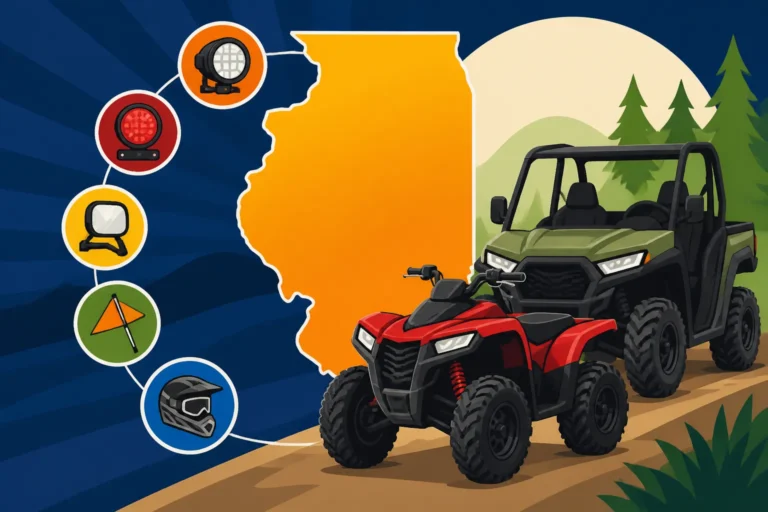
Once a local ordinance is in place, it almost always comes with a list of required equipment that your UTV must have to be considered street-legal. These aren't just suggestions; they are non-negotiable safety features designed to make your side-by-side more visible and controllable on public roads. Skipping even one item can lead to a ticket or prevent you from getting a permit. Companies like SuperATV offer a wide range of aftermarket accessories that can help you meet these requirements, from mirrors to turn signal kits.
Why Your UTV Needs a Working Rearview Mirror
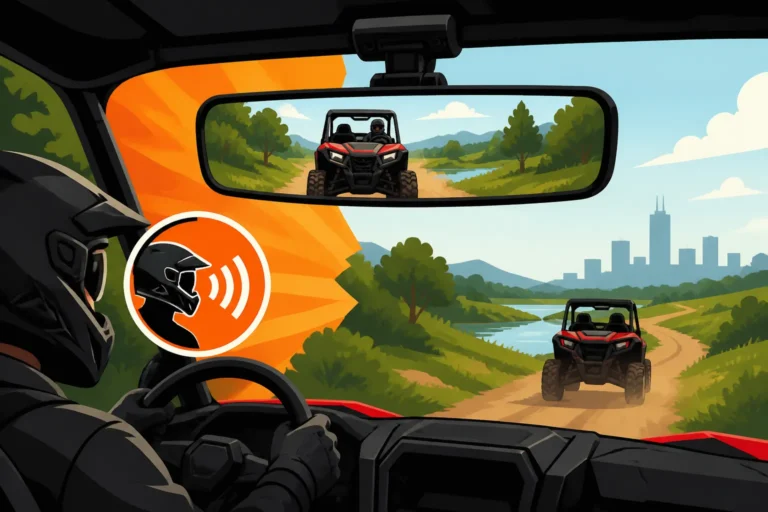
A rearview mirror isn't just a nice-to-have; it's absolutely essential for safe road operation. When you’re sharing the road with cars, trucks, and even bicycles, you need to be aware of what’s behind and to the sides of you. Illinois law, where it permits UTVs on roads, will invariably require a rearview mirror to ensure you can see traffic approaching from the rear. This isn't usually an optional accessory but a fundamental safety requirement. Think about backing up or changing lanes – without a mirror, you’re operating blind in a critical direction. [Illinois Requires a Rearview Mirror] is a non-negotiable point for road use.
Bolting a Slow-Moving Vehicle Emblem to the Rear
UTVs are, by their nature, generally slower than typical road vehicles. To signal this to other drivers, Illinois requires street-legal UTVs to display a slow-moving vehicle (SMV) emblem on the rear. This is that distinctive orange triangle with a red reflective border. It's meant to warn approaching drivers that your vehicle will be traveling at 25 mph or less, giving them ample time to react and slow down. Properly mounting this emblem is critical for safety and compliance. It should be visible and unobscured, typically centered on the rear of the machine. The importance of [The Orange Farm Emblem Your UTV Must Carry] cannot be overstated for preventing rear-end collisions.
Your Headlight Must Be Visible at 500 Feet
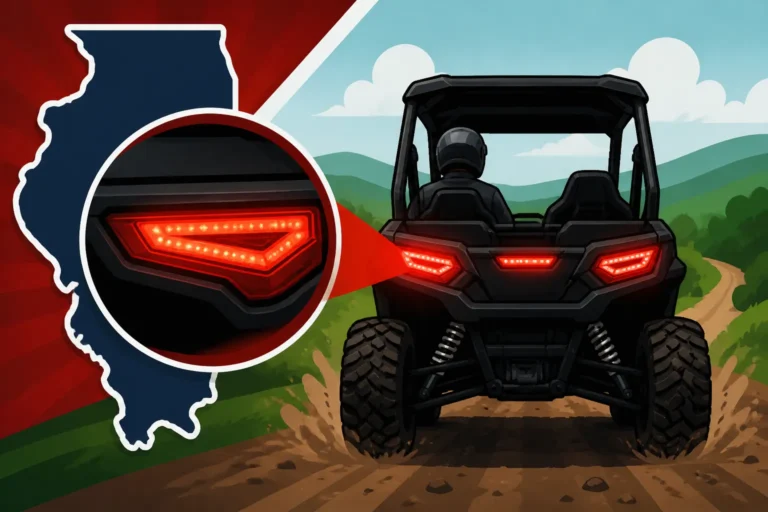
Visibility is paramount, especially during dawn, dusk, or in adverse weather. Illinois ordinances allowing UTVs on roads will mandate that your machine has working headlights that are visible from at least 500 feet away. Similarly, your UTV must have a red tail lamp visible from 100 feet to the rear. This isn't just about seeing where you're going; it's about being seen by others. If your UTV has aftermarket lights, ensure they meet these visibility standards. You might even consider upgrading your factory lights to more robust options from a brand like SuperATV for enhanced safety. [Illinois Requires a 500-Foot Headlight] and [Illinois Requires a 100-Foot Tail Lamp] are key safety mandates.
Turn Signals on a Side-by-Side
Unlike off-road trails where hand signals might suffice, road riding demands clear and unmistakable communication with other drivers. That's why working turn signals are a universal requirement for street-legal UTVs in Illinois. Both front and rear turn signals are necessary, allowing you to indicate your intentions to turn or change lanes. Many UTVs don't come with turn signals from the factory, so this is often an aftermarket installation. Luckily, many accessory providers, including SuperATV, offer complete turn signal kits designed specifically for UTVs, making the conversion fairly straightforward. Don't forget that [Illinois Requires Turn Signals] when riding on public roads.
Insurance and Licensing Requirements
Even if your local government has opened up roads to UTVs and your machine is fully equipped, there are still administrative hurdles to clear regarding insurance and who can legally operate the vehicle. These requirements are in place to protect all road users and ensure accountability.
Illinois Insurance Minimums for Street Use
Just like any other vehicle on the road, if your UTV is street-legal, it must be insured to meet Illinois's minimum liability requirements. This typically means coverage of 25/50/20: $25,000 for the injury or death of one person, $50,000 for the injury or death of two or more people, and $20,000 for property damage. This coverage protects you in case you are at fault in an accident. You'll need to carry proof of insurance with you whenever you're operating your UTV on public roads. Don't assume your existing auto policy covers your UTV; you'll almost certainly need a separate policy. For more details on what's required, look up [Illinois Insurance Minimums for Street Use].
Why an Out-of-State License Still Counts
Illinois doesn't have a special "UTV license." If you're riding your UTV on roads where it's legally permitted, you simply need a valid driver's license. This means your standard Illinois driver's license works, and if you're visiting from out of state, your valid driver's license from Indiana, Missouri, or wherever else is perfectly acceptable. The key is that you are a licensed driver, as the UTV is operating as a vehicle on a public road, even if it's considered a "non-highway vehicle" by default. The rules regarding [Illinois Requires a Driver's License] are straightforward in this context.
Road Restrictions and Rules of the Road
Even in towns that permit UTVs on their streets, there are almost always strict limitations on where and how you can operate them. These rules are designed to balance the recreational and utility needs of UTV owners with the safety of the general public.
Only Streets Posted 35 mph or Lower Qualify
One of the most common restrictions you'll encounter is that UTVs are only allowed on roads with a posted speed limit of 35 mph or less. This is a critical safety measure. UTVs are not designed for high-speed travel, and attempting to operate them on faster roads significantly increases the risk of accidents. This means you generally won't be cruising down state routes or major county highways that have higher speed limits, even if they pass through your town. Always pay attention to speed limit signs. Remember, [Only Streets Posted 35 mph or Lower Qualify] for UTV access in most Illinois municipalities.
State Highways May Be Crossed Only at an Intersection
While you generally can't ride on state highways, many local ordinances will permit you to cross them at an intersection. This allows UTV owners to access different parts of their town or connect to other permitted roads. However, these crossings must be made with extreme caution, yielding to all traffic and following all traffic laws. You cannot simply drive onto a state highway and proceed down it. These rules are put in place because [Illinois Crossings of State Highways] present unique challenges due to traffic volume and speed differentials.
Illinois Closes Tollways and Interstates to Every Machine
This restriction is universal across Illinois and applies not just to UTVs but to ATVs and many other types of non-highway vehicles. You cannot, under any circumstances, operate a UTV on an interstate highway or a tollway. These are high-speed, limited-access roads designed for conventional automobiles, and UTVs simply do not belong there. Attempting to do so would be extremely dangerous and would result in severe penalties. [Illinois Closes Tollways and Interstates to Every Machine] is a rule enforced statewide without exception.
Obtaining a Local UTV Permit
Once your local government has passed an ordinance and your UTV meets all the equipment requirements, the final step is usually to obtain a local permit. This permit serves as proof that your machine is compliant and authorized for road use within that specific jurisdiction.
Applying for a UTV Permit at Village Hall
The process for applying for a UTV permit typically involves visiting your local village or city hall. You'll likely need to fill out an application form, provide proof of ownership, present your valid driver's license, and show proof of insurance. There will usually be an associated fee, which can vary widely from town to town. Some towns might issue a decal or sticker that you must display on your UTV, indicating it's permitted for street use. Make sure you understand all the steps for [Applying for a UTV Permit at Village Hall] to avoid any delays.
The Inspection a Village Runs Before Issuing a Permit
Before a permit is issued, many municipalities will require your UTV to undergo a physical inspection. This inspection is to ensure that your machine has all the mandated safety equipment – working headlights, tail lights, brake lights, turn signals, rearview mirror, and the SMV emblem. They might also check for spark arrestors, proper tires, and general roadworthiness. This is not a state-mandated safety inspection like you might find for cars in some states, but a local check to ensure compliance with the specific ordinance. Be prepared for this step, as failing the inspection means no permit until the issues are corrected. This inspection is a standard part of [Illinois Equipment Inspections by a Village].
Penalties and Enforcement
Ignoring the rules or riding without the proper permits and equipment can lead to significant consequences. Local law enforcement, including village police, county sheriffs, and conservation officers, are authorized to enforce these regulations.
Being Pulled Over on a Rural County Road
Imagine you’re cruising down a quiet county road, enjoying the scenery, only to see flashing lights in your rearview mirror. If you don't have the proper permits, equipment, or are on a road not designated for UTVs, you're likely facing a citation. The officer will typically ask for your driver's license, proof of insurance, and any local UTV permit. If you're found to be in violation, you could receive a ticket that carries a fine, and in some cases, your UTV could even be impounded. It’s always best to be informed and compliant to avoid [Being Pulled Over on a Rural County Road] and subsequent penalties.
Contesting a UTV Ticket Written by a Village
If you receive a ticket for an alleged UTV violation, you have the right to contest it in court, just like any other traffic citation. This would typically involve appearing before a local judge or magistrate. If you believe you were unfairly ticketed, perhaps you did have the permit or were on a legally designated road, you'll need to present your evidence. This might include your permit, proof of insurance, or even maps showing the road's designation. However, if you were genuinely in violation, paying the fine is usually the most straightforward option. Understanding the process for [Contesting a UTV Ticket Written by a Village] is important if you find yourself in this situation.
Key Equipment Checklist for Illinois Street-Legal UTVs
For quick reference, here’s a summary of the equipment commonly required for UTVs to be street-legal in Illinois, based on local ordinances. Always check your specific local ordinance for exact requirements.
| Equipment Feature | Requirement | Purpose |
|---|---|---|
| Rearview Mirror | At least one mounted mirror providing a clear view of the rear. | Essential for situational awareness and safe lane changes/backing up. |
| Slow-Moving Vehicle Emblem (SMV) | Orange triangle with red reflective border, mounted clearly on the rear. | Warns faster traffic that the UTV is traveling 25 mph or less. |
| Headlights | At least one working headlight, visible from 500 feet. | Illumination for the driver and visibility to oncoming traffic. |
| Tail Lamps | At least one red tail lamp, visible from 100 feet to the rear. | Visibility to traffic approaching from the rear. |
| Brake Lights | Working brake lights that illuminate when brakes are applied. | Signals deceleration to following traffic. |
| Turn Signals | Functional front and rear turn signals. | Clear indication of turns and lane changes. |
| Horn | An audible warning device (horn). | Alerts pedestrians and other drivers to the UTV's presence. |
This table provides a general guide, but specific ordinances may have additional requirements or slight variations. For instance, some may require specific tire types or additional reflective tape. Always refer to your local ordinance for the definitive list.
Driving a UTV on the road in Illinois is not a simple "yes" or "no" answer; it's a "sometimes, if" situation, entirely dependent on local regulations and your machine's compliance. While the initial state law broadly prohibits it, the power granted to local municipalities allows for exceptions that can make your UTV a much more versatile machine. Doing your research, outfitting your UTV properly with quality parts (perhaps from a brand like SuperATV), obtaining the necessary permits, and adhering to all local rules are the keys to enjoying your side-by-side legally and safely on Illinois roads.
Disclaimer
This article is for general informational purposes only and does not constitute professional advice. Laws, prices and regulations vary by location and change over time. Consult a qualified professional for guidance on your specific situation.