Illinois Crossing Rules at Intersections
Navigating the roads in Illinois with an ATV or UTV can feel like walking through a minefield of regulations, especially when it comes to something as seemingly simple as crossing a street. Many riders get frustrated because they understand their machine isn't built for highway speeds, but they still need to get from point A to point B, often just a short hop across an intersection. This guide will meticulously break down the specific rules and common pitfalls surrounding ATV and UTV crossings at intersections in Illinois, helping you understand precisely when, where, and how you can legally traverse public roads.
Understanding the Illinois Baseline: The General Ban on Street Riding
Before we even talk about crossing, it’s absolutely vital to grasp the foundational principle of ATV and UTV use on public roads in Illinois: they are generally prohibited. This isn't just a suggestion; it's the starting point of the state's legal framework for these machines. Think of it as a "no" by default. Your off-highway vehicle (OHV) is designed for trails, fields, and private property, not for mixing with cars and trucks on paved roads. This overarching ban is in place for safety reasons, recognizing the different handling characteristics, lack of traditional safety features like crumple zones, and visibility issues that ATVs and UTVs present in traffic.
Why the Default is "No Street Riding"
The Illinois Vehicle Code specifically classifies ATVs and UTVs as "non-highway vehicles" (NHVs). This designation immediately sets them apart from typical cars, trucks, and motorcycles, which are legally designed and equipped for highway use. Because NHVs don't meet the stringent safety and equipment standards for highway travel, the state's default position is to keep them off public roads where they could pose a hazard to themselves and other motorists. It's not about punishing riders; it's about protecting everyone on the road. This default "no" is why local authorities have to go through a specific process to create exceptions. [Illinois Law Starts by Banning Street Riding] is a core concept that every rider needs to internalize.
Riders often express frustration, feeling like the state is being overly restrictive. They might say, "But my UTV has headlights and turn signals, why can't I just drive it a mile down the road?" The answer lies in that "non-highway vehicle" classification and the inherent differences in design. An ATV's narrow wheelbase and high center of gravity make it less stable than a car, and its open cabin offers little protection in a collision. UTVs, while often larger, still lack many of the safety features found in street-legal vehicles. The state's position is a blanket rule to prevent potential tragedies, leaving specific allowances to be carefully carved out.
How Local Ordinances Create Exceptions
While the state law begins with a general prohibition, it wisely includes provisions for local control. This is where villages, cities, townships, and even counties come into play. These local units of government have the authority to pass their own ordinances that permit the operation of ATVs and UTVs on designated local roads within their jurisdiction. However, these ordinances come with very specific conditions and rarely allow for unrestricted riding. Typically, they involve speed limits (often 35 mph or less), specific equipment requirements, permit systems, and designated routes.
For example, a small rural town might allow UTVs on its streets to facilitate access to farms or local businesses, recognizing the unique needs of its residents. But even then, they'll likely require a permit, proof of insurance, and specific safety equipment. You can't just assume that because one town allows it, the next one over does too. This patchwork of regulations means that a rider must diligently research the rules for every single jurisdiction they plan to ride in. [Illinois Municipalities That Pass Ordinances] goes into more detail about how these local laws come to be. It's a classic case of "check before you ride," as the rules can literally change block by block.
The Role of Non-Highway Vehicles NHVs in This Context
As mentioned, ATVs and UTVs fall under the "Non-Highway Vehicle" (NHV) umbrella in Illinois. This classification is key because it dictates the entire legal framework. Unlike "street-legal" vehicles that are designed and manufactured to meet federal motor vehicle safety standards for on-road use, NHVs are not. This fundamental difference means they are subject to a distinct set of rules, particularly when it comes to interacting with the public road system. It's not just a descriptive term; it carries significant legal weight.
The NHV classification explains why you won't find traditional license plates or titles that allow for unrestricted road use, as you would with a car or motorcycle. Instead, you'll encounter specific permits, decals, and usage stamps designed for off-road access or highly restricted on-road movement. Understanding the NHV status helps clarify why the rules are so particular for crossing or limited road use. It informs the state's stance on everything from insurance requirements to equipment standards for these machines when they touch public asphalt.
The Crucial Distinction: Crossing vs. Riding
Many riders mistakenly believe that if they can cross a road, they can also ride on it for a short distance. This is a critical misconception in Illinois, and it can lead directly to fines and other penalties. State law draws a very sharp distinction between simply "crossing" a public road or highway and "riding" or "operating" an ATV or UTV along its length. Understanding this difference is paramount to staying within the bounds of the law and ensuring your safety.
Why Crossing is a Specific Exception
Crossing an intersection is treated as a highly specific, limited exception to the general ban on street riding. The purpose of this exception is pragmatic: to allow riders to access trails, fields, or other permissible riding areas that happen to be divided by a public road. It acknowledges that sometimes, the only way to get from one legal riding spot to another, or from a private driveway to a trail entrance, involves traversing a paved road. This exception is not a loophole for street riding; it's a narrowly defined allowance for necessary transitions.
Imagine you're at a friend's farm, and the back forty is across a county road from the main property. The law provides a way for you to move your machine across that road directly, without having to load it onto a trailer. This is the intent behind the crossing rule. It's about connectivity for off-road use, not creating a new class of street-legal vehicle. This distinction is often lost on new riders, who might see a paved shoulder as an extension of their trail system, which is a dangerous and illegal assumption.
The Difference Between Through-Riding and Intersection Crossing
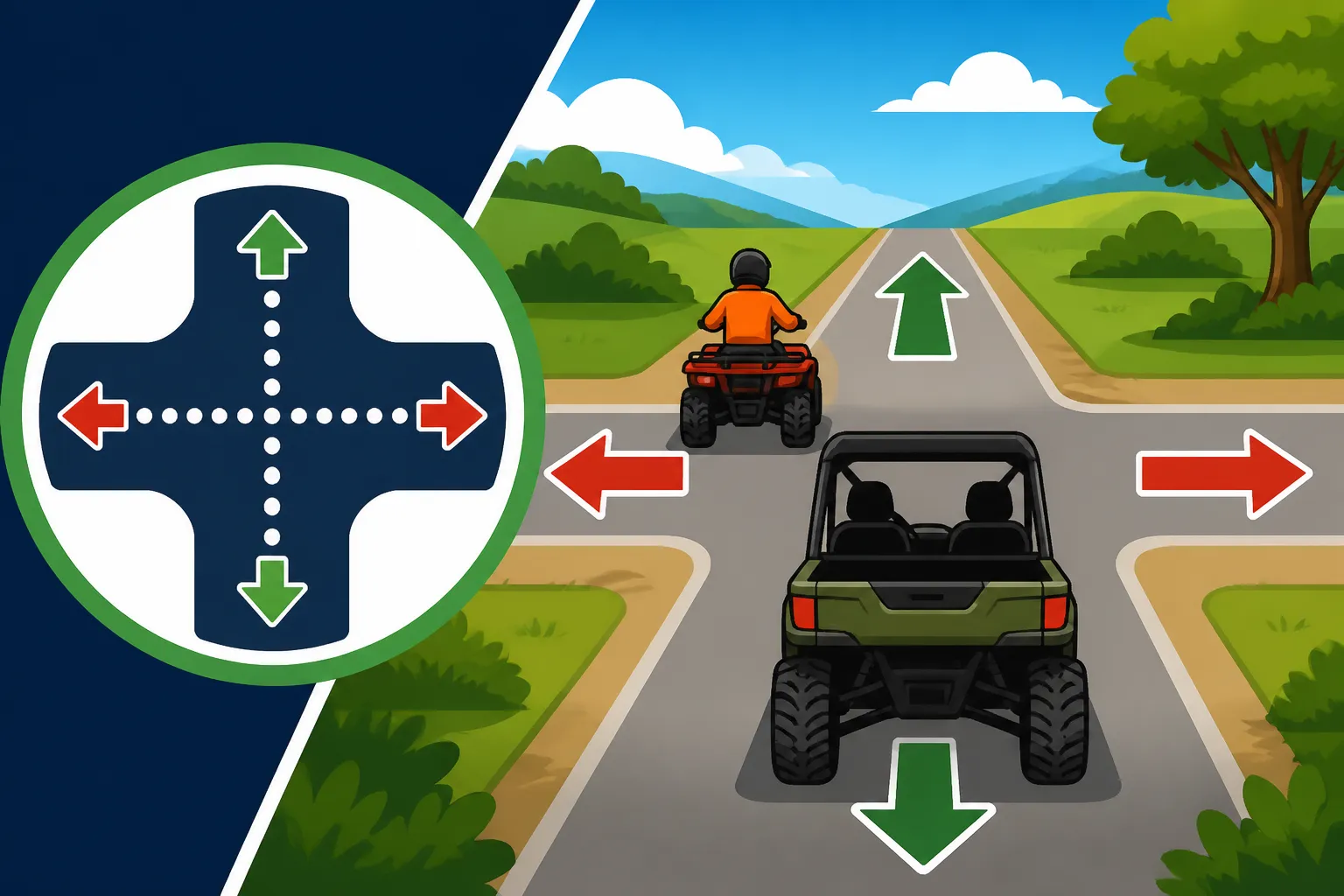
This is perhaps the most important concept to grasp. "Through-riding" refers to operating your ATV or UTV along a road, traveling parallel to traffic, even for a short distance. This is generally prohibited unless a specific local ordinance explicitly allows it for a designated route. "Intersection crossing," on the other hand, means moving your machine directly across a road at an established intersection, from one side to the other, usually perpendicular to the flow of traffic. The key here is that you are entering the roadway, traversing it as quickly and safely as possible, and exiting it on the opposite side without traveling along its length.
Consider this scenario: You're riding an approved trail, and it dead-ends at a state highway. The trail picks up again directly across the highway. The law allows you to cross at the intersection. What it does not allow is turning right onto the highway shoulder for 100 yards to get to the intersection, then crossing, and then turning left onto the shoulder for another 100 yards to find the trail. That "100 yards" along the shoulder is illegal through-riding. You must approach the intersection, cross, and immediately exit the roadway. This sharp distinction is critical for law enforcement officers who are looking for violations.
What "Crossing" Legally Entails
For a crossing to be legal, it must meet several criteria. First, it must occur at an intersection. You cannot simply stop traffic in the middle of a block to cross. Second, the crossing must be as direct as possible. This means moving straight across the roadway, without making any turns to travel along the road. Third, you must yield to all vehicular traffic on the roadway. This is not a right-of-way; it's a privilege granted under strict conditions. Finally, you must ensure your machine is equipped with the necessary safety features, which we'll discuss in detail, to make the crossing visible and safe.
The spirit of the law for crossing is swift and safe passage. You should stop, look both ways, and proceed only when it is absolutely clear and safe to do so, minimizing your time spent on the pavement. Think of it like a pedestrian crossing the street – they don't walk down the middle for a block; they cross quickly and efficiently at the designated spot. Any deviation from this direct, expedient, and safe approach could be seen as illegal street operation, even if your ultimate goal was just to get to the other side.
Illinois State Highway Crossing: Navigating the Major Arteries
Crossing state highways in Illinois presents a particular set of challenges and rules. These roads, often with higher speed limits and greater traffic volumes, demand extra caution and strict adherence to the law. The Illinois Department of Transportation (IDOT) maintains state highways, and their regulations, coupled with the Illinois Vehicle Code, provide specific guidelines for OHV crossings. Failing to understand these can put you in significant legal jeopardy and, more importantly, put your life at risk.
Specific Rules for State-Maintained Roads
When it comes to state highways, the rules are generally more restrictive than for local roads. The state explicitly prohibits ATV and UTV operation on these highways. The allowance is strictly for crossing at an intersection. This means you cannot ride on the shoulder, even for a short distance, to reach an intersection or to get from one side of a bridge to another. Your approach to the state highway intersection must come from an adjacent, legal riding area or private property, not from riding along the state highway itself. [Illinois Crossings of State Highways] details these regulations.
This strictness is due to the higher speeds and traffic density typically found on state routes. An ATV or UTV, even one equipped with all the required safety gear, is simply not designed to safely operate alongside vehicles traveling at 55 mph or more. Therefore, the state's position is unequivocal: direct crossing at an intersection, and nothing more. Any attempt to use the state highway as a connector between two points, even briefly, will likely result in a citation.
The "Intersection Only" Mandate
The most critical aspect of state highway crossing is the "intersection only" mandate. This means you cannot cross a state highway at any point other than a marked, public intersection. You cannot create your own crossing point where there isn't one, nor can you cross at a private driveway entrance unless that driveway itself forms part of an official intersection with the state highway. This rule exists to channel crossings through locations that are typically designed for vehicular traffic convergence, often with better sight lines and traffic control devices.
Attempting to cross a state highway at a non-intersection point, such as simply cutting across a four-lane road from a field, is not only illegal but extremely dangerous. Such actions put you in direct conflict with fast-moving traffic, often in areas where drivers least expect to see an ATV or UTV. The state's requirement for intersections is a safety measure, guiding riders to the least hazardous points for crossing.
Safety Considerations for High-Traffic Crossings
Crossing a busy state highway, even at an intersection, is inherently risky. You must exercise extreme caution. Before you even approach the intersection, slow down and observe traffic conditions. Look far down the road in both directions for approaching vehicles. Consider the speed of oncoming traffic; a vehicle traveling at 60 mph covers a lot of ground very quickly. Do not assume drivers see you, even if your machine is fully equipped with lights. Their expectation is to see cars, not OHVs.
If possible, cross with another rider who can act as a spotter, or choose times of day when traffic is lightest. Never attempt to cross if your visibility is limited by weather, terrain, or obstacles. Ensure your machine is in good working order, especially the brakes and throttle, to make a swift and decisive crossing. This is not the time for hesitation. Prepare to make your move, execute it quickly, and get off the highway pavement as soon as safely possible.
Local Road Crossings: Village, County, and Township Considerations
While state highways have their own rigid rules, crossing local roads—those maintained by villages, counties, or townships—can be slightly more nuanced. This is where the concept of local ordinances really comes into play, creating a patchwork of regulations that can vary significantly from one municipality or county to the next. Understanding the specific authority of these local governments is key to navigating their roads legally.
How Local Ordinances Impact Crossings
Local ordinances passed by villages, counties, or townships can either mirror the state's strict "intersection only" crossing rule or, in some cases, provide limited additional allowances. For example, a county board might pass a resolution permitting UTVs to operate on certain designated county roads within its jurisdiction, which would then also define how crossings are handled. However, even when local governments permit some form of road use, it's almost always under very specific conditions, such as low speed limits and strict equipment requirements. [Illinois Rules for Riding a Village Street] and [Illinois Rules for Riding a County Road] cover specific contexts.
It’s crucial to remember that a local ordinance cannot override state law regarding state highways. If a village passes an ordinance allowing UTVs on its streets, that ordinance only applies to the streets within its jurisdiction and does not grant you permission to ride or cross state highways differently than state law dictates. Therefore, when approaching a crossing on a local road, you must first ascertain if that specific local government has any ordinances pertaining to OHV use, and if so, what they permit.
The "Adjacent Property" Rule for Crossings
Sometimes, local ordinances will include provisions related to accessing adjacent property. This might allow for a very short distance of road travel or crossing to get from one section of private land to another that is divided by a local road. This is typically a very narrow exception, designed to accommodate agricultural use or property access, not recreational riding. The intent is to facilitate necessary movement between parcels of land, not to create a shortcut for a trail ride.
For instance, a farmer might need to move a UTV from one field to another directly across a township road. A local ordinance might specifically permit this, often with caveats about visibility, equipment, and yielding to traffic. It is never an open invitation to ride the shoulder. Always check the exact wording of any local ordinance; don't assume broad permissions based on a general understanding. Ignorance of the specific local rule is not a valid defense if you are stopped by law enforcement.
When Local Rules Might Contradict State Guidelines
It's important to understand the hierarchy of laws. State law is the baseline. Local ordinances can add to or specify rules within the framework of state law, but they generally cannot contradict or lessen state-mandated restrictions. For instance, a village cannot pass an ordinance saying ATVs don't need headlights for crossing if state law requires them. However, a local ordinance can be more restrictive; a village could choose to ban all ATV/UTV crossings on its roads, even if the state allows for intersection crossings.
This creates a scenario where a rider must not only know the state rules but also research the specific rules of every county, township, and municipality they intend to ride in or through. This might involve checking municipal websites, contacting local police departments, or even visiting the county clerk's office. This level of diligence can be frustrating for riders, but it's the reality of navigating Illinois's OHV laws. Using resources like [Where to Find Your Village's UTV Ordinance Online] can be very helpful here.
Equipment Requirements for Safe Crossing
Whether you're crossing a state highway or a local road, your ATV or UTV must be properly equipped to ensure visibility and safety. These aren't optional recommendations; they are legal requirements designed to minimize the risk of accidents with other vehicles. Think of these as the absolute minimum safety features you need before you even consider touching a paved road. Neglecting any of these can not only result in a ticket but significantly increase your risk of a collision.
Lights and Reflectors: What You Need
For any operation on a public road in Illinois, even a quick crossing, your ATV or UTV must have a functioning headlight and tail lamp. The headlight must be capable of illuminating persons and vehicles at a distance of at least 500 feet, and the tail lamp must emit a red light visible from at least 100 feet to the rear. This ensures that you are visible to oncoming and trailing traffic, particularly during dawn, dusk, or adverse weather conditions. [Illinois Requires a 500-Foot Headlight] and [Illinois Requires a 100-Foot Tail Lamp] are explicit on these points.
In addition to powered lights, your machine must be equipped with red reflectors on the rear. These passive safety devices provide visibility even if your tail light fails or your machine loses power. Many ATVs and UTVs come with these from the factory, but it's always wise to check their condition and cleanliness. Consider adding extra reflective tape, especially to the sides, to enhance your machine's profile, particularly if you find yourself crossing in lower light conditions. Every bit of visibility helps.
Slow-Moving Vehicle SMV Emblem Importance
Another non-negotiable piece of equipment for any road interaction is the Slow-Moving Vehicle (SMV) emblem. This is a triangular, fluorescent orange sign with a dark red reflective border. It must be prominently displayed on the rear of your ATV or UTV whenever it is operated on a public road, including during a crossing. The SMV emblem signals to other drivers that your vehicle is traveling at a speed significantly lower than the flow of traffic, giving them advance warning to slow down and exercise caution. [Illinois Slow-Moving Vehicle Emblem Rules] describes this in detail.
The presence of an SMV emblem is crucial for preventing rear-end collisions, which are a common hazard for slower-moving vehicles on faster roads. Without this emblem, a driver approaching from behind might not realize your relatively slow speed until it's too late. It's not enough to have it in your glove box; it must be securely mounted and visible. If your UTV has a bed, make sure the emblem isn't obscured by cargo or a tailgate.
Other Essential Safety Gear
While not always explicitly listed for a crossing-only scenario, common sense and the spirit of safety recommend additional equipment, especially if any local ordinance allows for limited road use beyond just crossing. A rearview mirror is incredibly helpful for checking traffic behind you before and during a crossing. [Illinois Requires a Rearview Mirror] is often part of local ordinances for general street use, and it's a smart addition even for simple crossings.
Turn signals, while not mandatory for a straight crossing, are required if any turns are made or if a local ordinance permits limited street use. [Illinois Requires Turn Signals] highlights this for UTVs. Even if you're only crossing, bright, functional brake lights are essential to warn following traffic if you need to stop or slow down suddenly. While not strictly "equipment," bright-colored clothing, especially a reflective vest, can significantly increase your personal visibility to other drivers, adding another layer of safety. Some riders even add a SuperATV rearview mirror kit or a turn signal kit for enhanced road visibility and compliance, even if only for occasional crossing.
Driver & Vehicle Requirements for Illinois Crossings
It's not just about the machine; the operator and the administrative status of the vehicle also come under scrutiny when an ATV or UTV touches public pavement in Illinois. There are specific requirements for who can drive, whether the machine needs insurance, and what documentation you should have on hand. Overlooking these aspects can quickly turn a simple crossing into a legal headache.
Driver's License Necessity
In Illinois, anyone operating an ATV or UTV on a public roadway, even for a brief crossing, must possess a valid driver's license. This means you cannot allow an unlicensed teenager or an adult without a valid license to operate the machine for this purpose. The state views any interaction with public roads as requiring the same level of driver competency and legal authorization as operating a car or truck. [Illinois Requires a Driver's License] clearly states this.
This requirement is in place because driving on public roads, even just crossing, involves navigating traffic, understanding right-of-way rules, and making quick decisions. These are skills that a licensed driver is presumed to possess. It's a significant point for families, as it means kids who are perfectly capable of riding an ATV on private property cannot be the ones to cross a road, even if an adult passenger is present.
Insurance Requirements for Any Street Use
While ATVs and UTVs are not registered for street use in Illinois, if you operate them on a public roadway, including for crossing, you must carry liability insurance. This is the same basic insurance requirement that applies to all other motor vehicles driven on Illinois roads. The minimum coverage is typically 25/50/20: $25,000 for the injury or death of one person, $50,000 for the injury or death of more than one person, and $20,000 for property damage. [Illinois Requires Insurance for Street Use] elaborates on this.
This insurance protects you financially if you are at fault in an accident while on a public road, even if it's just a minor fender bender during a crossing. Without it, you could be held personally responsible for damages and injuries, which could be financially devastating. Always carry proof of insurance with you when riding, as law enforcement can and will ask for it during a stop. It's also a good idea to ensure your policy specifically covers road interaction, even if limited to crossings.
Age Restrictions and Passenger Rules
Beyond the driver's license requirement, age restrictions for operating ATVs and UTVs in general still apply, even when making a crossing. While specific age rules for crossing are less detailed than for general operation, the underlying principle is that the operator must be legally allowed to operate the machine. Generally, this means no one under 10 years old can operate an ATV, and those between 10 and 16 require adult supervision and/or completion of a safety course, depending on the machine and context. For public road interaction, the driver's license rule essentially sets the minimum age at 16 (or whatever the minimum licensing age is).
Passenger rules for UTVs must also be observed. If a UTV has designated seating for passengers, they can be carried, but ensure they are properly secured and meet any age or height requirements specified by the manufacturer or park rules. ATVs are generally designed for a single rider, and carrying passengers on a single-rider ATV on a public road, even for a crossing, is extremely dangerous and often illegal. Always prioritize safety and adhere to manufacturer recommendations regarding passenger limits for your specific machine.
Common Mistakes and Penalties
Given the strict nature of Illinois's OHV laws regarding public roads, it's easy to inadvertently break the rules. Many riders, through a misunderstanding or a simple lapse in judgment, commit common mistakes that lead to citations. Understanding these pitfalls and their associated penalties is a strong deterrent and helps foster a more responsible riding culture. The consequences can range from hefty fines to the impoundment of your machine.
Illegal Through-Riding vs. Crossing
The most frequent mistake is blurring the line between a legal intersection crossing and illegal through-riding. Many riders, thinking they're just taking a "shortcut," will travel a block or two on a paved road to reach another trail segment or a friend's house. This is not a crossing; it's illegal operation. The temptation might be strong, especially on quiet rural roads, but it is a clear violation of state law unless a specific local ordinance for that exact road explicitly allows it.
Law enforcement officers are trained to spot this. If they see an ATV or UTV traveling along a road for any sustained distance, their assumption will be that it's an illegal operation, not a crossing. Even a few hundred feet can be enough for a ticket. The state law is quite clear: if you are on a public road, you are either crossing at an intersection as directly as possible, or you are violating the law, unless there is a specific, well-documented local ordinance permitting otherwise. [Illinois Penalties for Illegal Street Riding] should be a strong motivator to adhere strictly to the rules.
Ignoring Local Ordinances
Another common error is assuming that because you saw ATVs or UTVs on the roads in one town, you can do the same in the next town over, or even in an unincorporated county area. As discussed, local ordinances create a patchwork of regulations. What's legal in "Town A" might be completely illegal in "Town B," even if they're right next to each other. Riders who fail to research the specific rules for their riding location are setting themselves up for a citation.
This ignorance extends not just to the permission to ride, but also to the conditions of that permission. A local ordinance might allow UTVs on streets, but only between certain hours, or only if you have a specific local permit, or only on roads posted 35 mph or less. Ignoring these conditions is as much a violation as riding where it's completely banned. Always check before you ride, and if you can't find clear information, err on the side of caution and avoid public roads.
Consequences of Non-Compliance
The penalties for operating an ATV or UTV illegally on Illinois roads can be significant. A typical first offense for illegal street riding or improper crossing might result in a substantial fine, easily hundreds of dollars, plus court costs. These are not minor traffic tickets. Repeat offenses can lead to even higher fines, suspension of your driver's license, and potentially the impoundment of your machine. If your machine is impounded, the fees for towing and storage can quickly add up, often exceeding the cost of the original fine.
Furthermore, if you are involved in an accident while operating illegally or without the required insurance, the financial and legal consequences can be catastrophic. Your insurance policy might deny coverage if you were operating illegally, leaving you personally liable for damages and medical bills. The legal ramifications, including potential lawsuits, could follow you for years. It is simply not worth the risk to disregard the rules surrounding public road interaction for ATVs and UTVs.
Planning Your Route: Knowing Before You Go
Successfully navigating Illinois's ATV and UTV crossing rules comes down to proactive planning. You can't just hop on your machine and assume you know the lay of the legal land. Just as you'd plan your trail route, you need to map out your legal road interactions. This "know before you go" mentality is your best defense against citations and, more importantly, ensures your safety and the safety of others.
Researching Local Ordinances
The absolute first step in planning any route that involves public road crossings or limited street use is to research the specific local ordinances for every jurisdiction you'll be in. This includes villages, cities, townships, and counties. Many municipalities now post their ordinances online. Start with the village or city hall website, then look at the county's website for county-wide resolutions. If you're in an unincorporated area, the township rules may apply.
Don't be afraid to make a phone call. Reach out to the local police department (non-emergency line), sheriff's office, or even the village clerk. Ask specific questions about ATV/UTV access on their roads, including crossing rules, permit requirements, and equipment needed. Get the specifics in writing if possible, or at least note down who you spoke with and when. This diligence might seem like a lot of work, but it's far less troublesome than dealing with a ticket or an accident.
Using County and Township Websites
County and township websites are invaluable resources for understanding local regulations, especially in more rural areas. While smaller villages might have individual ordinances, counties often pass broader resolutions that affect unincorporated areas and sometimes even provide a baseline for the villages within their borders. These websites typically have sections for local laws, codes, or ordinances. Look for terms like "Off-Highway Vehicles," "ATV," "UTV," or "Recreational Vehicles."
It's important to differentiate between county roads (maintained by the county) and township roads (maintained by the township). Each can have its own set of rules, or a county resolution might set parameters for all roads within its jurisdiction. For instance, a county might have a resolution allowing UTVs on its county roads, but that doesn't automatically apply to the township roads within that county. Always dig into the details and identify the specific authority governing the road you intend to cross or use.
When to Ask for Clarification
Sometimes, even after extensive online research, the rules might still be unclear. Perhaps an ordinance is vaguely worded, or you find conflicting information. This is precisely when you must seek clarification from the local authorities. As mentioned, contacting the local police department or sheriff's office is often the best course of action. Be polite, explain your route and intentions clearly, and ask for specific guidance.
It's better to be a bit embarrassed asking a "dumb question" than to be cited for a violation you didn't understand. If a local officer tells you something, it's wise to jot down their name, badge number, and the date and time of the conversation. This can be helpful, though not necessarily legally binding, if there's ever a dispute. Ultimately, clarity and compliance are your goals, and sometimes that requires direct communication with the enforcers of the law.
Summary of Illinois ATV/UTV Crossing Rules
| Feature | State Highways | Local (Village/County/Township) Roads |
|---|---|---|
| Default Rule | General Ban on operation; Crossing is exception | General Ban on operation; Crossing is exception |
| Crossing Location | Only at marked public intersections | Only at marked public intersections (unless local ordinance states otherwise for specific access) |
| Through-Riding | Strictly Prohibited | Prohibited, unless a specific local ordinance allows designated routes |
| Driver's License | Required | Required |
| Insurance | Required (25/50/20 minimum liability) | Required (25/50/20 minimum liability) |
| Headlight | Required (visible 500 ft) | Required (visible 500 ft) |
| Tail Lamp | Required (red, visible 100 ft) | Required (red, visible 100 ft) |
| Red Reflectors | Required (on rear) | Required (on rear) |
| SMV Emblem | Required (on rear, visible) | Required (on rear, visible) |
| Turn Signals | Not required for straight crossing; required for turns/street use | Not required for straight crossing; required for turns/street use |
| Rearview Mirror | Recommended; required if local ordinance allows street use | Recommended; often required if local ordinance allows street use |
| Penalties | Fines, potential impoundment, license suspension | Fines, potential impoundment, license suspension |
Disclaimer
This article is for general informational purposes only and does not constitute professional advice. Laws, prices and regulations vary by location and change over time. Consult a qualified professional for guidance on your specific situation.