Illinois Requires a Driver’s License
It’s easy to get excited about the thought of taking your ATV or UTV out for a spin, especially when you imagine cruising down a quiet country road. But in Illinois, the rules about riding these machines on public roads are notoriously complex and can lead to a lot of confusion, not to mention a hefty ticket if you get it wrong. One of the most common questions, and perhaps one of the most critical, revolves around whether you actually need a driver's license to operate an off-highway vehicle on a street. This guide is here to clear up that very question, along with all the other essential requirements and considerations for legal, licensed street use in the Prairie State.
The Foundational Truth: Illinois Generally Bans OHVs on Public Roads
Let's start with the hard truth that often catches new riders, and even some seasoned ones, by surprise: Illinois law begins with a blanket ban on operating ATVs and UTVs on any public street, highway, or roadway. This isn't just a suggestion; it's a fundamental principle rooted in how these vehicles are designed and intended for use. While they're fantastic for tearing up trails, navigating farm fields, or tackling rugged terrain, they simply aren't built to share space with cars and trucks in typical traffic scenarios.
The state views these machines primarily as off-highway vehicles, built for off-road environments. They lack many of the safety features and operational characteristics required for standard road vehicles. This fundamental distinction is crucial because it means that if you're ever pulled over on a public road without meeting very specific local exceptions, you're already starting from a position of non-compliance. The burden is always on the rider to know and adhere to the exceptions, not on the state to outline every forbidden road.
This initial prohibition is why many riders, especially those new to the state or the hobby, feel so much frustration. They see others on the roads and wonder why they can't do the same, not realizing those other riders have jumped through specific hoops. It’s not about whether your machine can physically drive on the road; it’s about whether it’s legally permitted to do so, and that permission is rarely granted by the state itself, but rather delegated to local jurisdictions.
Why the General Ban Exists
The primary reason Illinois, like many other states, generally bans off-highway vehicles from public roads comes down to safety – both for the OHV operator and for other motorists. ATVs and UTVs are engineered for low-speed, off-road performance. Their suspension systems, tires, and steering mechanisms are optimized for uneven terrain, not the smooth, high-speed demands of paved roads. This can lead to stability issues, especially at higher speeds or during quick maneuvers required in traffic.
Furthermore, many ATVs and UTVs lack essential safety equipment found on street-legal vehicles. Things like turn signals, proper headlights and taillights visible at highway speeds, rearview mirrors, and even basic crumple zones are often absent or insufficient for road use. Imagine an ATV, designed for agility on a dirt track, suddenly having to brake hard on a slick asphalt road, surrounded by cars weighing ten times as much. The potential for serious accidents is significantly higher. The state's default position is one of caution, aiming to prevent these kinds of dangerous situations by restricting where these machines can be ridden.
Beyond safety, there’s also the issue of traffic flow and road wear. While an individual ATV might not cause significant damage, widespread use of off-road tires on pavement can accelerate road degradation in ways standard vehicles do not. The spirit of the law is to keep off-road machines in their element, preserving the safety and integrity of public roadways for their intended use. It truly boils down to a fundamental incompatibility between vehicle design and road environment.
What "Non-Highway Vehicle" Truly Means
The term "non-highway vehicle" is key to understanding Illinois's stance on ATVs and UTVs. Essentially, it classifies these machines as something distinct from traditional automobiles, motorcycles, or trucks. They are explicitly not considered vehicles built for highway use, even if they have an engine and wheels. This classification is vital because it determines which set of rules applies to them. If a vehicle is a "non-highway vehicle," it falls under specific statutes that restrict its operation to designated off-road areas or private property, unless a local government explicitly passes an ordinance to allow limited street use.
This designation also means that many of the typical vehicle registration requirements you might associate with cars, like license plates and annual sticker renewals, don't apply to ATVs and UTVs in Illinois, at least not for general road use. While you will need an [Illinois ATV Title Certificates Explained] for ownership proof, that title doesn't grant you street access. Instead, the state relies on its usage stamp and public access decal system for trail access, which is a completely separate set of regulations from street-legal operation. It’s a subtle but important distinction that often confuses owners, as they might have a title and think their machine is "registered" for all purposes, which isn't the case for public roads.
Consider it this way: a golf cart is also a "non-highway vehicle." While some towns allow golf carts on certain roads, nobody expects to drive a golf cart down a busy state highway. The same principle applies to ATVs and UTVs; their core identity as non-highway vehicles means they require special local permission, not just a title, to ever touch a public road.
The Driver's License Requirement: Your Key to Permitted Street Use
Now, to the heart of the matter: do you need a driver's license? The unequivocal answer is yes, if you plan to operate an ATV or UTV on any public road in Illinois, even where local ordinances permit it. This isn't just a suggestion; it's a mandatory legal requirement that goes hand-in-hand with any allowance for street use. You wouldn't expect to drive a car on the road without a license, and the same applies to an off-highway vehicle once it enters the public road system.
This requirement stems from the fact that even if a local municipality has opened certain roads to OHV traffic, those roads are still part of the public infrastructure. You'll be sharing the road with other licensed drivers, and you need to demonstrate that you possess the basic skills and knowledge required to safely navigate traffic, understand road signs, and adhere to traffic laws. A driver's license is the state's way of verifying that you've passed these fundamental tests. Without one, even if your machine is fully equipped and the road is open to UTVs, you're operating illegally.
It's a common misconception that because ATVs and UTVs aren't "cars," the same licensing rules don't apply. But once you leave private property and enter the public right-of-way, you become part of the broader transportation system, and the state's baseline rules for operating a motor vehicle kick in. Don't let this be the detail that spoils your ride or lands you in trouble.
What Type of License Is Needed
For the vast majority of riders, a standard Class D Illinois driver's license is sufficient to operate an ATV or UTV on roads where permitted. This is the same license you'd use to drive your everyday passenger vehicle. You don't typically need a special motorcycle endorsement or a commercial driver's license (CDL) for recreational or utility use of an OHV on public roads. The key is simply possessing a valid, unexpired driver's license issued by Illinois or another state.
It's important to remember that "valid" means it's not suspended, revoked, or otherwise invalid for operating a motor vehicle. If your standard driver's license is in jeopardy for any reason, that also impacts your ability to legally drive an ATV or UTV on public streets. Just as you wouldn't get behind the wheel of your car with a suspended license, you shouldn't get behind the handlebars or steering wheel of your off-road machine under similar circumstances. The rules for operating any vehicle on public roads are generally quite strict regarding licensure, and OHVs are no exception once they hit the pavement.
Beyond the license itself, you're expected to carry it with you whenever you're operating the machine on public roads. If a law enforcement officer pulls you over, they will ask for your license, registration (if applicable, though usually not for the OHV itself in Illinois for street use), and proof of insurance. Being unable to produce a valid driver's license on demand is a separate offense, regardless of whether you otherwise comply with local ordinances.
Out-of-State Licenses and Illinois Rules
Good news for visitors and new residents! Illinois generally recognizes valid driver's licenses issued by other U.S. states or Canadian provinces. So, if you're visiting Illinois from, say, Indiana or Missouri and your home state driver's license is current and in good standing, you typically don't need to get an Illinois license specifically to operate an ATV or UTV on roads where it's permitted. This principle ensures reciprocity and makes it easier for travelers to enjoy recreational activities without having to navigate multiple state licensing bureaucracies. [Illinois Rules for a Visiting Indiana Rider] can offer more insight into how this works for our neighbors.
However, there's a crucial caveat: while your out-of-state license is usually recognized, you still must comply with all other Illinois laws and local ordinances regarding OHV street use. This means you need to know which towns or counties allow street riding, what equipment your machine needs, and what insurance is required. Your out-of-state license doesn't grant you an exemption from these local Illinois rules. It simply satisfies the driver's license portion of the requirement.
For new residents, the standard Illinois rule for transferring a driver's license applies. If you've recently moved to Illinois, you typically have a grace period to obtain an Illinois driver's license. After that period, your out-of-state license might no longer be considered valid for operating any motor vehicle in Illinois, including your ATV or UTV on permitted roads. It’s always best to update your license as soon as you establish residency to avoid any issues down the line.
Age Restrictions and Provisional Licenses
The requirement for a valid driver's license naturally brings along age restrictions. In Illinois, to obtain a full, unrestricted Class D driver's license, you must be at least 18 years old. While there are provisional licenses for younger drivers, these often come with significant restrictions on driving hours, passenger limits, and other conditions. It's crucial to understand that these provisional license restrictions still apply when operating an ATV or UTV on public roads.
For example, a 16-year-old with a provisional license might not be allowed to drive after certain hours, or they might be prohibited from carrying passengers outside their immediate family. These limitations do not magically disappear when they hop on a side-by-side. In fact, many local ordinances permitting OHV street use might have additional age requirements that go beyond the state's basic licensing laws, sometimes stipulating that only fully licensed adult drivers (18+) may operate an OHV on municipal streets. Always check the specific local ordinance.
This also impacts younger riders who might operate ATVs or UTVs on private property without a driver's license. That's perfectly legal and common on private land. However, the moment that machine crosses onto a public road, even if only for a few yards, a valid driver's license becomes necessary, and the operator must meet the age and licensing requirements of Illinois law for public road operation. Safety courses are available, but [Illinois Has No Statewide Safety Course] that replaces the driver's license requirement for street use.
Local Ordinances: The Only Way to Legally Ride on Streets
Given Illinois's general prohibition on OHVs on public roads, the only way you can legally ride your ATV or UTV on streets is if a local unit of government – specifically a village, city, township, or county – has passed an ordinance or resolution explicitly allowing it. This is a critical point that cannot be overstated. You cannot simply decide to take your machine on the road because it "looks" street-legal or because you saw someone else doing it. The authority must come from a local legislative body.
These ordinances are not uniform. What's allowed in one town might be strictly prohibited in the next town over. This creates a patchwork of rules across the state, making it absolutely essential to research the specific regulations for any area you plan to ride in. A quick call to the local police department or municipal clerk's office is always a good idea. Many municipalities will post their ordinances on their websites, or you can find them through resources like Municode or individual municipal codes. [Illinois UTV Street Legal Rules by Town] can give you a starting point for understanding this complexity.
The process for passing these ordinances involves careful consideration by local officials, who must weigh traffic safety, public outcry, and the desires of their residents. They often implement strict conditions, such as specific road types, hours of operation, and required safety equipment, to mitigate risks. It’s a local decision, and without that explicit local permission, you are breaking state law.
How Towns and Counties Grant Permission
When a town, village, or county decides to permit OHV street use, they do so through a formal legislative process. A village board might vote on an ordinance, or a county board might pass a resolution. These legal documents outline precisely which streets are open, under what conditions, and often specify permit requirements. For instance, a village might allow UTVs on all roads posted 35 mph or less, but require an annual permit and a safety inspection. [How a Village Board Votes to Allow UTVs] explains this process in more detail.
These local allowances are not universal across all road types. A county might open its rural roads, but municipal streets within an incorporated village would still be subject to the village's own rules. Similarly, state highways, even those running through a town that allows OHVs, usually remain under the jurisdiction of the Illinois Department of Transportation (IDOT) and are generally off-limits except for direct crossings. This means that even with a local ordinance, your access might be limited to specific, locally maintained roads.
The details matter. Some ordinances might specify that UTVs are allowed, but not ATVs. Others might restrict the days of the week or times of day. It's not enough to know that a town allows OHVs; you need to understand the exact parameters of that permission. This due diligence is part of being a responsible rider and is the key to avoiding fines and legal issues.
The "Under 35 MPH" Rule
A common thread running through many local ordinances that permit OHV street use is the "under 35 mph" rule. This stipulation typically means that ATVs and UTVs are only allowed on streets where the posted speed limit is 35 miles per hour or less. This rule isn't arbitrary; it's a safety measure designed to ensure that slower-moving off-highway vehicles can safely share the road with traditional traffic. On higher-speed roads, the difference in speed can be extremely dangerous, increasing the risk of rear-end collisions and other accidents.
If a local ordinance allows OHVs, but the road you're on has a posted speed limit of 45 mph, you are still operating illegally on that road, even if it's within a permitted jurisdiction. Riders must pay close attention to speed limit signs, just as they would in any other vehicle. This rule underscores that even when street use is permitted, it's always under very specific, safety-conscious conditions. [Only Streets Posted 35 mph or Lower Qualify] for UTV use.
This limitation also highlights the fact that these machines are not intended to replace regular cars for general transportation. They are for limited, local travel where their lower speed capabilities are less of a hazard. It's about integrating them cautiously into existing road networks, not giving them free rein. Adhering to this speed limit requirement is crucial for both your safety and maintaining the good standing of OHV access within communities.
Crossing State Highways Legally
Even in towns and counties that allow OHVs on their local streets, state highways present a distinct challenge. Generally, state highways in Illinois are under the jurisdiction of the Illinois Department of Transportation (IDOT) and are not covered by local OHV ordinances. This means that even if you can ride on the side streets of a town, you typically cannot ride along a state highway.
The primary exception for state highways is crossing them at an intersection. Many local ordinances will specify that an OHV may cross a state highway at a designated intersection, provided it yields to all traffic and follows all traffic laws. This allows riders to get from one permitted local road to another without having to trailer their machine for a short distance. However, riding parallel to a state highway, even for a short stretch, is usually prohibited. [Illinois Crossings of State Highways] are strictly regulated.
It's critical to understand the difference between riding along a road and crossing it. A crossing is a direct, perpendicular movement from one side to the other, obeying all traffic signals and signs. Riding along the shoulder, even briefly, can be considered illegal operation on a state highway. Always approach state highway crossings with extreme caution and be absolutely certain that the local ordinance explicitly permits such crossings. When in doubt, it’s safer to find an alternative route or avoid that road altogether.
Essential Equipment for Street-Legal Machines
If you're lucky enough to live in an Illinois community that permits ATV or UTV street use, simply having a driver's license and understanding the local ordinance isn't enough. Your machine itself needs to be properly equipped to meet certain safety standards for road operation. These requirements are in place to make your vehicle more visible and safer for sharing the road with other vehicles. Think of it as bringing your off-road warrior up to a basic level of road etiquette.
These equipment rules are designed to bridge the gap between an off-road machine's original design and the demands of public road safety. They often mirror the requirements for low-speed vehicles or even motorcycles, ensuring that your machine can signal its intentions, illuminate the road, and be seen by others. Ignoring these equipment mandates not only puts you at risk but also gives local authorities a reason to ticket you, even if you have all the other permissions in place.
Many riders turn to aftermarket parts suppliers like SuperATV to get their machines up to snuff. They offer a wide range of accessories specifically designed to convert off-road vehicles for limited street use, from turn signal kits to mirrors and horn assemblies. Investing in quality, compliant equipment is a non-negotiable step for legal street riding.
Lights, Reflectors, and Mirrors
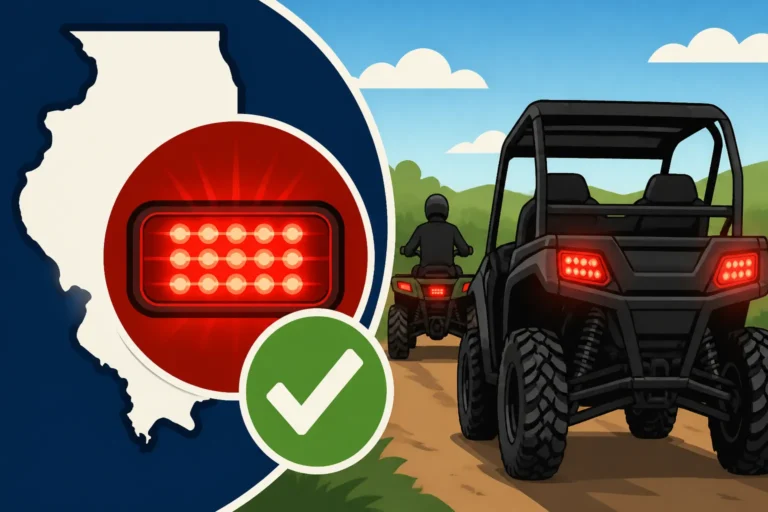
For any ATV or UTV to be considered safe for street use in Illinois, even under a local ordinance, it must have functional headlights, taillights, and brake lights. Your headlight needs to be powerful enough to be visible from at least 500 feet, and your taillamp must show a red light visible from at least 100 feet. These aren't just for seeing where you're going; they're crucial for other drivers to see you, especially during dusk, dawn, or adverse weather conditions. [Illinois Requires a 500-Foot Headlight] and [Illinois Requires a 100-Foot Tail Lamp].
Beyond active lighting, your machine also needs reflectors. Typically, these include red reflectors on the rear and sometimes amber reflectors on the sides, to enhance visibility even when your lights aren't on or fully illuminated. These small, often overlooked details are essential for passive safety, making your machine more noticeable to others.
Lastly, a rearview mirror is almost universally required. Just as in a car, a rearview mirror allows you to monitor traffic behind you, enabling safe lane changes or turns. Many OHVs aren't equipped with factory-installed mirrors suitable for road use, so this is often an aftermarket addition. Options from companies like SuperATV can provide robust, vibration-resistant mirrors designed for the rugged nature of these machines, ensuring you have a clear view of what’s coming up behind you. [Illinois Requires a Rearview Mirror] is a firm rule.
Slow-Moving Vehicle Emblem and Turn Signals
Another vital piece of safety equipment for street-legal OHVs in Illinois is the slow-moving vehicle (SMV) emblem. This is a highly visible, fluorescent orange triangle with a red reflective border, typically mounted on the rear of the machine. Its purpose is to clearly signal to drivers approaching from behind that your vehicle is traveling at 25 mph or less, giving them ample warning to slow down and pass safely. Given that most OHV street use is restricted to 35 mph or under, this emblem is incredibly important for preventing rear-end collisions, especially on rural roads. [Illinois Requires a Slow-Moving Vehicle Emblem] on street-legal OHVs.
Turn signals are also a standard requirement for street use. While an ATV might have hand signals for off-road communication, on public roads, clear, illuminated turn signals are necessary for signaling your intentions to other drivers. Many UTVs might come with basic turn signals, but for ATVs, this is almost always an aftermarket kit. Companies like SuperATV specialize in these types of kits, offering integrated turn signal systems that include front and rear lights, a dash-mounted switch, and sometimes even a horn, all designed to make your machine compliant and safe.
Without proper turn signals, you’re not able to communicate your planned movements clearly, which can lead to confusion and dangerous situations in traffic. Both the SMV emblem and functional turn signals are non-negotiable for integrating your OHV safely onto public roadways.
The Importance of Maintenance and Functionality
It’s not enough to simply have the required equipment; it must be in good working order. A headlight that’s burned out, a brake light that doesn’t illuminate, or a rearview mirror that’s cracked and obscures your vision renders your machine non-compliant. Police officers conducting traffic stops for OHVs will often perform a quick visual inspection to ensure all required safety equipment is present and functional.
Regular maintenance of your street-legal modifications is just as important as maintaining the engine or drivetrain. Check your lights, signals, and horn before every ride on public roads. Ensure your SMV emblem is clean and clearly visible. Make sure your tires are properly inflated for road use (which might be different than for trail use) and that your brakes are responsive. These machines take a beating off-road, and vibrations can loosen connections or damage components.
Ignoring the functionality of your safety equipment is not only a safety hazard but also leaves you vulnerable to tickets and fines. Imagine getting pulled over with a valid license and permit, only to be cited because your brake light isn't working. It's an easily avoidable issue with a quick pre-ride check. A well-maintained machine, with all its safety features working as intended, signals to law enforcement and other drivers that you are a responsible operator taking street riding seriously.
Insurance: A Non-Negotiable for Street Riding
Just like with your driver's license, the moment your ATV or UTV touches a public road in Illinois, the state's motor vehicle insurance laws kick in. This is a critical requirement that often gets overlooked by riders who primarily use their machines off-road, where insurance might be optional or covered under a general homeowner's policy. For street use, you must carry specific liability insurance coverage, just as you would for a car or motorcycle. [Illinois Requires Insurance for Street Use].
This isn't merely a suggestion or a good idea; it's a legal mandate. Operating an uninsured motor vehicle on public roads in Illinois is a serious offense that can lead to significant fines, suspension of your driver's license, and even impoundment of your machine. The state requires this coverage to protect anyone who might be injured or suffer property damage as a result of an accident involving your OHV. It’s about taking financial responsibility for potential incidents.
When you're discussing insurance for your ATV or UTV, be very clear with your agent about your intentions to use the machine on public roads in specific municipalities. Standard off-road recreational policies might not provide the necessary liability coverage for street use, or they might exclude it entirely. You need a policy that specifically addresses and covers on-road operation in Illinois.
Minimum Liability Coverage Requirements
Illinois mandates specific minimum liability coverage amounts for any motor vehicle operated on public roads. This is often referred to as "25/50/20" coverage:
- $25,000 for bodily injury liability per person.
- $50,000 for total bodily injury liability per accident.
- $20,000 for property damage liability per accident.
This coverage protects you financially if you are found at fault in an accident and cause injury to another person or damage to their property. For example, if you accidentally back into another vehicle in a parking lot while operating your UTV, the property damage liability would help cover the repairs to their car. If you cause a collision that injures another driver, the bodily injury liability would help cover their medical expenses. [Illinois Insurance Minimums for Street Use] apply directly to OHVs on permitted roads.
It’s important to understand that these are minimum requirements. Many insurance professionals recommend carrying higher limits, especially given the rising costs of medical care and vehicle repairs. An accident can quickly exceed these minimums, leaving you personally responsible for the difference. While the cost of insurance is a factor, the potential financial devastation of an uninsured accident far outweighs the savings from skimping on coverage.
Why Comprehensive Coverage Matters
While liability insurance is legally mandated for street use, many riders also opt for comprehensive and collision coverage, even though it's not legally required unless you're financing your machine. These coverages protect your ATV or UTV from damage, theft, or other non-collision-related incidents.
- Collision coverage pays for damages to your own machine if it collides with another vehicle or object, or if it rolls over. For many off-road machines, a simple rollover can cause significant damage, making this coverage incredibly valuable.
- Comprehensive coverage protects your machine from events other than collisions, such as theft, vandalism, fire, natural disasters (like hail or floods), or hitting an animal. Given the value of many modern ATVs and UTVs, and the risk of theft, comprehensive coverage offers peace of mind. [Illinois Comprehensive Coverage for a Quad] can be a smart addition.
Consider your investment. If you've spent a significant amount of money on your side-by-side, having comprehensive and collision coverage ensures that a mishap doesn't completely wipe out your investment. If your machine is financed, your lender will almost certainly require these coverages as a condition of the loan, protecting their asset. Discussing these options with your insurance agent is crucial to tailor a policy that fits both your legal obligations and your personal financial protection needs.
Proof of Insurance on Hand
Just like your driver's license, you are legally required to carry proof of insurance with you whenever you operate your ATV or UTV on public roads. This can be an insurance card, a copy of your policy, or increasingly, digital proof on your smartphone. If a law enforcement officer pulls you over, they will ask for this documentation. Failure to produce valid proof of insurance can result in a ticket, regardless of whether you actually have coverage.
It's a simple step that's often overlooked. Many riders keep their proof of insurance in their wallet with their driver's license, or in a secure, waterproof compartment on their machine. Some use an app on their phone, but always consider areas with poor cell service if that's your primary method. Having both physical and digital proof is often a good strategy.
This requirement reinforces the seriousness of insurance for street use. It's not enough to simply have coverage; you must be able to demonstrate it on demand. Make it a routine part of your pre-ride checklist: license, insurance, and local permit (if required). Being prepared with your paperwork can save you a lot of hassle and potential penalties during a traffic stop. [Proof of Coverage in the Glovebox] is a simple habit to adopt.
Understanding Penalties for Non-Compliance
Breaking the rules when riding an ATV or UTV on Illinois roads can lead to a host of unpleasant consequences. These aren't minor infractions; they can range from monetary fines to having your machine impounded, and even impact your driving privileges. The state takes the operation of motor vehicles on public roads seriously, and off-highway vehicles are no exception once they venture onto the pavement.
Many riders assume that because it’s "just an ATV," the penalties won't be as severe as for a car. This is a dangerous assumption. Operating an unregistered, uninsured, or unlicensed vehicle, or operating any vehicle where it's prohibited, can carry significant legal weight. The frustration of getting a ticket for something you didn't fully understand is real, but ultimately, the responsibility falls on the operator to know the law.
Understanding the potential penalties can be a powerful motivator to ensure you're fully compliant before you ever leave your driveway. It’s far better to spend a little time researching and preparing than to face the legal and financial fallout of a violation.
Fines and Court Costs
The most immediate consequence of violating Illinois's OHV street riding laws is typically a fine. The amount of the fine can vary widely depending on the specific infraction and the jurisdiction. For instance, operating an OHV on a prohibited public road could result in a fine, while driving without a valid driver's license, or without proof of insurance, could incur separate, additional fines. These fines can quickly add up, turning what was supposed to be a fun ride into an expensive mistake. [Illinois Ticket Costs for Street Riding] can be substantial.
Beyond the initial fine, you'll also likely face court costs and administrative fees. Even if you simply pay the ticket and don't contest it, these additional costs can significantly increase the total amount you owe. If you choose to fight the ticket in court, you might incur further legal fees, not to mention the time and effort involved. It’s rarely a simple slap on the wrist.
For example, a ticket for illegal street riding might be comparable to a minor traffic violation, but operating without a license or insurance can escalate quickly into more serious charges, sometimes reaching hundreds or even thousands of dollars in combined fines and fees. It's a steep price to pay for not knowing or following the rules.
Impoundment and Recovery Costs
One of the most disruptive and costly penalties for severe violations, particularly for operating without a valid license, without insurance, or on a clearly prohibited roadway, is the impoundment of your ATV or UTV. If your machine is impounded, it will be towed to a storage facility, and you will be responsible for all towing and storage fees. These fees accrue daily and can become very expensive, very quickly.
To recover your machine, you'll typically need to first resolve the legal issues (pay fines, appear in court), and then provide proof of ownership, a valid driver's license, and often proof of current insurance for the vehicle. If you didn't have a license or insurance at the time of the impoundment, you'll need to acquire them before you can even attempt to get your machine back. This entire process can be incredibly frustrating, time-consuming, and financially draining. [What It Costs to Recover an Impounded Machine] can be a shocking revelation for many.
The threat of impoundment is a strong deterrent because it not only hits your wallet hard but also takes away your prized possession. It's not a temporary inconvenience; it can mean weeks or months of legal battles and mounting storage fees before you can get your machine back, assuming you meet all the requirements.
The Impact on Your Driving Record
Operating an ATV or UTV on public roads in Illinois without a valid driver's license, without insurance, or in violation of other traffic laws can have a direct and negative impact on your standard Illinois driver's license and driving record. While an OHV is a "non-highway vehicle," the act of operating it illegally on a public road typically falls under the broader motor vehicle code.
For example, a citation for driving without a valid license or without insurance would likely be recorded on your driving abstract, just as if you were driving a car. These violations can lead to points on your license, increased insurance premiums for all your vehicles, or even the suspension or revocation of your driver's license. If your license is suspended for an OHV-related offense, you wouldn't be able to legally drive any motor vehicle, including your car, until the suspension is lifted.
This is a critical point that many OHV riders don't fully appreciate. The consequences of illegal street riding extend far beyond just the specific off-road machine; they can affect your ability to drive legally in all aspects of your life. This potential impact on your driving record should serve as a serious reminder to always be fully compliant when considering taking your ATV or UTV onto any public road.
Best Practices for Responsible Street Riding
Navigating the complex landscape of Illinois's ATV and UTV street-legal rules requires more than just knowing the laws; it demands a commitment to responsible riding practices. Even when you have all your ducks in a row – license, insurance, equipment, and local permits – operating an off-highway vehicle on public roads carries a unique set of responsibilities. It's about being a good ambassador for the sport and ensuring the safety of yourself and everyone around you.
Responsible street riding isn't just about avoiding tickets; it's about minimizing risk and maintaining positive relationships with the communities that have granted OHV access. A few bad actors can quickly lead to ordinances being repealed, closing off access for everyone. By adopting best practices, you contribute to a safer riding environment and help preserve the limited street access that exists.
Think of it as setting an example. When you ride responsibly and safely, you demonstrate that OHVs can indeed coexist with other traffic, fostering a more accepting attitude from both law enforcement and the general public.
Checking Local Ordinances Before You Ride
This cannot be stressed enough: always verify the specific local ordinances for any town, village, or county you plan to ride in. Do not rely on hearsay, outdated information, or what you "think" might be allowed. Laws change, and what was permissible last year might not be this year. The easiest way to do this is to visit the municipality's official website, look for their code of ordinances, or call the local police department or clerk's office directly.
Make sure you understand the details:
- Which specific roads or areas are open to OHVs?
- What are the hours of operation?
- Are there any age restrictions beyond the standard driver's license requirements?
- Is an annual permit required, and if so, how do you obtain it and what are the fees? [Illinois Permit Fees Set by a Town] can vary widely.
- What specific equipment is required (lights, mirrors, turn signals, SMV emblem, etc.)?
- Are there any noise restrictions or other behavioral guidelines?
Many towns that issue permits will also provide you with a summary of their rules. Keep this information with you while riding. Being able to show an officer the precise ordinance you are following can prevent misunderstandings. [Illinois Ordinance Lookups Before You Ride] should be a mandatory step for every trip.
Visibility and Defensive Driving
When you're riding an ATV or UTV on a public road, you are inherently less visible than a car or truck. Your machine is smaller, often lower to the ground, and can be easily overlooked by inattentive drivers. Therefore, maximizing your visibility and practicing defensive driving are paramount.
- Wear bright, reflective clothing: Choose gear that stands out, especially during dawn, dusk, or overcast conditions.
- Keep your lights on: Always operate with your headlights and taillights illuminated, even during the day. This is a common practice for motorcycles and is equally important for OHVs.
- Maintain proper lane position: Don't hug the shoulder. Ride in a position that makes you visible in other drivers' rearview mirrors, but also allows you an escape route if needed.
- Anticipate other drivers: Assume that other drivers don't see you. Be prepared for unexpected turns, lane changes, or stops from other vehicles. Make eye contact if possible.
- Avoid distractions: No phone use, no fiddling with navigation. Your full attention needs to be on the road and surrounding traffic.
Using your equipment, like turn signals, well in advance of a maneuver gives other drivers more time to react. If you’ve upgraded your UTV with a SuperATV turn signal kit, use it! Riding predictably and deliberately makes you a safer road user. Your actions contribute significantly to how well OHVs are perceived on public roads.
Respecting Local Residents and Property
The privilege of riding an ATV or UTV on public roads in Illinois comes with a responsibility to be a good neighbor and respect the community. Local residents are often sensitive to noise, dust, and perceived recklessness. Your actions can directly influence whether a town continues to allow OHV access.
- Adhere to speed limits: Even if the posted limit is 35 mph, if you're riding through a residential area, slow down. Excessive speed creates dust, noise, and safety concerns for pedestrians and children.
- Control noise levels: Ensure your machine's exhaust system is stock or otherwise compliant with any local noise ordinances. Loud exhausts are a common source of complaints.
- Avoid aggressive riding: This is not the time or place for wheelies, donuts, or high-speed maneuvers. Public roads are for transportation, not recreation. Keep the stunt riding for designated private areas.
- Stay on designated roads: Never veer off the permitted roadway onto private property, sidewalks, or ditches. Trespassing is illegal and quickly erodes trust.
- Minimize dust: If riding on gravel roads, reduce your speed to keep dust levels down, especially when passing homes or other vehicles.
By being considerate and demonstrating respect for the community, you help foster a positive image for OHV enthusiasts. Conversely, a few instances of irresponsible behavior can quickly lead to public outcry, petitions to repeal ordinances, and ultimately, the loss of street access for everyone. Be part of the solution, not the problem.
Important Considerations for Illinois OHV Street Use
| Requirement Category | Specific Item | Key Details & Considerations |
|---|---|---|
| Operator Eligibility | Driver's License | Standard Class D required. Provisional licenses have restrictions. Out-of-state licenses are generally accepted if valid. |
| Local Authority | Local Ordinance | ABSOLUTELY necessary. State law generally bans OHV street use; local villages, cities, townships, or counties must pass specific laws. |
| Road Conditions | Speed Limit | Most ordinances restrict OHVs to roads with a posted speed limit of 35 mph or less. |
| Road Type | State Highways | Generally prohibited except for direct crossings at intersections, which must be explicitly allowed by local ordinance. |
| Vehicle Equipment | Headlights | Visible from at least 500 feet. Always on for street use. |
| Taillights & Brake Lights | Red taillight visible from 100 feet. Functional brake lights are mandatory. | |
| Reflectors | Red on rear, possibly amber on sides, to enhance visibility. | |
| Rearview Mirror | Required for monitoring traffic behind the vehicle. Aftermarket options are common. | |
| Turn Signals | Essential for signaling intentions. Often an aftermarket installation for ATVs. | |
| SMV Emblem | Slow-Moving Vehicle (orange triangle) mounted on the rear, indicating speeds 25 mph or less. | |
| Horn | Functional horn required for signaling. | |
| Insurance | Liability Coverage | Mandatory minimum 25/50/20 coverage required for all vehicles on public roads. Proof must be carried. |
| Comprehensive/Collision | Recommended for protecting your investment, often required by lenders. | |
| Compliance | Permit/Sticker | Many local ordinances require an annual permit or sticker issued by the municipality. |
| Maintenance | All required equipment must be in good working order and regularly maintained. | |
| Behavior | Safe Driving | Practice defensive driving, maintain visibility, adhere to all traffic laws. |
| Community Respect | Control noise, dust, and speed. Stay on permitted roads. |
Disclaimer
This article is for general informational purposes only and does not constitute professional advice. Laws, prices and regulations vary by location and change over time. Consult a qualified professional for guidance on your specific situation.